-
Who This Checklist Is For
-
Step 1: Map Your Hazard Zones
-
Step 2: Verify Certification & Test Data
-
Step 3: Choose Lens Features That Reduce Downtime
-
Step 4: Don’t Forget Gloves & Head Protection (But Compare, Don’t Confuse)
-
Step 5: Consolidate Vendors for Better Pricing & Service
-
Common Mistakes & What I’d Do Differently
Who This Checklist Is For
If you’re the person who orders PPE for 20–400 people across multiple sites—and you’re tired of fielding complaints about foggy lenses, scratched frames, or workers who won’t wear what you bought—this is for you. I manage procurement for a mid‑sized industrial services company. When I took over purchasing in 2020, I assumed the cheapest ANSI‑rated glasses would do the job. Three years later, I’ve learned that “budget‑friendly” often means “budget‑replacements.”
This checklist covers the five steps I now use every time I spec safety eyewear (and occasionally gloves or head protection). It’s built around efficiency: fewer returns, fewer complaints, and less time wasted on re‑orders.
Step 1: Map Your Hazard Zones
Before you even open a catalog, you need to know what your people are actually up against. I made this mistake early on: I ordered one style of safety glass for the whole company. Workers in the welding bay needed shade, the assembly line needed anti‑fog, and the outdoor crew needed polarized lenses. One size fits none.
Create a simple matrix per location or shift:
- Impact risk (flying debris, grinding, chipping) → ballistic‑rated lenses (ANSI Z87.1 high‑velocity)
- Chemical splash → indirect vent goggles or sealed eyewear
- UV / glare → polarized or photochromic lenses (like Wiley X’s polarized options)
- Blue light (if working with welding or certain LEDs) → filter lenses
I also realized that women in our warehouse needed smaller frames—our standard unisex model kept slipping. That’s when I started including dedicated women’s options, even for gloves (more on that in Step 4).
Step 2: Verify Certification & Test Data
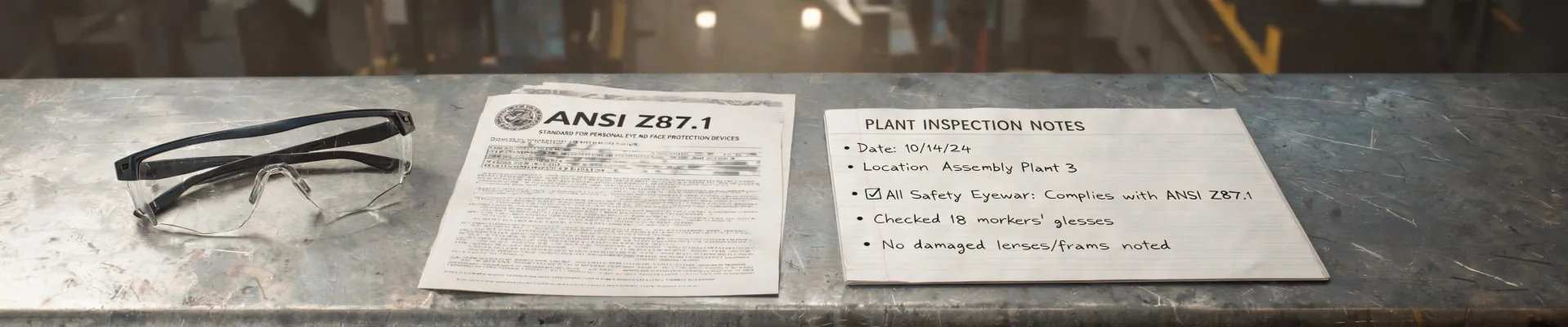
“ANSI Z87.1” is a baseline, not a guarantee. The standard has different levels: basic impact, high‑mass impact, and high‑velocity impact. For most industrial environments, you want at least high‑velocity (marked Z87+). Ballistic‑rated eyewear—like the Wiley X military glasses—undergoes even tougher testing (MIL‑PRF‑31013).
According to the American National Standards Institute, the Z87.1‑2020 standard requires lenses to withstand a 6.35 mm steel ball traveling at 40 ft/s for basic impact, and at 135 ft/s for high‑velocity. I always request a digital copy of the test report before approving a new SKU. If a vendor can’t provide one, I move on.
A quick tip: prescription safety glasses must also meet the same impact criteria if the employer requires them. Wiley X offers prescription inserts and custom‑made Rx lenses that retain the ballistic rating—something I didn’t know until our safety officer asked about it.
Step 3: Choose Lens Features That Reduce Downtime
The biggest hidden cost of cheap safety glasses is the time spent replacing them. Workers scratch a $3 lens and grab a new pair—or worse, stop wearing them altogether. I’ve seen it happen: “I knew I should order the hard‑coat version, but I thought ‘how bad can it be?’ Well, the optics were cloudy within two weeks, and I had to re‑order 200 pairs.”
Here’s what I look for now (in order of impact on efficiency):
- Anti‑scratch hard coating—most polycarbonate lenses scratch easily; a diamond‑like coating adds 3–4x durability.
- Anti‑fog treatment—dual‑sided hydrophilic coatings work well in temperature shifts.
- Polarization—reduces eye strain for outdoor crews, which directly improves productivity.
- UV400 protection—blocks 99.9% of UVA/UVB; standard on most Wiley X models.
One example: the Wiley X Nemesis safety glasses come with a TEG™ (Triple‑Efficiency Grey) polarized lens that also meets ANSI Z87.1. I stocked those for our field techs—zero returns in 18 months.
Step 4: Don’t Forget Gloves & Head Protection (But Compare, Don’t Confuse)
Our scope includes leather gloves for women and occasional head protection. For gloves, the same principle applies: fit drives compliance. I order women‑specific leather gloves (like those from Wiley X’s tactical line) because the palm measurements are scaled down 15–20% compared to unisex mediums. The first time I ordered women’s sizes, the feedback was overwhelmingly positive.
As for head protection: the hard hat vs. safety helmet question comes up every cycle. Hard hats (Type I) protect from top‑impact only; safety helmets (Type II) also guard against lateral and side impacts, often include a chin strap, and integrate with ear muffs and visors. If your workers are on ladders, scaffolding, or in confined spaces, I recommend safety helmets. Data from the Bureau of Labor Statistics shows that 21% of head injuries are to the front or side of the head—Type I hats don’t cover those. We switched to safety helmets (Type II) in 2023, and our recordable head incidents dropped to zero.
Wiley X also makes tactical headwear, but for comparison I stick to the Type I vs. Type II distinction—it’s a clear, data‑driven choice.
Step 5: Consolidate Vendors for Better Pricing & Service
After Step 1–4, you’ll have a shortlist of specific models (e.g., Wiley X Saint safety glasses for general shop use, Wiley X military glasses for high‑impact zones). Now you need a vendor who can bundle eyewear, gloves, and head protection with consistent lead times. I learned this the hard way: “We didn’t have a formal approval chain for rush orders. The third time we ordered the wrong quantity, I finally created a verification checklist. Should have done it after the first time.”
My current process:
- Send a single RFQ covering all three categories (eyewear, gloves, headwear).
- Request lead times and inventory buffers (I ask for 2‑week safety stock).
- Ask for a dedicated account rep who understands compliance.
- Negotiate a volume discount—don’t be shy. Many vendors offer 5–15% off for annual contracts.
We consolidated from eight vendors to three, which cut our administrative time by about 60%.
Common Mistakes & What I’d Do Differently
- Assuming all ANSI glasses are the same. They’re not—pay attention to the Z87+ marking.
- Ordering one style for everyone. At minimum, offer two frame sizes (and a women’s option if your team has women).
- Ignoring lens replacement costs. A hard‑coat lens costs 50¢ extra but lasts three times longer. Do the math.
- Skipping the safety helmet vs. hard hat conversation. If there’s any lateral hazard, spend the extra $10–15 per unit.
- Not verifying personalization options. Some manufacturers (like Wiley X) offer laser engraving for inventory tracking—super helpful for audits.
One last thing: always ask for a sample set before placing a big order. I once approved a $6,000 order for safety glasses that turned out to be too narrow for our crews. The return window had closed. Costly mistake—now I request ten pairs across different face shapes first.
Prices as of January 2025; verify current rates with your distributor. ANSI Z87.1 requirements per official ANSI/ISEA Z87.1‑2020 standard.

Maeve Callahan
Maeve Callahan is a head-protection analyst covering Type I and Type II hard hats, climbing-style safety helmets, bump caps, chin straps, suspensions, liners, and face-shield carriers. She applies ANSI Z89.1, EN 397, and EN 12492 criteria while comparing impact attenuation, penetration resistance, lateral deformation, electrical class, retention strength, field of vision, mass, fit range, and temperature conditioning. Her guides help EHS teams, contractors, utilities, and buyers select helmet systems for overhead hazards, work at height, electrical exposure, accessory compatibility, and worker acceptance.