If you've somehow become responsible for safety equipment purchasing—usually because you're the organized one, not because you have any safety training—here's the short version: pay 10-20% more for the vendor who can prove calibration support and delivery dates, and stop chasing the lowest quote. The savings from the cheapest bid vanish the first time an auditor asks for calibration records you don't have.
I'm the office administrator for a 180-person manufacturing company. I've been managing safety equipment purchasing since 2020—roughly $85K annually, spread across gas detectors, fire alarm maintenance, respirators, hard hats, safety glasses, gloves, earplugs, and whatever else the shop floor needs replaced that week. My initial assumption was that this was just another procurement category. Three quotes, pick the middle one, done.
That assumption cost me about six months of grief—and one audit close call. Here's what I actually do now.
Why you should trust this (and why you shouldn't take it as gospel)
I'm not a safety engineer. I don't have certifications in industrial hygiene. What I have is five years of purchase orders, a vendor phone list that's longer than I'd like, and one workers' comp carrier audit in March 2023 that changed how I think about this whole category.
The audit itself wasn't dramatic. The carrier sent someone to check documentation, not to walk the floor looking for hazards. They asked for calibration records for the fixed gas detectors in the mixing area. I had a folder with invoices. Not a calibration log.
We passed, barely, because our maintenance supervisor had been tracking it in a spreadsheet she'd been keeping without telling me. But standing there while the auditor flipped through the pages, I realized the Honeywell logo stamped on those detectors wasn't just branding—it was a compliance record that someone, specifically me, was supposed to be maintaining.
The parts of this job that actually matter
Gas detector calibration: the five-minute task that determines everything
Our fixed detectors are XNX Honeywell Analytics units. The XNX gas detector calibration cycle is where part-time administrators get into trouble. The hardware itself is reliable—we've replaced maybe two sensors in five years. The calibration schedule is what kills you.
The Honeywell manual specifies calibration intervals of 30 to 90 days depending on sensor type. For our catalytic LEL sensors, the interval is 90 days. That's four calibrations per year per sensor, times however many sensors you have. We have six, so 24 calibrations annually, each taking about an hour of technician time.
I don't have hard data on how many facilities miss this. Based on vendor conversations over the past few years, my guess is that at least a third of small-to-mid-size facilities are running late on at least one sensor at any given time. The reasons are always the same: no calendar owner, no budget line set aside for calibration gas, or the person who used to handle it left and nobody picked it up.
We didn't have a formal calibration schedule until the audit forced one. The third time we had to pay rush shipping on calibration gas because someone forgot, I finally put every sensor on a shared calendar with reminders set at 14 days out. Should have done that after the first time.
There's also a communication issue worth flagging: when I first ordered the XNX units, I told the vendor I needed the installation to include "calibration." They heard "initial calibration at installation." I heard "ongoing calibration is part of the service." It wasn't. That misunderstanding cost us about $1,200 to sort out with a separate service contract.
Last March, we needed replacement calibration gas in a hurry—one sensor was overdue and we couldn't run the mixing line without it. Standard shipping was eight days. I paid $280 for two-day delivery. The alternative was shutting down the line, which runs about $4,000 per shift. The math wasn't close.
Fire extinguisher inspection checklist: simpler than people think
The fire extinguisher inspection checklist you actually need is less complicated than most vendors will make it sound. Under NFPA 10, most portable extinguishers require a monthly visual inspection—your own staff can do this—and an annual maintenance service by a qualified technician, which is usually a vendor.
Our monthly checklist is five items:
- Pressure gauge reading in the green zone
- Pin and tamper seal intact
- No visible damage, rust, or corrosion
- Hose clear of obstruction
- Inspection tag current
We have 13 extinguishers in the building. Actually, 16—I keep forgetting the two in the basement storage area and one in the loading dock office. The walk-through takes about 15 minutes on the first Monday of each month.
The tricky part isn't the checklist. It's remembering that the annual service is separate from the monthly visual, and that the annual service has to be documented by the vendor. We keep a binder with the annual tags next to the monthly logs. Old school, but the auditor liked it.
Monitored fire alarm systems: a quick explanation for non-facilities people
If you've ever wondered what is a monitored fire alarm, here's the version I'd give a new hire: it's an alarm system connected to a third-party monitoring center. When the alarm triggers, the monitoring center calls the fire department—and you—whether or not anyone is in the building.
The difference matters most at 2 AM on a Sunday. An unmonitored alarm rings locally and, if the building is empty, that's it. A monitored system triggers a dispatch. Our monitoring fee is around $95 per month, and our insurance carrier rates our policy about $600 lower annually because of it. Doesn't fully offset, but it's closer than I expected.
What I didn't understand at first is that the monitoring contract and the alarm maintenance contract are usually different vendors. Our alarm panels are serviced by one company and monitored by another. Nobody told me that for the first two years.
PPE that isn't yours to manage (but somehow is)
When the fabrication team asked for Lincoln Electric welding helmets specifically—they had strong opinions about the headgear adjustment—I learned not to push back. If workers have a brand preference for the equipment protecting their own eyes and face, you buy the brand they trust. The administrative cost of ordering the wrong thing and then reordering is higher than the price difference between brands.
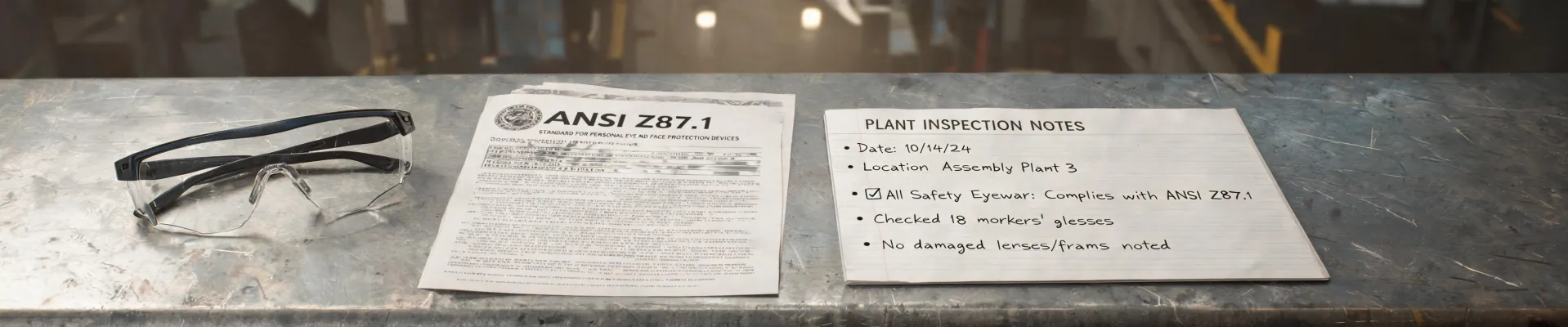
The same principle applies to the Honeywell safety glasses, hard hats, gloves, and earplugs the shop goes through. I order what people will actually wear. Our PPE consumables line runs about $18K annually, and the biggest waste isn't in unit price—it's in items that sit in a closet because they're uncomfortable, sized wrong, or just not what people wanted.
Where this advice stops working
Everything here comes from one facility—a 180-person manufacturer with predictable demand. If you're running a seasonal operation where headcount doubles in summer, or a multi-site company with a dozen buildings, the calculus changes. At that scale, you probably need a dedicated safety manager, not an administrator with a shared Google Calendar and a binder.
I also don't want to imply that paying more is always right. There are commodity PPE items—earplugs, basic safety glasses—where the brand genuinely doesn't matter much and the cheapest compliant option is fine. The categories where I'd spend the extra 10-20% are the ones with ongoing service requirements: gas detection, fire alarm systems, calibration support. That's where the cheap option becomes expensive six months later.
If your situation looks like mine—one person, multiple categories, no safety engineering background—the single highest-value thing you can do this week is figure out who owns your calibration calendar. If the answer is "nobody," that's the fire you want to put out before the one behind it starts.

Maeve Callahan
Maeve Callahan is a head-protection analyst covering Type I and Type II hard hats, climbing-style safety helmets, bump caps, chin straps, suspensions, liners, and face-shield carriers. She applies ANSI Z89.1, EN 397, and EN 12492 criteria while comparing impact attenuation, penetration resistance, lateral deformation, electrical class, retention strength, field of vision, mass, fit range, and temperature conditioning. Her guides help EHS teams, contractors, utilities, and buyers select helmet systems for overhead hazards, work at height, electrical exposure, accessory compatibility, and worker acceptance.