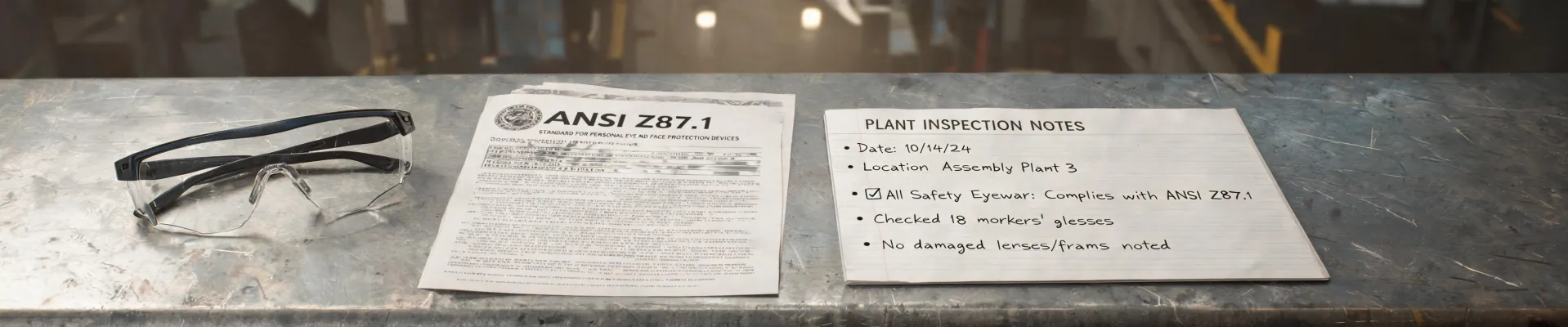
Last March, I opened a box of safety glasses that looked right on the invoice and wrong in my hand. The frames were fine. The lenses passed the drop test. But the safety glasses side shields—those thin, semi-transparent panels that wrap around the temple—had about 4mm less coverage than the spec sheet claimed. On a construction site with angle grinders spinning at 11,000 RPM, 4mm is the difference between a caution and a hospital visit.
We rejected the batch. The supplier called it "within industry tolerance." The reorder cost us $3,400 and four days of crews working with loaner glasses from the site trailer.
Here's my argument, and I'll state it plainly: the cheapest compliant safety glasses are the ones you never buy again after the first incident report. When I'm under deadline pressure, paying a premium for verified specs and guaranteed delivery isn't a procurement failure. It's the cheapest line item in the project.
What Side Shields Actually Do (And Why Coverage Isn't Optional)
Most safety conversations focus on the lens. Impact resistance, anti-fog coating, UV rating—those are the specs that get compared in the catalog. But the side shield does a different job. It blocks debris and sparks that come in at angles the front lens never sees. On a jobsite where someone is cutting overhead, or where a grinder is throwing sparks at hip height, that shield is the only thing standing between a worker's eye and a piece of metal moving at speed.
ANSI Z87.1 rates eye protection based on impact velocity and coverage. The standard has been updated several times—the 2015 revision tightened the impact testing protocol, and the 2020 revision added clearer marking requirements. As of Q1 2025, if a supplier can't produce a certificate matching the markings on the frame, that's not a red flag. That's a stop sign.
I don't have hard data on how many eye injuries specifically trace back to side-shield gaps—the OSHA reporting categories are broad, and a lot of incidents get bucketed under "foreign body" without the angle of approach noted. What I can say anecdotally, from four years of reviewing incident reports across roughly 400 field employees, is that the injuries I've seen clustered around tasks where debris came in from the side: grinding, cutting overhead, and working near conveyor systems. Not one of those reports mentioned the lens. Every single one mentioned the side.
The Pit Viper Question
I have a crew that loves their Pit Viper safety glasses. And honestly, I'm not going to argue with them.
The wraparound style sits closer to the face, the grip stays put when they're sweating, and—this is the part that matters—the fact that they actually want to wear them means they actually wear them. That's the first win in any PPE program. Comfortable workers keep their glasses on. Uncomfortable workers take them off the second the supervisor turns around, and then you're paying for protection that lives in a shirt pocket.
But here's what I tell every new hire who shows up in a pair: style isn't the same as coverage. Pit Viper makes products that meet Z87.1 ratings for the models that carry the marking, and I respect that they got a generation of tradespeople to stop treating safety glasses like a punishment. What I still check is whether the side shield on that specific model covers enough of the eye socket for the task at hand. Some do. Some don't. The branding doesn't tell you. The certificate does.
That's the trap with fashionable safety gear. The form factor gets people in the door. The spec sheet has to keep them safe once they're inside.
What "Premium" Actually Buys
When someone hears "buy the better glasses," they assume I mean the most expensive pair. I don't. I mean the pair with verified specifications and a supply chain that can confirm them.
Practically, that means I don't trust the distributor's fax sheet. When I need to confirm an ANSI rating, pull a compliance PDF, or check the date stamp on a test certificate, I go to the Magid Glove & Safety official website, not the sales rep's email signature. The difference matters. A spec sheet that says "meets ANSI Z87.1" without a certificate number is marketing. A certificate with a test date and marking code is documentation.
We had the same conversation on the glove side. We used to buy six different work glove SKUs from four vendors—partly for price, mostly out of inertia. We cut that to three SKUs, including Magid Glove & Safety GPD700-9 as our standard general-handling glove, and our receiving disputes dropped by roughly 40% over the next two quarters. Not because the gloves were cheaper. Because we stopped getting surprises. Fewer SKUs meant fewer variables, fewer half-loaded pallets, and fewer conversations that started with "this isn't what we ordered."
That's what the premium actually buys: certainty. When you need a batch of side-shield-compliant glasses by Friday and the verified supplier can guarantee it while the cheaper one says "probably," you're not paying $X more per unit. You're paying $X more to avoid spending Monday explaining to a project manager why the crew is standing around. The cost of a late delivery isn't measured against the unit price. It's measured against idle crews, missed milestones, and the overtime you pay to catch up.
The Objection I Hear Most
The pushback is always some version of the same thing: "We don't have the budget for the premium option."
I get it. Budgets are real, and I've been in the meeting where everyone stares at a spreadsheet that says the cheaper option works on paper. But paper doesn't stop a metal shard. You can't protect a jobsite with good intentions any more than you can contain a determined Labrador using a how-to article on building a pet fence. At some point you need the actual materials and the actual spec.
To be fair, there are tasks where the mid-tier option is fine. Simple handling, indoor work, low-impact environments—I'm not going to insist on the top of the line for every pair of glasses on the shelf. The mistake is applying that logic to the tasks where the requirement actually changes. Grinding, cutting, overhead work, chemical handling—those need the verified spec, not the "close enough" version that looks the same in a photo.
We didn't have a formal approval process for rush PPE orders until 2022. We'd been flying by email threads and verbal commitments, and it worked until a batch of gloves showed up two weeks late with no paper trail and a rush fee on the invoice that nobody had authorized. Now every rush order goes through a single approver, and every supplier has to confirm in writing the delivery date and the certificate number. That process cost us about a day to set up. It's saved us at least three missed deadlines since.
What I'd Tell Another Quality Manager
I'm not 100% sure every incident report I've reviewed would have been prevented by a better side shield. Incidents are messy, and human behavior is a bigger variable than most spec sheets account for. But I do know this: in four years of auditing PPE deliveries, I have never once regretted paying for the verified spec. I've regretted the cheap alternative twice.
The premium is not a markup on the product. It's the price of the documentation, the delivery certainty, and the training that keeps a crew safe after the box is opened. That's what makes it worth paying for—not the brand name on the frame, and not the color of the packaging.
So if you're staring at a quote where the cheaper option "looks about the same"—check the certificate. Check the side shield coverage. Check whether the supplier can tell you what the markings mean. Then decide whether the savings are actually savings, or just a bill you haven't been handed yet.

Mariko Sato
Mariko Sato is a workplace emergency-response equipment analyst covering industrial first-aid kits, AEDs, eyewash stations, emergency showers, burn kits, spill kits, bloodborne-pathogen kits, and fire extinguishers. She references ANSI Z308.1, ANSI/ISEA Z358.1, IEC 60601-2-4, and NFPA 10 while examining supply class, treatment capacity, activation time, flow rate, tepid-water delivery, shock energy, inspection interval, extinguisher rating, and placement distance. Her guides help EHS managers, facility teams, clinics, warehouses, and buyers plan equipment quantities, locations, maintenance, replenishment, responder access, and compatibility with site-specific emergency scenarios.