Last January I pulled our 2024 safety equipment spend report and saw something that made me put my coffee down: $198,000 spent against a $165,000 budget. A 20% overrun on a line item I'd personally signed off on twelve months earlier.
My first call was to finance. My first assumption? Prices went up. They didn't — not really. When I lined up the invoices, our unit costs were within 3% of 2023. The overrun was coming from somewhere else entirely.
That's when I started asking the question I should've asked seven years ago: what's the actual cost of the safety equipment we buy, not just the invoice total?
The answer nobody quotes you
Here's what I found when I rebuilt our procurement model from scratch. The purchase price is maybe 40% of what a piece of PPE actually costs us over its service life. The rest is replacement cycles, compatibility problems, training time, and — this one hurt — compliance gaps that forced us to re-buy.
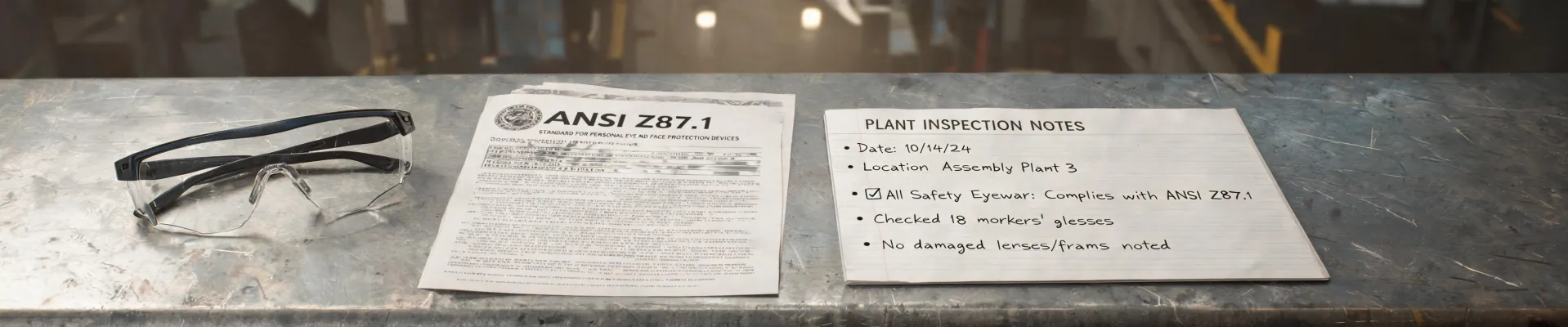
Take something as boring as safety glasses. We were buying a generic brand at $4.20 a pair. MSA safety glasses — I'm talking about the V-Gard line — ran closer to $9.50. On paper, the generic looked like a 55% savings. But when I tracked actual usage over six months, our guys were going through generic pairs twice as fast. Frames cracked at the hinge. Lenses scratched by week three. And when the fit was off, people just stopped wearing them — which meant we were reissuing more often and still failing our internal audit numbers.
The MSA pair lasted roughly twice as long and, more importantly, people actually wore them. The effective cost per wear-hour was lower. That's the thing about TCO: it doesn't care about your quote sheet.
Why this keeps happening (the structural reason)
Most procurement policies — ours included, until I rewrote it — are built around the lowest compliant bid. That's not a bad principle. It's just incomplete. The rule answers 'what's the cheapest option that meets spec?' It never asks 'what does this option cost us over the next 24 months?'
I used to think this was a vendor problem. Pushy sales reps, fine print on service contracts. Then I sat through a meeting in Q2 2024 where a rep walked me through the calibration cadence for a gas detection fleet we were evaluating. He wasn't trying to upsell. He was telling me — almost apologetically — that calibration alone would run us $340 per unit per year. That number wasn't on any quote I'd received from any supplier.
What most people don't realize is that the quote sheet is a sales document, not a cost document. It's designed to answer the question you asked, not the question you should've asked.
Here's a parallel I keep coming back to. You know that moment when someone asks 'why is my fire alarm going off' and the lazy answer is 'smoke'? Sometimes it is. But just as often it's a dirty sensor, a humidity problem, a battery issue, or a detector past its service life that needs replacement. The surface question and the actual problem are two different things. Same with safety equipment cost. The surface question is 'what's the price?' The actual problem is 'what's the total cost of ownership?'
Ten years ago, when I got into procurement, the 'buy cheap, replace often' logic made more sense. Vendors were fewer, pricing data was opaque, and honestly, a hard hat was a hard hat to most of us. The ANSI Z87.1 eye protection standard has been around since 1967, but the gap between a compliant product and a well-engineered one has narrowed in some categories and widened in others. Today, the data to compare total cost of ownership is available — if you ask for it. That's the evolution. Not the products. The procurement approach.
Where the money actually goes
Let me show you the breakdown from our 2024 audit — the one that came from actually tracking this stuff instead of guessing.
Our fall protection harnesses: unit price $78. Replacement interval averaged 14 months, not the 24 we'd assumed. Why? Because we weren't budgeting for inspection write-offs when webbing showed wear. That's an extra $33 per unit per year in unplanned replacement.
Our Miller welding helmet fleet — we run a fabrication shop, so this matters: the cheap units we'd been buying had lens assemblies failing a full quarter earlier than the branded equivalents. Not catastrophic, but at 40 helmets, that's $2,400 in early replacements annually that never showed up in a quote.
And Rocky work boots. This one surprised me. We'd been letting workers pick whatever met the ASTM standard, which meant a mix of brands, most in the $130–160 range. When I checked our replacement data, the sub-$150 boots were averaging 8 months of service. The $190 Rocky pairs were lasting 15–16 months. That's not brand loyalty — that's the cost of a proper outsole and a reinforced toe cap. The math worked out to about $14 less per month per worker on the more expensive boot.
I'll be honest: when I first ran these numbers I thought I'd made an error somewhere. Maybe $3,000 in annual savings, I figured. When I added it all up — glasses, boots, helmets, harnesses, calibration on detectors — the delta was closer to $11,400. Maybe $11,600, I'd have to pull the exact spreadsheet. Either way, that's roughly 6.9% of our total PPE spend, recovered by buying better, not cheaper.
The cost of getting it wrong
Compliance gaps are the expensive part. According to OSHA (osha.gov), 29 CFR 1910.132 requires employers to provide PPE at no cost to workers and ensure proper use. Penalty structures in 2025 put serious violations at up to $16,131 per violation. And the Bureau of Labor Statistics reported roughly 5.3 million nonfatal workplace injuries in 2023 — a meaningful share of which trace back to PPE that wasn't worn, didn't fit, or wasn't maintained.
When I ran our own incident log against our purchase data, two of our four recordable hand injuries in 2024 involved gloves that had been 'issued' but weren't actually in service. Nobody budgets for that under 'equipment.' But it lands on your EMR anyway.
What changed in how we buy
I rewrote our procurement policy in Q3 2024 around three rules. They're not complicated, but they required me to admit that the way I'd been buying for six years was leaving money on the table.
Rule one: no PPE purchase decision above $500 without a 24-month TCO estimate. That means replacement cycle data, calibration costs where relevant, and a documented assumption about compliance risk. If a vendor can't supply the data, that's a data point too.
Rule two: standardization on compatible systems. We moved our hard hats to MSA Safety V-Gard — not because MSA is the only option, but because the accessory ecosystem (face shields, earmuffs, visor carriers) fits without adapters, and adapters are where we were losing time and money on mismatched gear.
Rule three: we track usage and replacement data in the same system as our purchase history. This sounds obvious. We didn't do it for the first five years. That's how you end up with a 20% overrun and no idea where it came from.
The uncomfortable part
Here's the thing about this whole exercise: it forced me to admit that 'cheapest compliant' was never protecting our budget. It was protecting the appearance of discipline. The lowest bid looks responsible on a spreadsheet. The total cost of ownership calculation looks like extra work — until you run it and realize you've been paying a premium for the privilege of buying cheap.
Prices referenced are from our own 2024 procurement records; verify current rates with your own vendors. The exact numbers will differ for your operation. The structural problem won't.

Pranav Shah
Pranav Shah is a hand and arm protection analyst specializing in cut-resistant gloves, chemical gloves, impact gloves, electrical insulating gloves, disposable nitrile gloves, welding gloves, and protective sleeves. He applies ANSI/ISEA 105, EN 388, EN ISO 374-1, and EN 60903 methods while examining cut level, puncture force, abrasion cycles, permeation breakthrough, impact attenuation, dielectric proof voltage, dexterity, grip, and cuff coverage. His guides help manufacturers, utilities, laboratories, construction teams, and sourcing specialists choose glove systems around the actual hazard, exposure time, tool handling, contamination control, and replacement frequency.