-
Step 1: Confirm the Threat Level (Don't Guess)
-
Step 2: Check the Frame Fit and Compatibility
-
Step 3: Verify the Lens Tint for the Environment
-
Step 4: Consider the Gloves (Yes, Really)
-
Step 5: Plan for Urgencies (Because You Will Have Them)
-
Common Mistakes People Make (From Someone Who's Made Most of Them)
When I first started coordinating PPE procurement for our team, I made a pretty basic mistake: I assumed all safety glasses were more or less the same. A lens is a lens, right?
Three years and about 200+ rush orders later—including a memorable March 2024 situation where we needed 48 pairs of ballistic-rated glasses for a training exercise with 36 hours notice—I can tell you that assumption was dead wrong.
This guide is for anyone who needs to spec safety glasses for a team, a site, or a department. I'll walk you through the five things I check on every order. Nothing theoretical. Just what I've learned from actual orders, actual deadlines, and a few expensive mistakes.
Step 1: Confirm the Threat Level (Don't Guess)
The single most common error I see is someone ordering 'safety glasses' without clarifying the actual hazard. It sounds obvious, but you'd be surprised how often it happens.
Here's my rule of thumb based on our orders:
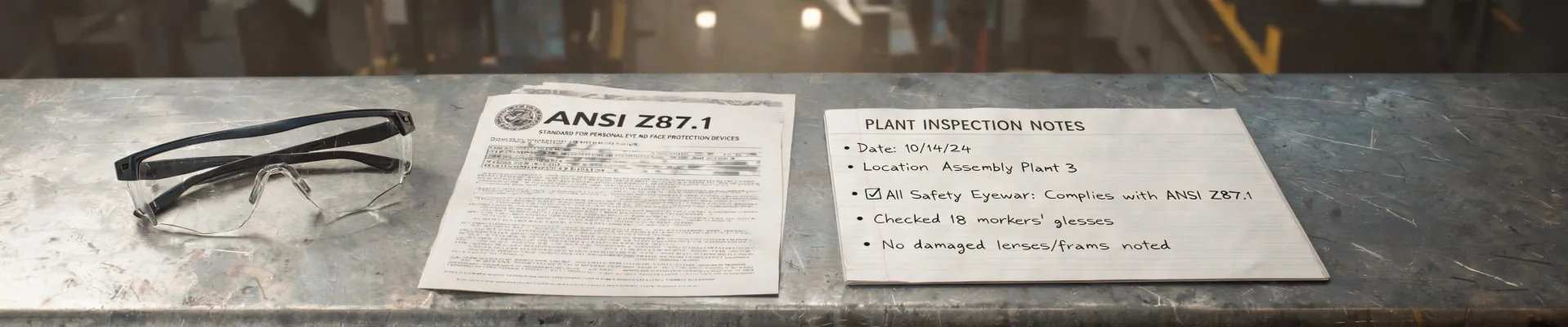
- Impact only (e.g., debris, dust, fragments): ANSI Z87.1 basic impact is your baseline. Most standard safety glasses cover this.
- Ballistic / high-velocity impact (e.g., military, law enforcement, shooting ranges): You need ANSI Z87.1+ high impact or specific ballistic standards (like MIL-PRF-31013 for frames).
According to ANSI (American National Standards Institute), the Z87.1-2020 standard specifies that high-velocity impact protection requires lenses to withstand a projectile traveling at 300+ feet per second. Source: ansi.org, Z87.1-2020. - Splash / chemical (e.g., labs, hazmat): You probably need goggles or a sealed frame, not standard glasses.
- Optical radiation (e.g., welding, lasers): Entirely different spec—shade numbers, filter lenses.
A vendor who says 'these work for everything' is a red flag. I've learned to ask for the specific standard they're tested to. If they can't show it, move on.
Step 2: Check the Frame Fit and Compatibility
I've had more returns due to fit issues than any other reason. Early on, I ordered 30 pairs of a seemingly universal model—turns out they were too narrow for about 60% of our team.
Here's what I check now:
- Adjustability: Can the temples be adjusted? Does the nose bridge fit different face shapes? Temples that don't adjust lead to slipping, which leads to people not wearing them.
- Prescription compatibility: If any of your team wears prescription glasses—and in my experience, roughly 30-40% of industrial workers do—you need an Rx insert or a direct prescription lens option.
Wiley X, for example, offers prescription safety glasses through their RX program. I've used it for several team members who needed ballistic-rated protection with their prescription. Turnaround time was usually 7-10 days, which is fairly good for custom lenses. - Helmet compatibility: If your team wears hard hats, the glasses need to fit under the brim without causing pressure points. Brands like Klein Hard Hat and Kask Hard Hat have specific brim geometries—not all safety glasses play nicely with them. I learned this the hard way when a push order of glasses didn't fit under our standard hard hats, and we had to pay $200 in rush shipping for replacements.
Step 3: Verify the Lens Tint for the Environment
This might sound like a small detail, but it's one of the most common complaints I get from end users. The wrong tint reduces visibility, increases eye strain, and—worst of all—makes people take their glasses off.
Here's a quick guide based on what we've used:
- Clear: Indoor work, low light, or when maximum color recognition is needed. Most common for general construction and manufacturing.
- Smoke / Grey: General outdoor use. Reduces brightness without distorting color.
- Yellow / Orange: Low-light or overcast conditions. Enhances contrast. Popular with shooters and pilots.
- Polarized: Cuts glare from reflective surfaces (water, roads, snow). Great for outdoor construction, driving, and marine use. But not ideal for jobs where you need to read LCD screens—polarization can make them hard to see.
- Mirrored / Iridium: Reduces visible light for very bright conditions. Less common in industrial settings, but used in tactical operations.
Honestly, I'm not sure why some vendors offer lens tints that have no real use case—like a 'rainbow' tint for construction. My best guess is it's a cosmetic option, but I've never ordered one. Stick to functional tints.
Step 4: Consider the Gloves (Yes, Really)
Wait—this article is about safety glasses. Why am I mentioning gloves?
Because in a real work environment, your team isn't just using one piece of PPE. They're wearing safety glasses, a hard hat, gloves, maybe a harness. If your gloves limit dexterity, they can't adjust their glasses easily. If your glasses fog up, they take them off and risk eye injury.
This is where material matters. In our team, we use vinyl gloves for quick, low-risk tasks where we need frequent changes. But for heavy-duty work—handling rough materials, working with chemicals—we spec nitrile gloves because they're more durable and offer better chemical resistance. According to OSHA guidelines (osha.gov), nitrile is generally recommended over latex for chemical protection due to its resistance to a wider range of substances. Source: OSHA CPL 03-00-000.
The point is: your PPE system needs to work together. If your gloves are too bulky to adjust your safety glasses, you'll have compliance issues.
Step 5: Plan for Urgencies (Because You Will Have Them)
If I've learned anything from ordering PPE for 5+ years, it's that 'normal' lead times are a luxury. In March 2024, as I mentioned earlier, we had 36 hours to get 48 pairs of ballistic-rated glasses for a military training exercise. Normal turnaround for custom ballistic specs? 10-14 days.
We found a vendor with stock inventory, paid a $450 rush fee (on top of the $1,800 base cost), and had them overnighted. The client's alternative was cancelling a $12,000 training contract.
What I do now:
- Keep a buffer stock of the most common sizes and lens tints. For us, that's 15% of our typical order volume.
- Pre-qualify a rush vendor for expeditions. I've tested 4 different rush delivery options over the years; two of them consistently deliver on time, one is hit-or-miss, and one I no longer use after they missed a critical deadline in 2023.
- Always ask: 'What's the fastest you can do this—and what does that cost?' Even if you don't need it now, knowing the answer saves panic later.
Common Mistakes People Make (From Someone Who's Made Most of Them)
- Assuming 'ANSI Z87.1' is one standard. It's not. There's basic impact, high impact, and additional requirements for welding, chemical splash, etc. Always check the specific marking on the lens.
- Ordering based on price alone. I lost a $5,000 contract once because we tried to save $300 on a cheaper pair of glasses that didn't meet the client's ballistic specs. The replacement cost us $800 in rush fees. We now have a policy: 'verify specs, then compare price.'
- Ignoring the wearing experience. If the glasses fog up, slip down, or pinch the nose, people won't wear them. And it doesn't matter how much ballistic protection they have if they're sitting in a pocket.
- Not verifying the glove compatibility. As I mentioned—it's a system, not a single product.
Pricing note: Prices mentioned are from specific orders between Q3 2023 and January 2025. Actual costs vary by vendor, volume, and shipping method. Always verify current pricing.
Final thought: A good vendor will tell you when their product isn't the right fit. One who says 'yes, this works for everything' probably hasn't seen a real job site. I'll take the honest specialist over the overpromising generalist every time.

Maeve Callahan
Maeve Callahan is a head-protection analyst covering Type I and Type II hard hats, climbing-style safety helmets, bump caps, chin straps, suspensions, liners, and face-shield carriers. She applies ANSI Z89.1, EN 397, and EN 12492 criteria while comparing impact attenuation, penetration resistance, lateral deformation, electrical class, retention strength, field of vision, mass, fit range, and temperature conditioning. Her guides help EHS teams, contractors, utilities, and buyers select helmet systems for overhead hazards, work at height, electrical exposure, accessory compatibility, and worker acceptance.