The Problem with "One-Size-Fits-All" PPE Advice
Here's the thing: when I started managing PPE procurement for our 120-person facility back in 2021, every vendor I talked to pitched their product as the universal solution. Wiley X makes great eyewear—I'm not disputing that—but the real question isn't "are they good?" It's "which Wiley X product is right for your specific crew?"
After processing 60-80 orders annually across 5 different PPE vendors, I've learned the answer depends entirely on three things: environment, threat level, and whether your team needs prescription lenses or not. Let me walk you through the scenarios.
Scenario 1: The Industrial Shop Floor
Who this applies to: Facilities with high-speed machinery, metalworking, or chemical exposure.
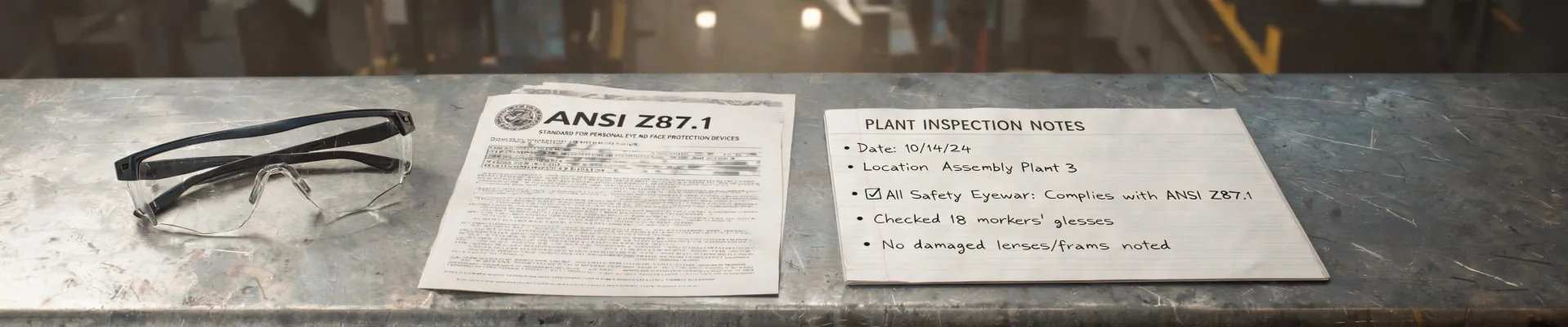
If your team is working near grinding, drilling, or any operation that sends particles flying, you need ballistic-rated lenses—period. Wiley X's ANSI Z87.1-2020 certification covers this. But here's a nuance I didn't appreciate until a near-miss: not all Z87.1 lenses are equal. The standard has two levels: basic impact and high impact (marked with a "+.")
For industrial floors, you want the high-impact variant. Wiley X bills their "Saber" series as ANSI Z87.1+ and MIL-PRF-32432 ballistic impact rated. I've seen steel shavings bounce off those lenses. I cannot say that for their fashion-forward "Saints" model (which lacks the ballistic rating).
Data point: The ANSI Z87.1 high velocity impact test requires a 1/4-inch steel ball traveling at 102 feet per second to hit the lens. That's about 70 mph.
Vendor lesson: I once ordered 30 pairs of a non-ballistic Wiley X for our maintenance team because it looked cooler than the Saber series. Three weeks in, a grinder disk fragment hit a technician's glasses. The lens didn't shatter—but it cracked. The technician was fine, but I got a stern call from safety compliance. Now I verify the specific Z87.1 rating before approving any order.
Scenario 2: Outdoor Crews (Construction, Surveying, or Inspectors)
Who this applies to: Workers exposed to UV, dust, and occasional low-velocity debris.
For outdoor work, you're balancing impact protection against glare and heat buildup. This is where Wiley X's polarized and photochromic lenses shine—but only if your crew spends most of the day outside.
I've fielded complaints from surveyors who said standard safety glasses made everything look "dark and dreary" during overcast days. The Wiley X "Boss" series with polarized lenses solves that: it cuts horizontal glare without darkening the entire field of view. But it's not impact rated for ballistic threats—it's ANSI Z87.1 (basic), not high impact.
Rule of thumb from my experience: If your team's primary risk is UV exposure and dust (not high-speed fragments), polarized or photochromic options are fine. If they're rotating between indoors and outdoors, photochromic lenses are gold—they darken in sunlight and clear up inside.
The hard truth: No single lens type handles both intense sunlight and welding or cutting spark protection well. I learned this after specifying polarized lenses for a crew that sometimes worked near a plasma cutter. The polarization didn't help—they needed dedicated shaded lenses for that task. Different booth, different glasses.
Scenario 3: Prescription Safety (The Silent Majority)
Who this applies to: About 40% of your workforce, statistically.
This is the most common request I get—and the most misunderstood. A standard pair of safety glasses doesn't help someone who's plus-2.00 diopters. Wiley X offers RX-able frames, but here's the catch: only certain models support prescription lenses, and they require specific lens blanks from Wiley X or an authorized lab.
I've had three situations where we ordered prescription safety glasses from a vendor who "fit" a generic lens into a Wiley X frame. Each pair failed our in-house drop test. The frame held, but the lens popped out because the curvature didn't match the frame's pressure points.
The approved route: Wiley X allows their own Rx program or a few certified partner labs (like SafetyRx or SportRx). Expect to pay $120-$200 per pair for single vision, and $250-$400 for bifocal or progressive lenses. Turnaround is 7-14 business days.
What not to do: Order prescription safety glasses through a random online lab that claims to fit any frame. Always verify they're an authorized Wiley X Rx provider. Otherwise, that $8000 mistake I made—ordering 20 pairs that all failed—could be yours.
Real Talk: Accessories You Shouldn't Skimp On
Two items that consistently cause friction in my ordering process:
1. Fence Posts (for Wiley X glasses) – The frames have small posts near the hinges that hold the temples securely. If these break (and they do, especially under heavy use), you can't just use any generic post. Wiley X sells a replacement kit (around $15 for 5 pairs). I keep a box in our inventory room to avoid downtime.
2. Fence Stretcher (for retaining cables) – Some Wiley X models, like the "Vertical" or "Gravity," use a cable system around the back of the head. A fence stretcher tool is needed to tighten this cable. If you don't have one, the cable loosens, and the glasses slide forward. I learned this after buying 10 pairs for our janitorial crew and getting complaints within a month. Now I include a fence stretcher in each order for new employees.
Budget tip: Don't get the fence stretcher online separately unless you're certain it matches the cable gauge. I wasted $60 on generic tools that didn't clamp properly. Stick with Wiley X's official tool.
How to Decide Your Scenario
Ask yourself these three questions:
- Threat level: Is the risk flying debris at 70 mph, or just sunlight and dust? If the former, you're Scenario 1 (ballistic). If the latter, Scenario 2 (polarized/photochromic).
- Vision correction: If more than 15% of your crew requires prescription glasses, invest in an Rx solution immediately. Non-Rx safety glasses are useless to them.
- Accessories: Do your workers need to consistently adjust or tighten their eyewear? If yes, prioritize fence posts and stretchers as consumables—order in bulk.
Final word of caution: Don't assume that the most expensive Wiley X model is automatically the right one. The "Saber" series, which costs $40-$60 less than the "Saints" or "Boss" models, is the only one with ballistic impact rating. Look, I'm not saying you should cheap out. I'm saying you should match the product to the risk.
This advice reflects my experience in a mid-size industrial facility as of Q1 2025. Standards and pricing evolve—verify current ratings and pricing with your distributor before ordering.

Maeve Callahan
Maeve Callahan is a head-protection analyst covering Type I and Type II hard hats, climbing-style safety helmets, bump caps, chin straps, suspensions, liners, and face-shield carriers. She applies ANSI Z89.1, EN 397, and EN 12492 criteria while comparing impact attenuation, penetration resistance, lateral deformation, electrical class, retention strength, field of vision, mass, fit range, and temperature conditioning. Her guides help EHS teams, contractors, utilities, and buyers select helmet systems for overhead hazards, work at height, electrical exposure, accessory compatibility, and worker acceptance.