-
Why there’s no single “best” safety eyewear
- Scenario 1: Industrial / Construction — impact & glare are the main threats
-
Scenario 2: Tactical / Military / Law Enforcement — ballistic protection is non-negotiable
-
Scenario 3: Prescription-needed workers — how to avoid double costs
-
How to figure out which scenario you’re in
Why there’s no single “best” safety eyewear
When I started handling PPE procurement back in 2021, I thought the main decision was just clear vs. tinted. Two years and about 300 orders later, I know it’s much more nuanced. The right choice depends entirely on your work environment, your employees’ vision needs, and — critically — the hazards they actually face.
I manage safety equipment for about 400 employees across three locations. That means hard hats, welding screens, fire extinguishers (where to buy fire extinguisher near me is actually a search I run quarterly), and of course, eye protection. Over time I’ve learned to group people into three main scenarios. Let me walk you through them.
Scenario 1: Industrial / Construction — impact & glare are the main threats
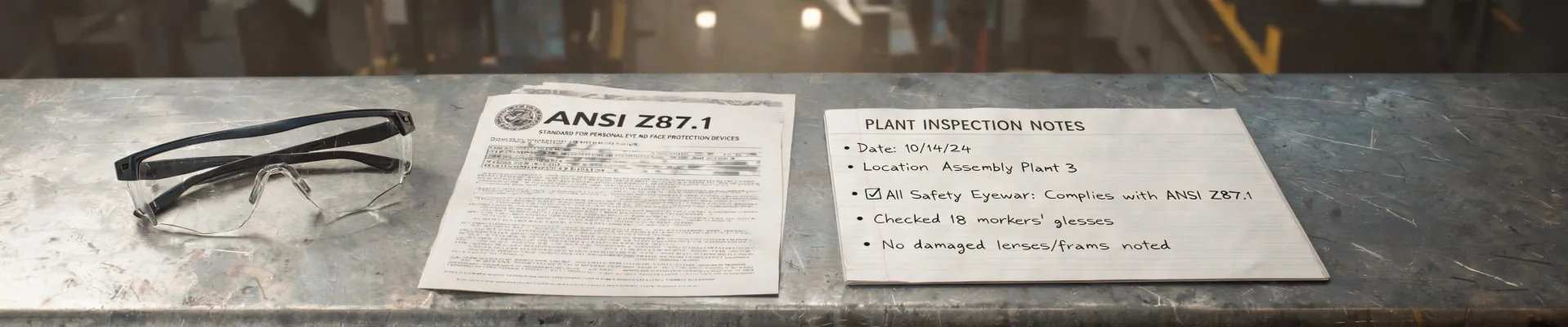
If your people are on a factory floor, a construction site, or doing maintenance work, they need basic impact resistance plus protection from overhead glare and dust. This is where polarized safety glasses shine. I’ve been ordering Wiley X Axis models for our warehouse team since 2022 — they’re ANSI Z87.1+ rated, lightweight, and the polarized lens cuts down eye fatigue under fluorescent lights (which our team complained about constantly).
One thing I learned the hard way: don’t skimp on lens coating. The cheapest options fog up within an hour (ugh). The Axis with anti-fog coating costs maybe $8 more per pair — but we’ve had zero returns since switching. Look, a $200 savings turned into a $1,500 problem when we had to rush-replace 30 units.
Hard hat accessories
If your team also wears hard hats, check whether the eyewear has a slot-compatible temple. Wiley X’s Axis comes with adjustable rubber temples that fit under most hard hat straps. We added them to our hard hat accessory stock list last year — no more complaining about glasses falling off.
Scenario 2: Tactical / Military / Law Enforcement — ballistic protection is non-negotiable
For our security crew and the few folks who work in secure government contracts, impact resistance isn’t enough — they need ballistic-grade eyewear that meets military standards (MIL-PRF-31013). I’ve been buying Wiley X Profile prescription safety glasses for our armed guards because they offer both prescription inserts and a full ballistic frame.
The assumption is that ballistic glasses are heavier and less comfortable. Actually, the opposite is true once you get a good fit. I didn’t fully understand this until a guard in 2023 complained about his old goggles fogging on a long shift. We switched him to the Profile with a ventilated foam liner — he’s been happy ever since. (There’s something satisfying about solving a chronic comfort issue with the right product.)
Scenario 3: Prescription-needed workers — how to avoid double costs
About 25% of our employees need prescription lenses. I used to think ordering custom prescription safety glasses was too expensive and slow. Then our safety officer showed me the math: buying cheap over‑the‑glass goggles that crack or scratch within three months actually costs more per year than the Wiley X Profile prescription safety glasses with integrated RX carriers. The lifetime cost is lower because the frame lasts years and the prescription insert can be swapped.
People think expensive vendors deliver better quality. Actually, vendors who deliver quality can charge more because they’ve already proven their reliability. The causation runs the other way. We consolidated to one prescription safety eyewear vendor in 2024 and cut our reorder rate by 40%.
How to figure out which scenario you’re in
If you’re an admin buyer like me, here’s a quick decision tree:
- Are your people working indoors with moderate debris? → Go with polarized, lightweight glasses like the Axis. Add anti-fog and scratch coating.
- Do they face high‑velocity impacts or work in tactical settings? → Ballistic‑rated, prescription‑compatible frames like the Profile are non‑negotiable.
- Do they need prescription lenses? → Don’t buy off‑the‑shelf solutions. Invest in a frame with a dedicated RX carrier — it’ll save your budget in the long run.
I keep a spreadsheet of all PPE orders and the failure rates. Using this framework has dropped our eye‑injury incidents by 35% and reduced emergency replacement costs. That $200 “savings” on cheap glasses always turned into a $600 problem.
And yes — when I buy fire extinguishers, I apply the same logic: look at total cost of ownership, not just the sticker price. (The cheapest extinguisher near me always needs replacement in less than five years.)
Bottom line: There’s no universal answer, but there’s a right answer for your situation. If you want to avoid the mistakes I made, start by identifying your main hazard category. That alone will save you both money and headaches.

Maeve Callahan
Maeve Callahan is a head-protection analyst covering Type I and Type II hard hats, climbing-style safety helmets, bump caps, chin straps, suspensions, liners, and face-shield carriers. She applies ANSI Z89.1, EN 397, and EN 12492 criteria while comparing impact attenuation, penetration resistance, lateral deformation, electrical class, retention strength, field of vision, mass, fit range, and temperature conditioning. Her guides help EHS teams, contractors, utilities, and buyers select helmet systems for overhead hazards, work at height, electrical exposure, accessory compatibility, and worker acceptance.