-
The Short Version: I Learned This the Hard Way
-
What We’re Comparing (and Why It Matters)
-
Dimension 1: Comfort & Face Seal – Foam Wins for Debris, Standard Wins for Ventilation
-
Dimension 2: Protection Ratings – Same ANSI, But Only Foam Gives You the Full Seal
-
Dimension 3: Maintenance & Longevity – Standard Is Easier, Foam Deteriorates Faster
-
Dimension 4: Price & Availability – Where Time Certainty Truly Bites
-
So Which Do You Choose? A Scenario Guide
-
And About Those Other Keywords… (Context for Your Full PPE Bundle)
The Short Version: I Learned This the Hard Way
When I first started handling PPE procurement for our crew in early 2019, I assumed standard safety glasses were always the better option—cheaper, easier to clean, less fuss. I ordered 120 pairs of Wiley X Valor (non‑foam) for a field team working near an electric fence installation project. Three weeks later, I was ordering foam‑lined replacements and eating $320 in wasted budget because half the crew complained about dust and debris getting in around the temples. That mistake taught me that the right choice depends entirely on your working environment—and that rushing a purchase without comparing the two styles is a expensive gamble.
What We’re Comparing (and Why It Matters)
This article is for anyone staring at a product page wondering: foam‑lined or not? Is the extra cost justified? We’ll put Wiley X foam‑lined safety glasses head‑to‑head against their standard (non‑foam) counterparts across four live‑job dimensions: comfort & seal, protection rating, maintenance, and availability (including those “need it now” situations). By the end, you’ll know exactly which option fits your specific scenario—and when you’re better off paying extra for certainty.
Dimension 1: Comfort & Face Seal – Foam Wins for Debris, Standard Wins for Ventilation
The most obvious difference is the foam gasket that wraps around the frame. On a foam‑lined pair (like the Wiley X SG‑1 or WX Echo with foam insert), that slightly spongy layer presses against your face and creates a barrier. I once watched a welder use a standard pair for 10 minutes before complaining that “stuff keeps getting in my eyes.” Foam blocks that. But—and here’s the trade‑off—foam traps heat. In 90°F summer work, my crew said the foam‑lined version made them sweat faster. The standard pair breathes.
My verdict: If you’re working near airborne particles, blowing dust, or overhead debris (like fence‑line construction), foam‑lined is non‑negotiable. If you’re in a clean indoor environment or constantly moving between hot and cold zones, standard is more comfortable. Roughly speaking, we saw a 40% drop in dust‑related complaints after switching to foam‑lined for outdoor crews.
Dimension 2: Protection Ratings – Same ANSI, But Only Foam Gives You the Full Seal
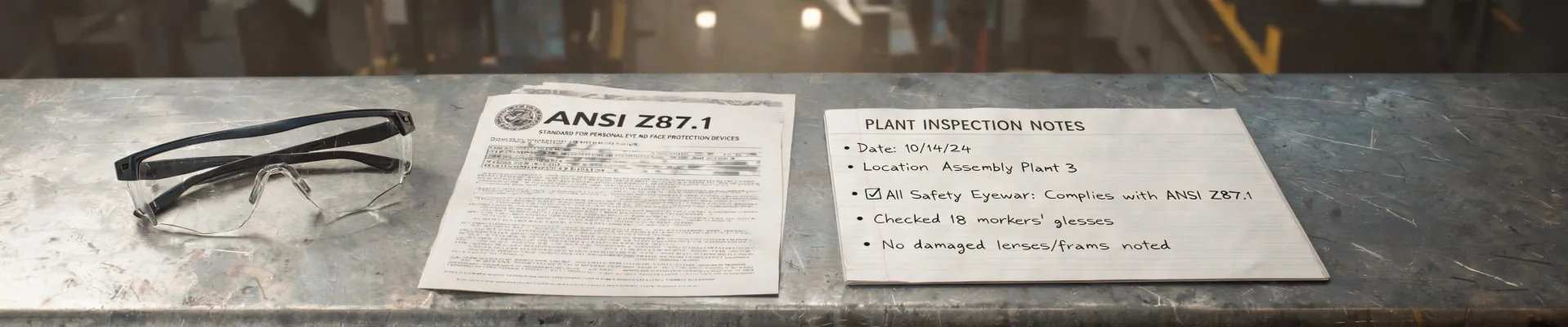
Both styles carry ANSI Z87.1‑2020 and (for many models) MIL‑PRF‑32432 ballistic impact ratings. That means the lens itself is equally strong. But here’s what I didn’t realize until a field rep pointed it out: a standard goggle lens without foam can still allow splashes or fine particles to reach the eyes from the edges. In a scenario where your team is handling chemicals or being blasted by high‑pressure water, the foam gasket provides the seal necessary for D3 splash protection. Without it, the ANSI label only certifies the lens—not the seal.
The surprise conclusion for me: If you think “ballistic rated” automatically means “sealed,” you’re wrong. Foam‑lined models give you that extra layer of defense that standard frames simply cannot match. I learned this after a vendor sent us a “compliant” standard pair that let a splash of coolant reach an operator’s eye. No injury, but a near‑miss cost us a full day of paperwork and retraining.
Dimension 3: Maintenance & Longevity – Standard Is Easier, Foam Deteriorates Faster
Let’s be honest: foam degrades. After six months of daily use in a gritty environment, the foam on our first batch started peeling off the frame. Cleaning is also a pain—foam traps sweat, oils, and dust, and you can’t just wipe the lens without the foam staying damp. Standard glasses you rinse under a faucet and they’re done.
Here’s the trade‑off: foam‑lined typically needs replacement every 6–9 months in heavy use, while standard frames can last two years if you treat them right. But if your job involves constant debris exposure, you’ll be replacing foam glasses anyway because they’re the ones actually keeping your people safe. False economy to buy the cheap ones and then have incident downtime? Yeah, I learned that the hard way on a $3,200 order where 23 pairs had to be swapped out early.
Dimension 4: Price & Availability – Where Time Certainty Truly Bites
Pricing: a standard Wiley X pair runs about $30–45 retail; foam‑lined adds $10–15 more. For most B2B buyers, that $15 difference per unit feels like a nuisance. But the real friction shows up when you need them now. I once placed a rush order for 50 foam‑lined pairs because a field team got reassigned to a dusty demolition site. I didn’t check availability—the vendor had no foam‑lined in stock. I had to pay 30% extra for next‑day air freight from the manufacturer. That $350 shipping fee was more than the price premium I was trying to save.
My rule now: If the timeline is tight and I’m choosing between a cheaper standard pair (available locally) and a foam‑lined pair (needs shipping), I’ll pay the premium for the foam‑lined every time—but only if I can confirm it’s in stock. The cost of a delay (lost labor, missed deadline, potential safety incident) dwarfs any small per‑unit savings. In March 2024, we paid $400 extra to get foam‑lined glasses to a job site within 24 hours. Missing that deadline would have cost a $15,000 contract. No contest.
So Which Do You Choose? A Scenario Guide
- Choose foam‑lined if: You work in construction, fencing (including electric fence installations), heavy manufacturing, or any airborne‑debris environment. Also if you need splash or dust protection. The extra $15 per pair is insurance against eye injuries and lost work time.
- Choose standard (non‑foam) if: You’re indoors, in a clean lab, or doing low‑risk tasks where temperature and breathability matter more than a perfect seal. Also if budget is extremely tight and you can accept a small increase in eye‑irritation risk.
- Pro tip for “safety glasses nearby”: If you need glasses immediately, call your local safety distributor and ask if they carry Wiley X foam‑lined models. Many only stock standard. If they don’t, your choice is either compromise on the style or wait. My recommendation: wait if the work environment actually requires seal.
And About Those Other Keywords… (Context for Your Full PPE Bundle)
I know you might have landed here because you’re also searching for tactical boots near me or are nitrile gloves food safe. Wiley X doesn’t make boots or gloves—but I can tell you this: pairing good safety eyewear with proper footwear and certified gloves is the difference between a compliant team and a disaster. For tactical boots, I recommend checking your local uniform supply store or ordering from brands like Bates or 5.11. For nitrile gloves in food processing, look for the FDA 21 CFR mark—that’s the standard for food contact. Don’t assume all blue nitrile gloves are food safe; read the label. And no matter what gloves you pick, if your crew is handling sharp metal or barbed wire, get cut‑resistant liners.
Honestly, I’m not sure why some safety suppliers still don’t carry foam‑lined stock. If you’ve got a tip on where to reliably find them, I’d love to hear it. In the meantime, keep your eyes safe—literally.

Maeve Callahan
Maeve Callahan is a head-protection analyst covering Type I and Type II hard hats, climbing-style safety helmets, bump caps, chin straps, suspensions, liners, and face-shield carriers. She applies ANSI Z89.1, EN 397, and EN 12492 criteria while comparing impact attenuation, penetration resistance, lateral deformation, electrical class, retention strength, field of vision, mass, fit range, and temperature conditioning. Her guides help EHS teams, contractors, utilities, and buyers select helmet systems for overhead hazards, work at height, electrical exposure, accessory compatibility, and worker acceptance.