-
This Checklist Is For You If...
-
Step 1: Understand the Threat Level
-
Step 2: Verify Compliance and Certifications
- Step 3: Choose the Right Lens Type
-
Step 4: Match the Frame to the Job
-
Step 5: Budget Realistically (Including Hidden Costs)
-
Step 6: Plan for Fit and Comfort
-
Step 7: Test Before You Commit
-
Common Mistakes I've Made (Learn From Them)
If you're the person in charge of ordering PPE for a team, you know the drill: find something that meets the safety standards, fits a range of face shapes, and doesn't blow the budget. For B2B buyers sourcing eyewear for industrial crews, military personnel, or law enforcement, the stakes are high—and the options can be overwhelming.
Choosing the right safety glasses isn't just about picking a model off a shelf. It's about balancing protection, comfort, compliance, and cost. I'll walk you through a checklist I've developed over 5 years of managing PPE procurement for a 400-person company spread across three locations. This isn't theory; it's what I've learned from actual orders, vendor meetings, and a few costly mistakes.
This Checklist Is For You If...
- You're buying safety glasses or tactical goggles for a team of 5 to 500.
- You need to comply with ANSI Z87.1 or military specs.
- You're comparing options like Wiley X tactical goggles vs. other brands.
- You want to avoid the hassle of returns, complaints, or failed inspections.
Here's a 7-step checklist. Each step includes a check point so you can verify you're on track.
Step 1: Understand the Threat Level
Not all workplaces are the same. A warehouse floor has different risks than a shooting range or a chemical lab. Start by asking: what are we protecting against?
Common threats:
- Impact: Flying debris, metal shards, or particles. Look for ballistic-grade ratings.
- UV / Glare: Outdoor work or bright environments. Polarized lenses help.
- Chemical splashes: Goggles with indirect ventilation.
- Laser or welding: Specialized filters.
Check point: Document the primary and secondary risks for each job role. For example, construction crews need impact protection and often deal with glare.
Step 2: Verify Compliance and Certifications
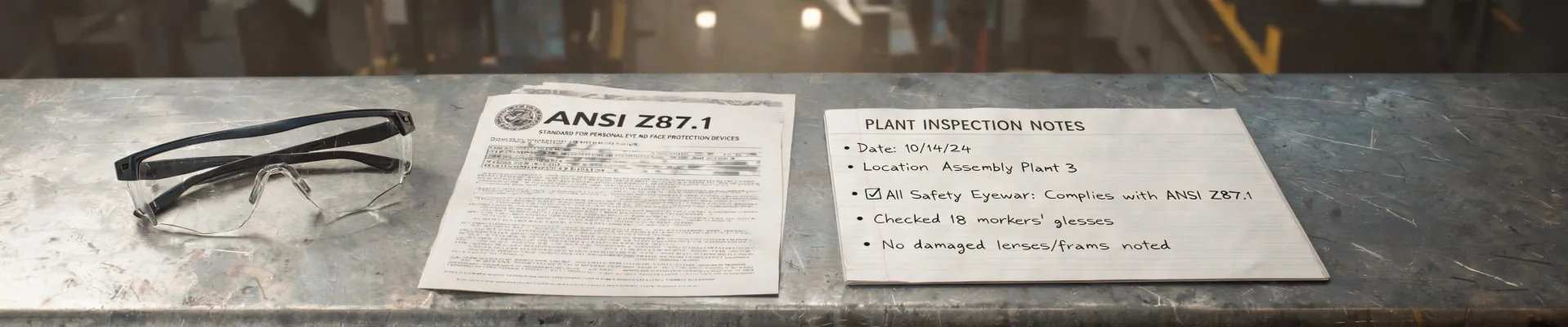
This is non-negotiable. If the eyewear isn't certified, you're risking employee safety and legal liability. In the U.S., the key standard is ANSI Z87.1. For the military, look for MIL-PRF-32432 or APEL (Authorized Protective Eyewear List).
What to check:
- Does the product clearly state ANSI Z87.1 certification?
- Does the packaging or product have the Z87 mark?
- For ballistic rating: look for Z87+ (high velocity impact).
Real-world example: I once had a vendor pitch me 'military-style' glasses. No certification. I passed. A year later, a competitor in our industry had a serious eye injury with uncertified gear. Not worth it.
Check point: Request a copy of the test report from your supplier. Most reputable brands like Wiley X provide this upon request. If they won't, red flag.
Step 3: Choose the Right Lens Type
Now for the practical details that affect daily use.
Prescription vs. Non-Prescription
About 60-70% of your workforce will need prescription lenses. If you buy only plano (non-prescription) glasses, you're forcing people to wear over-glasses or risk them wearing unsafe street glasses under their PPE.
Options:
- Prescription safety glasses: Best for full-time wearers. Brands like Wiley X prescription ballistic glasses offer inserts or custom-made lenses.
- OTG (Over-the-Glasses) goggles: Work for visitors or part-time use, but less comfortable for the whole shift.
- Plano (non-prescription): For people with perfect vision or those who wear contacts.
Check point: Survey your team. A simple email: 'Do you wear glasses? If so, are your current safety glasses comfortable?' The answer will guide your order.
Polarized vs. Non-Polarized
Polarized lenses reduce glare, which is super helpful for outdoor work, driving, or near water. But they can interfere with LCD screens (like those on modern machinery).
Rule of thumb: If your team works around digital displays or certain types of head-up displays, avoid polarized. Otherwise, it's a great upgrade.
Step 4: Match the Frame to the Job
Frame style matters for fit, durability, and compatibility with other PPE (like helmets and ear protection).
Frame options common in industrial settings:
| Style | Best For | Key Consideration |
|---|---|---|
| Full-frame wraparound | High impact, all-around protection | Can be bulky under helmets |
| Goggles | Dust, chemicals, particles | Must have anti-fog coating |
| Half-frame / Low-profile | Office-to-shop floor crossover | Less wraparound coverage |
| Rx (prescription) inserts | For existing prescription frame users | Must fit the frame well |
Check point: Ask for a sample kit from your vendor. Have 5-10 employees try them on. You'll get feedback fast: 'These pinch my nose,' 'These fog up,' 'Too heavy.'
A note on tactical goggles: For law enforcement or active military, Wiley X tactical goggles are popular because they offer high-impact ballistic protection with a comfortable, sealable fit that works with helmets and NVGs.
Step 5: Budget Realistically (Including Hidden Costs)
Here's where I've made mistakes before. You get a great price per unit, then find out there's a minimum order quantity, a setup fee for custom logos, or a separate charge for Rx inserts.
Full cost breakdown for a typical order of 100 safety glasses:
| Item | Budget Estimate | Comments |
|---|---|---|
| Base eyewear (plano) | $10 - $35 per pair | Depends on brand and features |
| Prescription inserts (if needed) | $25 - $75 per pair | Major cost driver |
| Polarized upgrade | $5 - $15 per pair | Adds for outdoor workers |
| Anti-fog coating | $3 - $8 per pair | Highly recommended for any humid or active environment |
| Shipping | $15 - $50 flat | Depends on volume and speed |
| Custom logo printing (optional) | $50 - $200 setup + $1-3 per unit | Only if you want branding |
| Total estimated (100 units, plano, mid-range brand) | $1,500 - $4,000 | Rx adds another $2,500-7,500 |
Hidden cost trap: The discount code for another product doesn't apply here. For example, a 'loop earplugs discount code' won't work on safety eyewear. I keep a separate budget line for each PPE category.
Check point: Ask your vendor for a total landed cost estimate before you place the order. Include shipping, taxes, and any set-up fees.
Step 6: Plan for Fit and Comfort
A safety glass that sits in a drawer isn't protecting anyone. Comfort and fit are the #1 reason employees don't wear their PPE.
Key factors:
- Temple length: Too long and they slide off; too short and they pinch.
- Nose bridge: Adjustable nose pieces are a huge plus for varied face shapes.
- Weight: Heavy glasses cause fatigue over 8-10 hour shifts.
- Anti-fog: Fogging is the #1 most common complaint about safety glasses. If it fogs up, they'll take them off. Period.
My rule of thumb: Always order a sample of the top 3 models. Have people with different face shapes (narrow, wide, and round) try them for a full shift. Then decide.
Step 7: Test Before You Commit
Don't place a large order for 500 units straight away. Do a pilot.
Pilot process:
- Order 10-20 units of your top 2-3 candidates.
- Distribute to a mix of departments (e.g., 5 from assembly, 5 from shipping, 5 from office).
- Give them 2 weeks. Ask them one question: 'Would you voluntarily wear these for a 10-hour shift?'
- Collect feedback. Expect at least 60-70% 'yes' from a model to proceed.
- If one model fails (<40% yes), drop it. Move to the next.
Why this matters: A $100,000 order of the wrong specs is a disaster. A $300 pilot is a small price to pay for peace of mind.
Common Mistakes I've Made (Learn From Them)
- Skipping the Rx check: I once ordered 200 plano glasses for a crew where 80% needed prescription lenses. Ended up paying for custom inserts. That added $4,000 and delayed deployment by 6 weeks.
- Ignoring anti-fog: First order of a budget goggle model. Fogged up within 30 minutes in the warehouse. Store room is now full of useless goggles. I still kick myself for not testing that.
- Assuming 'one size fits all': It doesn't. Especially for women and people with smaller faces. Invest in at least two frame sizes.
- Going too cheap: A pair of $5 safety glasses saved us $20 upfront per person, but they broke in 2 weeks. Replacement costs and employee frustration made them way more expensive in the long run.
Final thought: The best safety glasses for your team are the ones they actually wear. Everything else—certification, budget, brand—comes second to that. If you have mixed feelings about spending more upfront, I get it. But I've found that investing in a proven brand like Wiley X with ANSI Z87.1 certification and ballistic-grade protection costs more initially but saves money on returns and replacements down the line. Pretty straightforward once you know what to check.

Maeve Callahan
Maeve Callahan is a head-protection analyst covering Type I and Type II hard hats, climbing-style safety helmets, bump caps, chin straps, suspensions, liners, and face-shield carriers. She applies ANSI Z89.1, EN 397, and EN 12492 criteria while comparing impact attenuation, penetration resistance, lateral deformation, electrical class, retention strength, field of vision, mass, fit range, and temperature conditioning. Her guides help EHS teams, contractors, utilities, and buyers select helmet systems for overhead hazards, work at height, electrical exposure, accessory compatibility, and worker acceptance.