The Call That Changed Everything
It was March 2024, 3:30 PM on a Tuesday. My phone rang with our site supervisor’s voice crackling through the speaker: “We’ve got flying debris from the concrete demo on Floor 4. Three workers already had fragments hit their lenses. I need 20 sets of real eye protection by tomorrow morning, or I shut down the whole crew.”
I was the guy responsible for PPE procurement at a mid-sized construction firm, handling orders for about six years at that point. I’d made my share of mistakes (and documented them on a shared checklist that my team now jokes about). But this one? This one still makes me wince.
The Temptation of Cheap
My first instinct (honestly, my first instinct every time) was to go with the lowest bid. We had a budget to protect. The company’s standard suppliers offered “industrial safety glasses” at $3.50 per pair—unbranded, no mention of any standard beyond a vague “impact resistant” label. They promised 2‑day shipping, which was cutting it close for our morning deadline but technically possible. I placed the order within 20 minutes.
Then I made a second, smarter call to a distributor who stocked Wiley X Omega prescription‑compatible safety glasses. Their quote: $28 per pair, with overnight shipping available. Total cost: $560 for 20 pairs plus $120 rush shipping. Versus $70 total for the cheap ones. The difference was $610. I opted for the cheap order, figuring I’d save the company money.
The Moment Everything Went Wrong
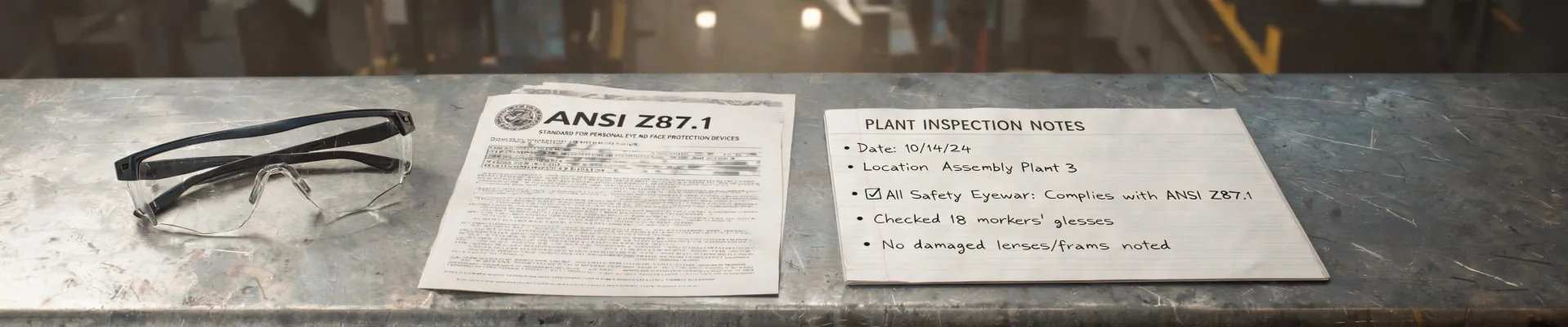
The cheap glasses arrived the next morning—just barely. But something felt off. The lenses had visible waves in the plastic. The frames flexed way too easily (think: a toy rather than a tool). I checked the packaging: no ANSI stamp, no Z87.1 mark, no manufacturer name. Just a sticker that said “Safety Eyewear.” I knew in my gut that these weren’t the real deal, but the crew needed something, and we had no backup.
Fast‑forward to 2:00 PM. A worker near the concrete saw took a direct hit to his left lens. The cheap lens shattered—actually cracked into multiple pieces. A shard sliced his eyebrow, and a second piece barely missed his cornea. He ended up in the ER for debris removal and four stitches. The crew went on a two‑hour safety stand‑down. The superintendent called me, breathing fire.
The Emergency Switch to Wiley X
I didn’t have time to argue. I called the distributor back, ordered 25 pairs of Wiley X Omega safety glasses with clear, anti‑fog lenses (plus a few prescription inserts that one worker needed). They promised delivery by 6 AM the next day. The total came to $820 with rush shipping—more than 10× the cheap order—but I didn’t hesitate. At that point, I would have paid any price to get certified protection on site.
The glasses arrived on time. Every pair carried the ANSI Z87.1‑2020 stamp, and the ballistic rating (MIL‑PRF‑31013, actually) was printed right on the temple. The crew wore them for the rest of the project. No more incidents.
What I Learned (The Hard Way)
The direct costs of the cheap decision: $70 for the initial glasses + $820 for the replacement + the worker’s medical bill (about $1,100 after insurance) + the two‑hour production delay (roughly $1,300 in labor and equipment downtime). Total: about $3,290. And that’s not counting the near‑miss on a permanent eye injury. The “savings” I thought I’d captured turned into a $3,200 loss.
Safety Glasses vs Safety Goggles: A Real Distinction
Most buyers (including me, back then) think “safety glasses” and “safety goggles” are interchangeable terms for eye protection. They’re not. According to ANSI Z87.1, safety glasses (like the Wiley X Omega) provide frontal impact protection with side shields; safety goggles offer a sealed seal around the eyes for splash or dust hazards. In our concrete‑dust environment, goggles would have been ideal, but the certified glasses with foam gaskets (the Omega has removable gaskets) were sufficient for the flying debris we faced. The cheap “glasses” didn’t even meet the baseline impact test.
And here’s the part that nobody talks about: delivery certainty is a premium that’s often worth more than the product itself. I paid $120 for overnight shipping on the Wiley X order—and it arrived exactly when promised. The cheap order, with its 2‑day “estimate,” arrived the morning of the deadline—barely, and with no buffer. In an emergency, “probably on time” is a gamble you can’t afford.
The Role of Other PPE (Hard Hats & Coveralls)
Our crew already wore hard hats and coveralls—standard issue. But eye protection was the weak link. Everyone thinks head and body protection first; eyes are an afterthought. The cheap glasses failure was a reminder that every layer of PPE must be certified, not just the ones that look impressive. Hard hats and coveralls protect the skull and skin, but a flying metal shard doesn’t care about fabric—it goes straight for the cornea.
Why Wiley X Became Our Default
Since that incident, I’ve standardized our company’s eye protection on Wiley X. The Omega model is our go‑to because it offers:
- ANSI Z87.1‑2020 high‑velocity impact protection
- Optional prescription inserts (saving separate prescription safety glasses costs)
- Polarized and non‑polarized variants for outdoor tasks
- Removable foam gaskets (turns them into basic goggles when needed)
The price premium—about $25–$30 per pair vs $3–$5 for commodity glasses—is negligible when you consider the cost of one injury. More importantly, I now budget for guaranteed delivery on any emergency order. When the next “need it by tomorrow” call comes, I automatically add rush shipping and a backup supplier. The extra $120 shipping is insurance, not waste.
“In emergency situations, paying for delivery certainty is cheaper than the alternative. The cheap product that arrives late or fails costs you more than the premium product that shows up on time.”
The Takeaway for Any PPE Buyer
If you’re buying safety eyewear for your team, please don’t repeat my mistake. Look for the ANSI Z87.1 stamp—it’s not optional. Understand the difference between safety glasses and goggles based on your hazard. And when the deadline is tight, pay for the fast, reliable supplier. Your worker’s eyes are worth more than a $600 saving.
I still keep a pair of those failed cheap glasses on my desk as a reminder. They sit right next to my Wiley X Ome gas. (Circa 2025, I haven’t needed a single replacement pair of lenses—they’re that tough.)

Maeve Callahan
Maeve Callahan is a head-protection analyst covering Type I and Type II hard hats, climbing-style safety helmets, bump caps, chin straps, suspensions, liners, and face-shield carriers. She applies ANSI Z89.1, EN 397, and EN 12492 criteria while comparing impact attenuation, penetration resistance, lateral deformation, electrical class, retention strength, field of vision, mass, fit range, and temperature conditioning. Her guides help EHS teams, contractors, utilities, and buyers select helmet systems for overhead hazards, work at height, electrical exposure, accessory compatibility, and worker acceptance.