-
Why There’s No Single “Best” Safety Glass for Every Job
- Scenario A: High-Impact Work (Construction, Manufacturing, Demolition)
-
Scenario B: Precision or Lab Work (Welding, Chemical Handling, Electronics)
-
Scenario C: Prescription and Polarized Needs (Outdoor Work, Driving, All-Day Wear)
-
How to Decide Which Scenario Fits Your Team
Why There’s No Single “Best” Safety Glass for Every Job
When I first took over PPE ordering for our 200-person facility in 2022, I assumed the solution was simple: pick one good safety glass model, buy in bulk, and move on.
Three months and a lot of complaints later, I learned the hard way that “safety glasses” covers a huge range of needs. (Not ideal, but an expensive lesson nonetheless.)
The truth is, the best safety eyewear depends on who’s wearing it, what they’re doing, and how much risk they’re facing. What works on a construction site won’t cut it in a chemical lab. A model that’s perfect for the warehouse might be foggy and useless in a humid cleanroom.
So I’ll break this down by scenario. If you’re managing purchasing for a team, you can skip straight to the section that matches your situation. If you’re unsure, I’ll include a quick guide at the end to help you decide.
Scenario A: High-Impact Work (Construction, Manufacturing, Demolition)
If your team is on a job site with flying debris, falling objects, or heavy machinery, your priority is impact protection above everything else.
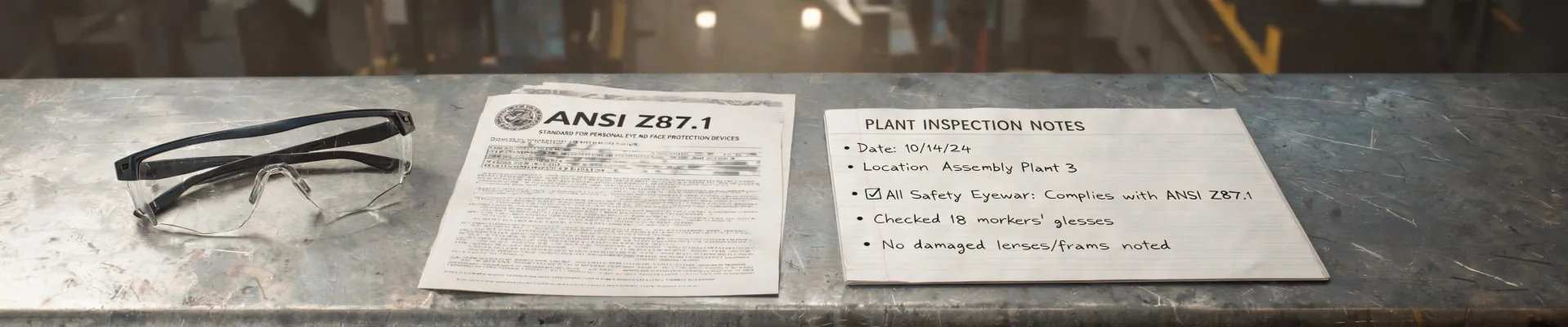
For this group, I lean toward models with ballistic-rated frames. That’s not just marketing—ballistic-rated frames are tested to withstand much higher velocities than standard ANSI Z87.1 requires.
The Wiley X Ovation and Fusion models are good starting points for this exact reason. Both are ANSI Z87.1-2020 certified and feature shatter-resistant lenses. The Ovation is lightweight and has a full seal, which helps with dust and debris on construction sites. The Fusion has a wraparound design that reduces peripheral gaps—handy if your crew is moving around a lot.
Here’s a quick comparison from my notes:
- Wiley X Ovation Safety Glasses: Best for workers who need a full seal and lightweight frame. Prescription-ready.
- Wiley X Fusion Safety Glasses: Best for wraparound coverage and a more modern fit. Polarized options available.
Key buying tip: For high-impact environments, don’t compromise on frame material. Polycarbonate lenses are standard, but frame rigidity matters. A flimsy frame can pop off or flex on impact, exposing the eye. I’ve seen it happen.
When to pay the “Certainty Premium”
If your team is working with a tight timeline—say, a week until a big project starts—and you need the glasses shipped and on-site, don’t gamble with slow shipping. I paid $85 extra for rush delivery once to ensure a shipment arrived in 2 days instead of 5. The alternative was a $4,000 delay in a contracted job. Worth every cent.
Scenario B: Precision or Lab Work (Welding, Chemical Handling, Electronics)
For welding safety equipment, impact protection is still important, but the priority shifts to optical clarity and splash resistance.
If your team does welding, look for glasses or goggles with appropriate shade levels (usually Shade 3-5 for cutting or Shade 5-8 for torch work). Most general-purpose safety glasses won’t meet the light-filtering requirements for welding. The Wiley X line includes some models with removable side shields and premium anti-fog coatings—both useful in high-heat environments.
My biggest frustration: Anti-fog claims. (Ugh.) Some “anti-fog” coatings last a few weeks and then wear off. I’ve learned to look for models with permanently bonded coatings or dual-pane designs. Wiley X uses an anti-fog lens technology on some models that holds up better than the spray-on type.
For chemical handling, a full-seal goggle is non-negotiable. Splashes can sneak in through gaps in standard safety glasses. If your team is handling acids or solvents, consider chemical-resistant frames (silicone or PVC) and replaceable lenses for cost-effectiveness.
Scenario C: Prescription and Polarized Needs (Outdoor Work, Driving, All-Day Wear)
This is the group that often gets overlooked—workers who need corrective lenses and employees who work outdoors in bright conditions.
If your team spends significant time in glare-prone environments (construction sites with reflective surfaces, road work, outdoor patrolling), polarized safety glasses can reduce eye strain significantly. I used to think of polarized lenses as a luxury, not a safety feature. A few employees with chronic headaches proved otherwise.
Wiley X offers prescription safety glasses in many of its models. The key advantage: you can order prescription lenses directly from the manufacturer, ensuring they meet ANSI standards. Third-party prescriptions may not maintain the same impact rating. (Another lesson learned from a reorder that didn’t pass our internal safety audit.)
Cost note: Prescription safety glasses generally run 2-3x the cost of standard models. But for workers who require them, it’s not optional—if they can’t see clearly, they’re a safety risk. Budget for it.
How to Decide Which Scenario Fits Your Team
Here’s a quick way to narrow it down:
- Do your employees work around flying debris or heavy machinery? Go with high-impact models like the Ovation or Fusion. Prioritize ballistic frames and ANSI Z87.1-2020 certification.
- Do they need chemical splash protection or welding shades? Look for full-seal goggles or shaded lenses. Anti-fog and replaceable lenses are a plus.
- Do they wear prescription glasses or work in bright outdoor conditions? Invest in prescription-ready frames or polarized options. Confirm the lenses are ANSI-rated, not just the frame.
- Is your timeline tight? Budget for rush shipping. The cost of a missed deadline almost always exceeds the shipping premium.
A final thought: I’ve found that involving a few employees in the selection process helps avoid complaints later. Let a couple of team members test a model before you order 50 units. Their feedback on fit, comfort, and fogging is worth more than any spec sheet.
(Also: don’t forget to check if your vendor offers military discounts. Many sites list military discounts, but you often have to ask or create a bulk account to qualify.)

Maeve Callahan
Maeve Callahan is a head-protection analyst covering Type I and Type II hard hats, climbing-style safety helmets, bump caps, chin straps, suspensions, liners, and face-shield carriers. She applies ANSI Z89.1, EN 397, and EN 12492 criteria while comparing impact attenuation, penetration resistance, lateral deformation, electrical class, retention strength, field of vision, mass, fit range, and temperature conditioning. Her guides help EHS teams, contractors, utilities, and buyers select helmet systems for overhead hazards, work at height, electrical exposure, accessory compatibility, and worker acceptance.