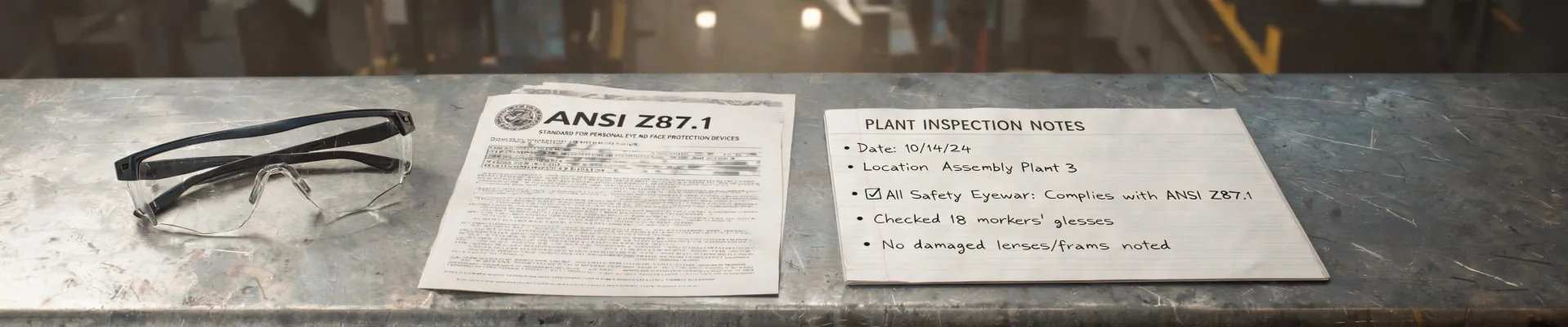
I didn't fully understand the importance of getting the exact Wiley X model for the job until a $3,200 order came back completely wrong. It wasn't the glasses' fault—it was mine. I had picked a general-purpose goggle for a team working in a high-heat, low-light warehouse. The lenses fogged up within an hour, and workers had taken them off by lunch, essentially wasting the entire investment. That was in September 2022.
Here's the catch: there's no single "best" Wiley X safety glasses. What works for a military contractor on an outdoor range is a liability for a chemical plant operator. What's perfect for a construction foreman is a compromise for a lab technician. This post breaks down the main scenarios I've seen (and messed up in), so you can figure out which one fits your team.
Scenario A: The Compliance Buyer (Budget-First, ANSI Minimum)
This is where I started. You need eye protection to pass an OSHA inspection or meet a client's site requirement. Budget is tight. You're tempted to grab the cheapest Z87.1-rated pair on the shelf.
My mistake: In my first year (2017), I ordered 50 pairs of a basic Wiley X model for a landscaping crew. I didn't check the lens tint or the frame fit for their sun-exposed, dusty environment. The glasses were scratched within a week. They looked fine on the spec sheet.
What I do now: For pure compliance with a tight budget, look at the Wiley X Epic Safety Glasses. They are ANSI Z87.1-2020 certified, offer a solid wraparound design, and are available with clear or smoke lenses. They are not the most advanced, but they are serviceable and reliable. The key is to verify the specific use case (indoor/outdoor, dust/impact). If it's just for a one-day event or a visitor helm, this is fine.
One more thing: I learned the hard way that even with cheap glasses, you should pay for a scratch-resistant coating. It added maybe 5% to the cost but extended the life by months.
Scenario B: The Prescription & Indoor Specialist (Clarity & Comfort)
This scenario is for your team members who wear prescription glasses and work indoors, like in a warehouse, lab, or assembly line. This is a different beast entirely.
My biggest regret: In March 2023, I told a long-time employee, "Just wear your regular glasses under the safety goggles." They did, but the fit was terrible. They were constantly adjusting, and the pressure caused a headache after 2 hours. The result: reduced productivity and a complaint to HR. The total cost was an $890 reorder plus a 1-week delay while we sourced Rx inserts for the original goggles.
What I do now: For prescription wearers, the Wiley X Saber Advanced Ballistic Shooting Glasses are often the best fit, but only if the model supports prescription inserts (Rx). The Saber frame is designed to accept Wiley X's prescription lens carrier. This gives you ballistic protection (up to MIL-PRF-32432A) with custom clarity. For purely indoor low-light environments, avoid dark tinted lenses. Go for the clear or yellow-tint option for contrast.
Critical check: You must verify the prescription tolerance. Not all Wiley X frames accept all prescriptions. I wasted
Scenario C: The Tactical & Extreme Environment User (Ballistic & Polarized)
This is for law enforcement, military contractors, shooters, and anyone working in high-impact, high-glare environments (like oil rigs or coastal construction). This is where the "more is more" logic applies.
The decision that gave me anxiety: I went back and forth between the Saber Advanced and a simpler model for a security detail working on a dockside project for two weeks. The simpler model offered 25% savings. My gut said go with the ballistic-rated option. I chose the Saber because the project was too important to risk a shattered lens. The team was exposed to flying debris and glint from the water. The polarized lens version was the right call.
What I do now: For these users, I don't compromise. The Wiley X Saber Advanced is the go-to. The key differentiators: it has a built-in replaceable gasket to block dust and debris, it meets the higher ballistic impact standard (MIL-PRF-32432A), and the polarized option (SAB2) cuts glare from water, snow, or machinery. If you have a team working in these conditions, the extra
How to Figure Out Which Scenario You're In
Don't hold me to this as a perfect formula, but here's a rough guide I use now after several expensive lessons:
- Scenario A: You need a large quantity (50+ units), the work is low-impact (like light construction or general warehouse), and your budget is locked. Choose the Wiley X Epic.
- Scenario B: Your team wears prescription glasses, they work indoors, and comfort is a factor. Go with the Saber Advanced (with Rx carrier).
- Scenario C: Your team faces ballistic threats, extreme glare, or blowing debris (tactical, military, oil & gas). The Saber Advanced (polarized) is the only option.
One last thing I learned: always order one sample unit first. Let a team member wear it for a full shift. Check for fogging, pressure points, and lens clarity. It costs
The value of getting the right fit isn't just the speed—it's the certainty. For safety-critical teams, knowing your gear works is worth more than a lower upfront price with 'estimated' compatibility. Miss that deadline, and you're not just wasting money. You're risking someone's vision.

Maeve Callahan
Maeve Callahan is a head-protection analyst covering Type I and Type II hard hats, climbing-style safety helmets, bump caps, chin straps, suspensions, liners, and face-shield carriers. She applies ANSI Z89.1, EN 397, and EN 12492 criteria while comparing impact attenuation, penetration resistance, lateral deformation, electrical class, retention strength, field of vision, mass, fit range, and temperature conditioning. Her guides help EHS teams, contractors, utilities, and buyers select helmet systems for overhead hazards, work at height, electrical exposure, accessory compatibility, and worker acceptance.