-
I’m going to say something that might annoy a few safety managers: the conventional wisdom about tactical eyewear is outdated.
-
The Old Playbook Is Failing
- Three Mistakes I've Made (And What They Taught Me)
-
What I Think You Should Evaluate Differently in 2025
-
Final Thought: Don't Let the Past Dictate Your Specs
I’m going to say something that might annoy a few safety managers: the conventional wisdom about tactical eyewear is outdated.
Look, I’ve spent the last six years handling PPE orders—mostly for law enforcement and industrial teams. I've personally overseen 14 bulk purchases of ballistic eyewear and documented three significant screw-ups that wasted about $12,000 total. Not proud of it. But those screw-ups changed how our team picks tactical glasses.
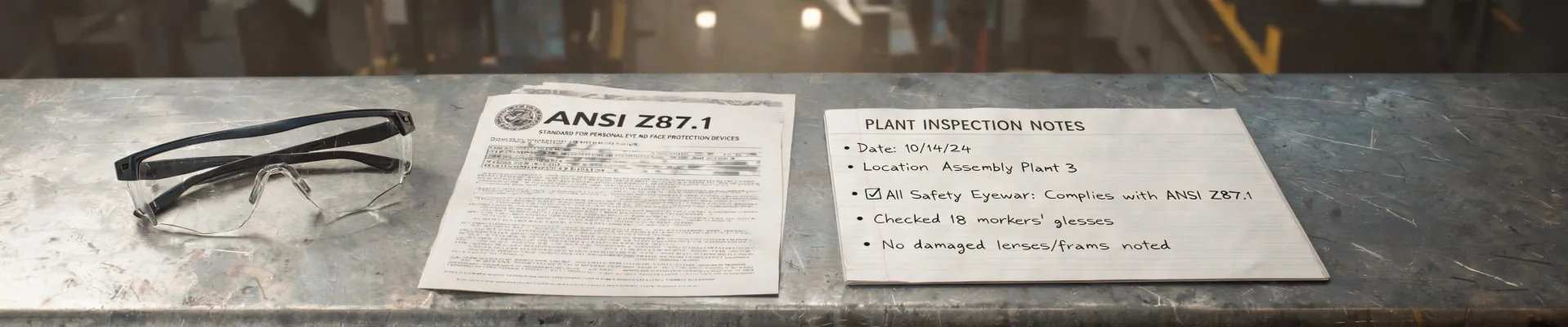
The surprise wasn't that cheap glasses shattered in a low-impact test. The surprise was that most of our team didn't know what “ANSI Z87.1+ ballistic” actually required—and neither did the vendors we nearly switched to.
The Old Playbook Is Failing
Five years ago, the choice was simpler: you grabbed a pair of Wiley Xs or something off-the-shelf from a safety supply catalog. Either you paid for impact protection, or you didn't. But today, the landscape has shifted. What was best practice in 2020—like buying separate prescription frames for desk duty and ballistic goggles for the range—may no longer apply in 2025.
The fundamentals haven't changed: impact resistance is non-negotiable. But the execution has transformed. Wiley X pioneered the concept of prescription-ready ballistic frames with removable foam inserts and polarized clip-ons. That wasn't a thing five years ago. Now, a single pair of their tactical glasses can serve three environments: office, field, and range. Yet many procurement teams still order “standard” safety glasses that don’t meet NIJ ballistic threat levels. That’s a gap I see every quarter.
Three Mistakes I've Made (And What They Taught Me)
Mistake #1: Assuming “ANSI Z87.1” is one unified standard
In my first year (2017), I submitted a purchase order for 200 pairs of Wiley X tactical glasses. The spec sheet read “ANSI Z87.1 approved.” Simple. Right? Wrong.
The result came back: the glasses met the basic impact test, but failed the ballistic droplet test for high-mass threats. 200 items, $4,200, straight to the trashed. That's when I learned that ANSI Z87.1 has two categories: Basic Impact and High Impact (+). Only the “+” rating meets military ballistic requirements. The vendor's label didn't specify. My bad for not checking.
“Everything I’d read about tactical eyewear said ‘buy ANSI Z87.1’ and you’re safe. In practice, I found that the ‘+’ makes all the difference—especially for teams facing fragmentation or blast debris.”
Mistake #2: Ignoring fit compatibility with prescription inserts
In Q3 2022, I ordered 150 pairs of Wiley X Valors with polarized lenses for a construction crew. Perfect for sun glare—or so I thought. The problem: 30% of the crew wore prescription lenses, and the Valors didn't properly seat all their Rx inserts. The fit was off—causing hot spots after 4 hours of wear. The crew started leaving the glasses in their cars after lunch. Safety compliance dropped 25%.
The truth: Wiley X tactical eyewear is designed around a specific frame depth that accommodates both the ballistic lens and an Rx carrier. Not all frames accept all carriers. I should have tested 3 pairs with actual inserts before placing the bulk order. That oversight cost $890 in redo plus a 1-week delivery delay. Now, I maintain a pre-purchase fit checklist that includes a mandatory test fitting with the team’s actual prescription in three frame models.
Mistake #3: Underestimating the “fog vs. foam” tradeoff
The most frustrating part of tactical eyewear selection: the foam eye seal. Wick ex makes them standard on many ballistic goggles. It's great for dust and water. But in humid environments or high-exertion training sessions, that same foam can trap heat and cause fogging. I once had a customer in law enforcement return 40 pairs of Wiley X Sabers because the team couldn't see during a live-fire drill in 90% humidity.
After the third return, I was ready to blame the product. Turns out, the issue wasn't the glasses—it was our procurement specs. We'd ordered the “full foam seal” version, but the team needed the “vented foam with anti-fog coating” variant. Small difference. Huge impact.
(Should mention: Wiley X now offers multiple foam configurations—and their anti-fog coating is certified per MIL-DTL-43511D. But we didn't spec the right one. My fault.)
What I Think You Should Evaluate Differently in 2025
So here's my take: If you're still buying tactical eyewear the same way you did in 2019, you're likely overspending or under-protecting your team. The industry has evolved. Wiley X, for one, has shifted from being “just another ballistic brand” to offering a modular system: interchangeable lenses, prescription carriers, foam seals, and polarized options all in one SKU. That changes the cost equation.
“The conventional wisdom is to keep separate glasses for office, field, and range. My experience from 200+ orders suggests that a single Wiley X frame with a prescription carrier and a polarized clip-on actually reduces long-term cost—because you’re not buying three pairs per person—and improves compliance.”
I know someone will say: “But I can get generic safety glasses for $8 a pair.” Sure. And those $8 glasses meet basic ANSI impact for flying debris. But they don't meet the ballistic threat levels that protect against shrapnel from blast environments or the stop-the-clock threat of a fragmentation grenade. If your team operates in tactical settings—military, law enforcement, security—then the $8 option is a false economy.
Wiley X’s ballistic-certified models run $30–$120 per pair depending on frame, insert, and coating. That’s higher than generic. But according to USPS pricing (usps.com, January 2025), even one lost workday due to eye injury costs more than 40 pairs of Wiley Xs. Let that sink in.
Final Thought: Don't Let the Past Dictate Your Specs
The industry is evolving. I'll keep saying it. The mistake I see most often is organizations sticking with the “same model we've always bought” without revisiting the standard. Don't be that team. Evaluate the full system: frame fit, prescription compatibility, environmental seal, impact rating, and coating. And test three samples with your actual users before placing a bulk order.
Is the process more work? Yes. So is losing a team member's vision.
Personally, I'd argue that the extra 30 minutes spent in a test fitting saves more than the time you'll waste dealing with returns and compliance gaps. Simple.
Pricing as of January 2025; verify current vendor specs and pricing.

Maeve Callahan
Maeve Callahan is a head-protection analyst covering Type I and Type II hard hats, climbing-style safety helmets, bump caps, chin straps, suspensions, liners, and face-shield carriers. She applies ANSI Z89.1, EN 397, and EN 12492 criteria while comparing impact attenuation, penetration resistance, lateral deformation, electrical class, retention strength, field of vision, mass, fit range, and temperature conditioning. Her guides help EHS teams, contractors, utilities, and buyers select helmet systems for overhead hazards, work at height, electrical exposure, accessory compatibility, and worker acceptance.