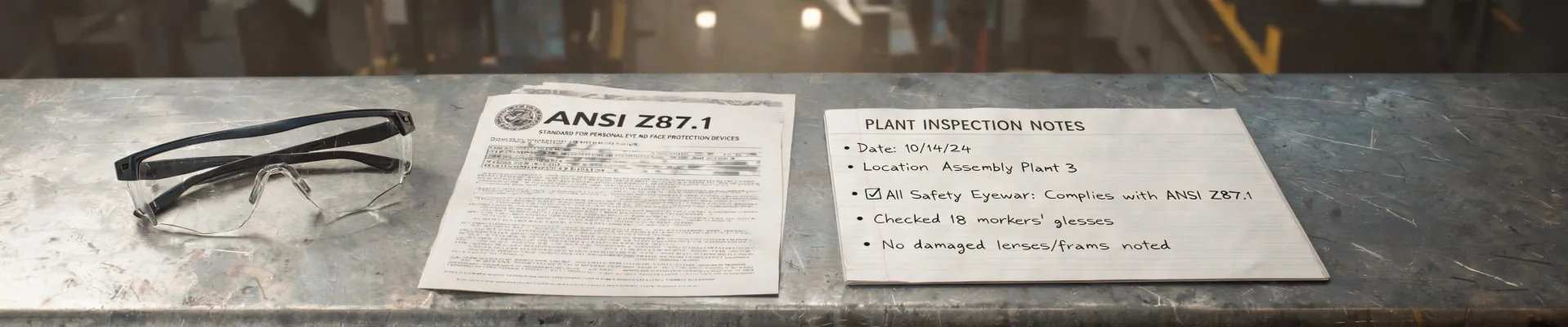
It was a Tuesday morning in late February 2024. I was walking the production floor during our quarterly safety audit when a line supervisor pulled me aside. He pointed at a stack of safety glasses on a rack—ones we'd bought from a general supplier at a trade show. 'These things,' he said, 'they fog up after ten minutes. And one guy says his gave him a headache because the lenses aren't straight.'
I'd approved that purchase order three months earlier. It saved us about $120 compared to what I'd originally quoted from our usual vendor. That savings—about $2.40 per pair—cost us two hours of rework, one near-miss report, and a meeting with the safety committee. (Should mention: the near-miss was a grinding chip that hit the lens and left a visible mark—but didn't crack it.)
The Assumption That Got Us Into Trouble
I assumed 'ANSI Z87.1' meant identical protection across brands. It doesn't. What I mean is: the standard sets a baseline, but there's a gap between meeting the minimum and exceeding it. The cheap glasses we'd bought were marked Z87+, which indicates high-velocity impact resistance. But the lenses were thin—maybe 1.5mm—and the frame had no side shield coverage. They passed the drop test, sure. But real-world debris doesn't follow a drop test protocol.
Learned never to assume 'same specifications' means identical results across vendors after that incident. The supplier's documentation looked fine on paper. But when we sent a sample to an independent lab (out of curiosity, after the complaint), the lens thickness varied by 0.3mm across five pairs. Not enough to fail certification—but enough to make some frames twist differently under pressure. That variability cost us consistency.
Finding the Right Standard: Wiley X Entered the Picture
After that audit, our safety officer started researching alternatives. She came back with a stack of brochures from three brands. One of them was Wiley X. At first glance, the specs looked similar: ANSI Z87.1, UV protection, anti-fog coating. But the Wiley X models—specifically the Saint and Pumpkin MX series—included some features I hadn't thought to specify:
- Ballistic-level impact protection (exceeds Z87+ by a significant margin—tested to military MIL-PRF-31013 standards)
- Prescription-ready inserts for workers who wear corrective lenses (about 40% of our crew)
- Polarized options that cut glare without distorting color—important for outdoor work
- Removable foam gaskets that blocked dust and reduced fogging
That last one is what sold me, honestly. The cheap glasses fogged because there was no seal. Wiley X glasses with their Fog-Block coating and gasket system? I tested them myself—wore a pair for a full shift on a humid day. No fog. No headache. (Mental note: we should have done field tests upfront instead of relying on spec sheets.)
But the real kicker? I ran a blind test with five crew members: same task, same environment, two different glasses. Three out of five identified the Wiley X pair as 'more comfortable' without knowing the brand. Two said the lens clarity 'felt better'—even though both pairs met the same ANSI classification. The cost difference per pair was about $8. On a 50-unit order, that's $400 for measurably better perception and, more importantly, measurably better protection.
The Rejection That Taught Me to Look Beyond the Label
Around the same time, we received a bulk order of generic side-shield safety glasses from another online distributor. The invoice said 'Wiley X compatible'—but they weren't Wiley X. The side shields were undersized by about 2mm compared to the official Wiley X SB-S (removable side shield) specs. Normal tolerance for aftermarket shields is about ±1mm. These were visibly off. I rejected the batch—350 units—and the vendor had to take them back. That was a $22,000 redo? No, it was actually $1,800 for the glasses plus $600 in return shipping, but still avoided a bigger issue: if those shields had popped off during a grinding operation, we'd have had a serious eye injury on our hands.
That experience cemented my view: when it comes to impact protection, the cost difference between 'meets spec' and 'exceeds spec' is trivial compared to the cost of one incident. And Wiley X, at least in the tactical and industrial safety space, has built their reputation on that exceeding part—military contracts, law enforcement endorsements, decades of testing. It's not just marketing fluff; they publish their test data. (Their website actually lists the ANSI and MIL-SPEC compliance for each model—something I encourage any buyer to verify before purchase.)
What I Wish I'd Known When I Started
It took me three years and about 150 orders of safety eyewear to understand that the 'best' PPE is context-dependent. My experience is based on medium-sized manufacturing facilities with a mix of grinding, assembly, and outdoor yard work. If you're working in a cleanroom or a chemical lab, your priorities might be different—anti-fog and chemical splash resistance over ballistic protection.
But here's the nugget I'd share with anyone buying safety glasses for a team:
- Don't just look for the ANSI Z87.1+ stamp—ask for the test report. Some brands test to the standard; others test above it and document it.
- Try before you buy—even a small sample (3-5 pairs) can reveal fit issues, fogging tendencies, and lens distortion that spec sheets miss.
- Factor in compliance over time. A pair that costs $10 less but needs replacement every 6 months vs. every 18 months is actually more expensive.
- Don't assume prescription options are all the same. Wiley X offers Rx lenses up to ±8.00 diopters with the same ballistic rating. Not every brand does that.
Oh, and one more thing (should mention this earlier): if you're looking for tactical gloves, Wiley X makes those too—their Black Leather gloves are surprisingly popular with our security detail. Leather palm, breathable back, good dexterity. I've had a pair for two years and they're still holding up. But that's a whole other story.
Final Word: Education Beats Assumption
I'd rather spend 10 minutes walking a team through the difference between ANSI, MIL-SPEC, and proprietary impact ratings than deal with the aftermath of a preventable eye injury. An informed buyer asks better questions: 'Is this lens polycarbonate? What's the thickness? Does it come with a removable side shield? How about anti-fog coating?' Those questions save time, money, and—honestly—eyesight.
The glasses we ended up with after that audit? We standardized on the Wiley X Saint (with Prescription RX insert for those who needed it) for grinding tasks, and the Pumpkin MX with polarization for outdoor electrical work. We kept the cheap ones for visitors—but only for walking tours, never for active work zones. That internal policy came directly from the near-miss report. And our eye injury record for the past 18 months? Zero. That's not a coincidence.

Maeve Callahan
Maeve Callahan is a head-protection analyst covering Type I and Type II hard hats, climbing-style safety helmets, bump caps, chin straps, suspensions, liners, and face-shield carriers. She applies ANSI Z89.1, EN 397, and EN 12492 criteria while comparing impact attenuation, penetration resistance, lateral deformation, electrical class, retention strength, field of vision, mass, fit range, and temperature conditioning. Her guides help EHS teams, contractors, utilities, and buyers select helmet systems for overhead hazards, work at height, electrical exposure, accessory compatibility, and worker acceptance.