-
Q1: How is Wiley X tactical eyewear different from regular ANSI-rated safety glasses?
-
Q2: Does the Wiley X logo matter? How do I verify I'm buying genuine product?
-
Q3: Are Ariat composite toe boots adequate for heavy construction environments?
-
Q4: Hog wire fence — why do industrial sites use it over chain link?
-
Q5: Nitrile vs latex gloves — which should I order for my team?
-
Q6: What's the biggest PPE procurement mistake you've made?
-
Q7: How do I get my team to actually wear the PPE I order?
I've been handling PPE procurement at our facility since 2017. In that time, I've placed somewhere around 350 orders across eyewear, gloves, footwear, and fencing materials. I've also made enough mistakes to fill a binder — the kind you keep locked in a drawer so nobody else sees it.
This FAQ covers the questions I get most often from new hires and from peers at other plants. I'm answering them honestly, including the parts where I screwed up. Here's what I wish someone had told me in my first year.
Q1: How is Wiley X tactical eyewear different from regular ANSI-rated safety glasses?
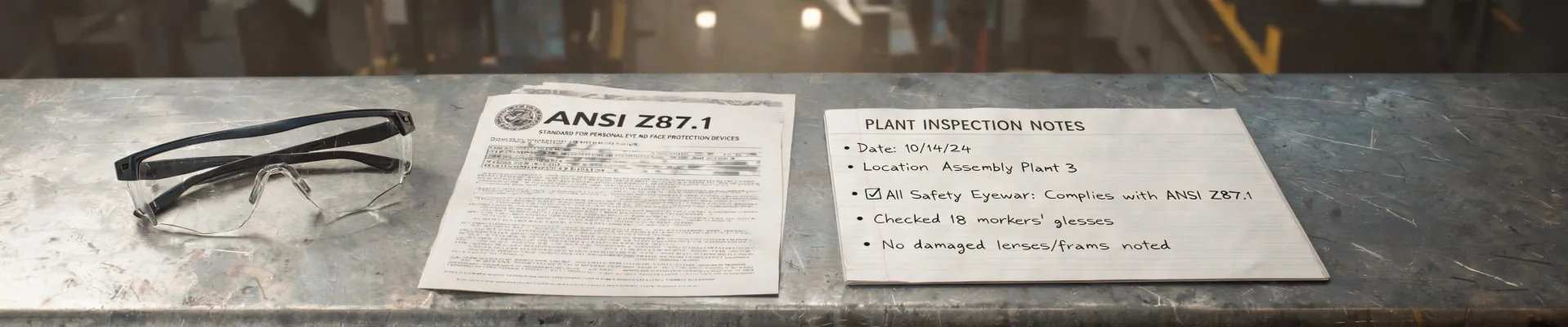
The short answer: impact rating and lens retention. Wiley X tactical glasses meet ANSI Z87.1 for high-velocity impact, and many models also carry military ballistic standards like MIL-PRF-32432. That's a higher threshold than basic Z87.1 — the military standard tests against larger projectiles at higher velocities.
In practice, this means the frame geometry and lens retention system are built to keep the lens seated even when the frame flexes. I don't have hard data on how often that matters in a warehouse setting, but based on a 2021 grinding incident we had — a metal fragment hit a worker's lens at close range — the lens held. A basic pair probably wouldn't have. That said, if your team is doing standard material handling, basic ANSI glasses may be enough. My experience is based on metal fabrication environments, so adjust accordingly.
Q2: Does the Wiley X logo matter? How do I verify I'm buying genuine product?
Genuine Wiley X glasses have the model number and standard markings laser-etched on the lens itself — not printed. The logo on the frame is molded into the polymer. If the markings wipe off or the logo peels, it's probably counterfeit.
I wish I'd tracked our counterfeit rate more carefully over the years. What I can say anecdotally: we got burned once in 2019 on a bulk order from a third-party marketplace. The lenses arrived with visible edge distortion. We sent three pairs to our regional distributor, who confirmed the temple hinge design was wrong and the ANSI markings were the wrong font. That order cost us about $2,100 in wasted product plus a two-week delay while we re-sourced from an authorized dealer. If the price is below the distributor floor, it's probably below for a reason.
Q3: Are Ariat composite toe boots adequate for heavy construction environments?
Composite toe meets ASTM F2413-18 for impact and compression — the same standard as steel toe. The difference is weight and temperature transfer. Composite won't conduct cold the way steel does, which matters if your crew works outside in winter. Ariat makes models that meet the standard, no question.
But "adequate" depends on what else is in the environment. If there's a risk of puncture from below — nails, rebar, scrap — you need puncture-resistant midsoles, and those carry a separate rating. I once ordered 40 pairs of composite boots without checking for that rating. They passed general construction use but failed our own site audit for a foundation work area. That was a $3,600 mistake and a hard lesson in matching spec sheets to specific job hazards, not just the general category.
Q4: Hog wire fence — why do industrial sites use it over chain link?
Hog wire (welded wire) is cheaper per linear foot than chain link, and for perimeter zones, equipment yards, and erosion barriers, it's often sufficient. The trade-off is impact durability. Chain link handles vehicle impact better; hog wire is lighter and easier to install on irregular terrain.
One frustration: hog wire specs vary wildly between manufacturers. Gauge numbers don't mean the same thing across suppliers. We ordered a roll described as "12-gauge" that turned out thinner than a previous batch from a different manufacturer. If you're ordering for permanent installation, get the actual wire diameter in thousandths of an inch and the mesh spacing — don't rely on gauge alone. I should add that this isn't unique to hog wire; it's a problem across most wire products.
Q5: Nitrile vs latex gloves — which should I order for my team?
Nitrile for most industrial settings. Latex has better tactile sensitivity and elasticity, but it triggers allergic reactions in a significant portion of the workforce — roughly 3-10% for type I latex allergy, per NIOSH data. Nitrile has no latex proteins, better chemical resistance, and doesn't degrade as fast with oils and solvents.
Here's where I messed up early on: I ordered latex because it was cheaper per box. Two workers filed allergy complaints within the first month. We had to re-order nitrile, and HR had to process the paperwork. The cost difference per box was maybe $2 — not worth the disruption. My rule now: nitrile is the default unless there's a specific task requiring maximum dexterity where latex genuinely performs better. Even then, check for allergies first.
Q6: What's the biggest PPE procurement mistake you've made?
Buying for price instead of total cost. In 2018, I sourced our safety glasses from the lowest bidder. The lenses scratched within two weeks. Workers stopped wearing them. We had a near-miss incident in month two, and I had to justify the original decision to our safety director. The re-order from a higher-quality vendor cost 40% more per pair, but those glasses lasted six months instead of two weeks.
I still kick myself for that one. If I'd calculated cost-per-wearing-day instead of cost-per-unit, the answer would've been obvious from the start. Switching to a vendor with consistent quality cut our replacement rate from monthly to quarterly. That's the efficiency lesson — cheapest upfront is often most expensive overall.
Q7: How do I get my team to actually wear the PPE I order?
Involve them in the selection. I used to just order what the spec sheet said and hand it out. Then I noticed half the safety glasses were sitting in lockers. Turns out the fit was wrong for some face shapes — something I couldn't have known from a catalog. We switched to options with adjustable nose pieces and multiple temple lengths.
The most frustrating part: you'd think compliance would follow good equipment, but comfort matters just as much. Now we run a trial period on new PPE — order a small batch, let the crew test it for a week, gather feedback, then bulk order. It added a step to the process, but our usage rate went from about 60% to over 90%. Worth the extra two days of lead time, every time.

Maeve Callahan
Maeve Callahan is a head-protection analyst covering Type I and Type II hard hats, climbing-style safety helmets, bump caps, chin straps, suspensions, liners, and face-shield carriers. She applies ANSI Z89.1, EN 397, and EN 12492 criteria while comparing impact attenuation, penetration resistance, lateral deformation, electrical class, retention strength, field of vision, mass, fit range, and temperature conditioning. Her guides help EHS teams, contractors, utilities, and buyers select helmet systems for overhead hazards, work at height, electrical exposure, accessory compatibility, and worker acceptance.