-
1. What should I look for in Wiley X Founder safety glasses?
-
2. Are Wiley X-SG-1 tactical goggle reviews actually useful?
-
3. Do I really need a fire extinguisher for car safety?
-
4. What specs matter for a chain link fence around a jobsite?
-
5. Are Body Armor drinks healthy?
-
6. Why does delivery certainty matter more than the lowest price for safety gear?
-
7. What's the one thing most buyers miss?
I'm a quality/brand compliance manager at an industrial safety supplier. I review every PPE batch before it goes to our crews—roughly 200+ items a year. I've rejected about 12% of first deliveries in 2024 because of spec mismatches, missing certificates, or lens defects. So when people ask me about safety gear, I tend to skip the brochure language and go straight to what I check.
Here are the questions I get most often, including a few that mix categories: Wiley-X eyewear, vehicle fire extinguishers, chain link fence, and even Body Armor drinks. (Yes, really.)
1. What should I look for in Wiley X Founder safety glasses?
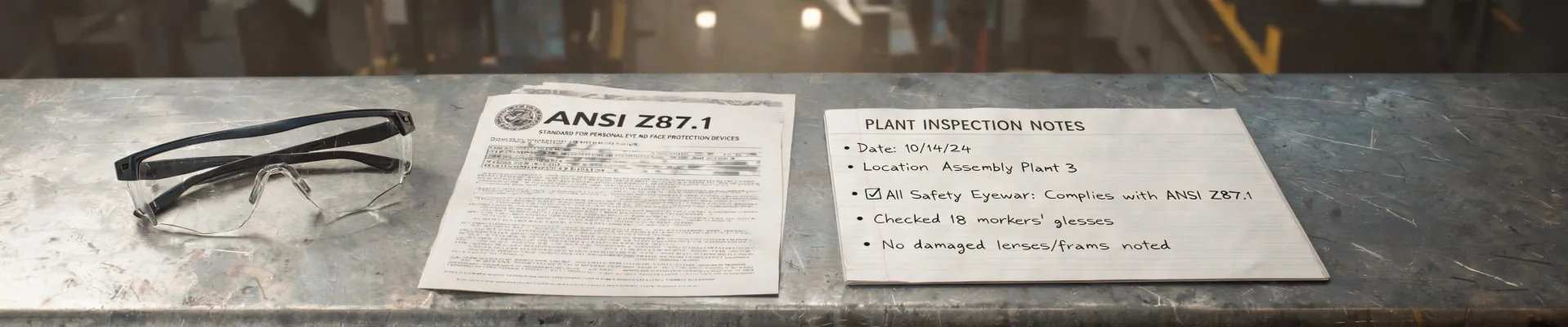
If you're buying Wiley X Founder safety glasses for a crew, don't just look at the frame. Check the lens markings. For the U.S., you want ANSI Z87.1-2020, and for ballistic claims, MIL-PRF-32432. OSHA 29 CFR 1910.133 requires eye and face protection where there is a hazard. That's the floor, not the ceiling. Wiley X generally labels both ratings, but I verify the certificate on the batch, not the website photo.
The Founder model is popular because it has a removable foam gasket and comes in prescription-ready versions. That gasket matters in dusty environments—but it also traps heat. In my experience, people either love it or take it out after two hours. If you have workers who switch between indoor and outdoor tasks, order one pair with the gasket and one without before committing to a 100-pair order.
Also check side coverage. A lot of 'safety glasses' have great front impact rating but weak side protection. When I compared a generic $12 pair and a Wiley X Founder side by side in our lab, I finally understood why people keep paying for better hinge tension and lens retention. Not huge on paper, but over a 10-hour shift, it matters.
2. Are Wiley X-SG-1 tactical goggle reviews actually useful?
I read reviews, but I don't trust them as a spec sheet. For the Wiley X-SG-1 tactical goggle, the useful reviews mention three things: fit with helmets, lens swap time, and fogging in humid heat. The useless reviews say 'great goggles' or 'bad goggles' with no context.
Here's what I check instead: ANSI Z87.1+ marking, MIL-PRF-32432 ballistic rating, and whether the replacement lenses are actually in stock. A goggle is only as good as its spare parts. In 2023, we had a batch of tactical goggles from another vendor that passed impact tests, but the replacement lenses were backordered six months. That's a process gap. We didn't have a formal spare-parts check. Cost us when a training event had to run with half the team in older goggles.
If you're reading Wiley X-SG-1 tactical goggle reviews, sort by 'verified purchase' and look for details about strap adjustment and anti-fog coating. If a review doesn't mention those, it probably wasn't written by someone who wore them on a shift.
3. Do I really need a fire extinguisher for car safety?
For company fleet vehicles, I'd argue yes—if you have drivers carrying equipment, lithium batteries, or flammable cargo. For personal cars, it's a judgment call, but it's cheap insurance. The key is not just buying one. It's mounting it where you can reach it and checking the gauge monthly.
Look for a UL-rated ABC extinguisher. A 2.5 lb ABC is common for cars. NFPA 10 covers portable extinguisher selection and placement, though local vehicle codes vary. As of January 2025, many auto parts stores sell 2.5 lb ABC units for $25–$45. Verify current pricing and local rules because they change.
We didn't have a formal vehicle safety check process. Cost us when a driver's extinguisher was six years past its inspection date. Nobody got hurt, but it failed a client audit. Now every fleet checklist includes the extinguisher gauge, mounting bracket, and inspection tag. Takes 30 seconds. Worth it.
4. What specs matter for a chain link fence around a jobsite?
Chain link fence is not just 'fence.' For a jobsite, check mesh size, wire gauge, coating, and post gauge. A common spec is 9-gauge wire with 2-inch mesh, but high-security areas may need 11-gauge or smaller mesh. The coating matters more than people think. Galvanized before weaving lasts longer than galvanized after weaving in coastal or chemical environments.
ASTM F567 covers installation practice, and ASTM F1043 covers strength and protective coatings for steel chain link fence framework. If your vendor can't tell you which standard they build to, that's a red flag.
I've seen a chain link fence look fine on day one and rust at the bottom rail within 18 months because the posts weren't coated properly. In my opinion, pay for the heavier coating now. The labor to replace a fence line is way more than the material upgrade. Plus, a fence that fails an insurance inspection can delay a project.
5. Are Body Armor drinks healthy?
First, to be clear: Body Armor here is the sports drink brand, not body armor for ballistic protection. It's basically an electrolyte drink with vitamins. Is it healthy? That depends on what you compare it to.
Compared to water, it has sugar and calories. Compared to many sodas, it has fewer calories and more electrolytes. As of January 2025, a 28 oz Body Armor bottle can have around 20–30g of sugar, depending on flavor. That's not automatically bad if you're sweating for hours, but it's not a daily desk drink.
For industrial crews in heat, water plus an electrolyte packet is often cheaper and easier to control. If you have workers with diabetes, hypertension, or kidney issues, they should ask a doctor. I'm a quality manager, not a nutritionist. The bottom line: read the label, check the serving size, and don't treat a sports drink as a health food.
6. Why does delivery certainty matter more than the lowest price for safety gear?
Because a missed safety deadline isn't just an inconvenience. If your crew can't start because the PPE isn't there, you're paying for idle labor, delay penalties, or worse—someone works without proper protection.
In March 2024, we paid $380 extra for guaranteed two-day delivery on 120 pairs of prescription safety glasses. The alternative was missing a plant turnaround deadline. The overtime cost would have been around $9,000. The rush fee was annoying (unfortunately), but it was the cheapest part of that decision.
After getting burned twice by 'probably on time' promises, we now budget for guaranteed delivery on critical PPE. The way I see it, you're not buying speed. You're buying certainty. A lower price with a vague ship date is often the most expensive option in the end.
7. What's the one thing most buyers miss?
They don't verify the certificate against the batch. They see 'ANSI Z87.1' on a product page and assume every unit is compliant. I've had vendors send a certificate for a different model, or an expired test report, or a certificate that covered the lens but not the frame.
So here's my process: I ask for the test report, the model number, and the production date. I match them. If anything is off, I reject the batch. That quality issue cost us a $22,000 redo in 2022 and delayed a launch by three weeks. Now every contract includes a spec sheet and a certificate requirement.
If you're buying Wiley X eyewear, fire extinguishers, chain link fence, or even checking whether Body Armor drinks are healthy, the same rule applies: get the details in writing. Trust the documentation, not the marketing copy.

Maeve Callahan
Maeve Callahan is a head-protection analyst covering Type I and Type II hard hats, climbing-style safety helmets, bump caps, chin straps, suspensions, liners, and face-shield carriers. She applies ANSI Z89.1, EN 397, and EN 12492 criteria while comparing impact attenuation, penetration resistance, lateral deformation, electrical class, retention strength, field of vision, mass, fit range, and temperature conditioning. Her guides help EHS teams, contractors, utilities, and buyers select helmet systems for overhead hazards, work at height, electrical exposure, accessory compatibility, and worker acceptance.