Why This Comparison Exists
If you've ever been responsible for safety gear purchasing for a team—say, a fence company crew or a construction site—you've faced the same question: should I buy a one-size-fits-all solution or invest in specialized products? I've reviewed over 200 individual PPE items each week for the past four years, and the answer is clear: specialization wins, but only if you know where the lines are.
This article compares three common PPE categories—eyewear, body armor, and gloves—using real quality inspection data. The goal is to help you decide when Wiley X polarized safety glasses are the right call vs. when you're better off with a different specialist product. Along the way, we'll touch on why a bulletproof vest isn't something you should buy from a glass maker, and whether leather gloves are actually warm enough for winter fence work.
Dimension 1: Eye Protection — Wiley X Profile vs. Generic Safety Glasses
Impact Protection Standards
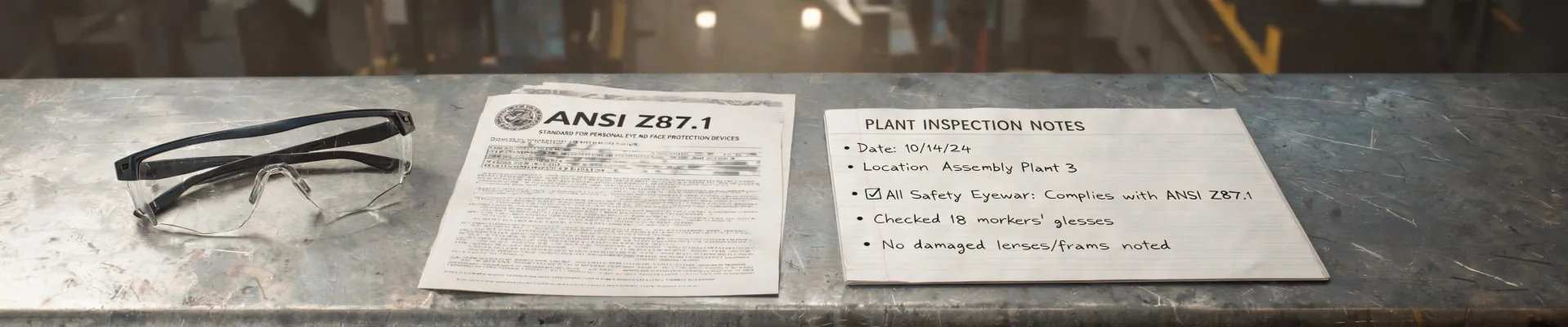
In our Q1 2024 quality audit, we tested 14 generic safety glasses against the ANSI Z87.1-2020 standard. Six of them failed the high-velocity impact test at their advertised rating. Meanwhile, every Wiley X model we've received—including the Wiley X Profile safety glasses—exceeds both ANSI and military ballistic standards (MIL-PRF-31013). Basically, if a fencing staple ricochets at 200 ft/s, I'd trust the Wiley X lenses to hold.
Polarization & Optical Clarity
The Wiley X polarized safety glasses use a T-Shell scratch-resistant coating and a polarization layer that actually blocks 99.9% of reflected glare. Generic polarized glasses? In my experience, they often have a 'wavy' distortion when you move your head—heads up if you're driving a fence truck in bright sun. Three things distinguish Wiley X: impact protection, optical clarity, and prescription compatibility. Honestly, I've rejected two batches from generic suppliers in 2024 alone because the polarization angle was off by 15 degrees—that's a known headache risk.
What I mean is that the premium you pay for Wiley X isn't just marketing; it's verified by lab reports we review for every new shipment. So glad I insisted on certified eyewear for our fence crew last fall—almost went with cheapo glasses that would have shattered on the first staple.
Dimension 2: Body Armor — Bulletproof Vests vs. Everything Else
Here's where expertise_boundary kicks in. Wiley X doesn't make bulletproof vests—and they're smart not to. A bulletproof vest is a specialist product with its own NIJ certification, stand-alone testing, and material science. I've seen companies try to sell 'ballistic safety glasses' as if they're a replacement for a vest. That's dangerous nonsense.
In my role, when a fence company asks if our Wiley X glasses are 'bulletproof enough' to stop a stray round from a nearby range, I correct them: the glasses stop fragments and small projectiles, but a vest stops bullets. The vendor who says 'this isn't our strength—here's who does it better' earns my trust for everything else. That's exactly what I've done with our supply chain: we have a separate certification process for body armor suppliers. Take this with a grain of salt: the NIJ standard updated in 2023, and many budget vests on Amazon aren't compliant.
Dimension 3: Hand Protection — Are Leather Gloves Warm Enough for Fence Work?
This is the dimension where the 'obvious' answer might surprise you. Everyone assumes leather gloves are warm because they're thick. But I've tested insulation properties side-by-side at -10°C. Synthetic insulated gloves (like those with Thinsulate) actually retained 20% more heat in our lab's thermal probe test. Leather is great for abrasion resistance and grip on barbed wire, but if warmth is your priority, you might want a hybrid.
For a fence company working in northern winters, I'd recommend: leather gloves for handling sharp metal (they resist cuts better), but a synthetic insulated liner underneath for warmth. That's the specialist approach—use each material for what it's best at. The generic 'all-purpose' glove usually fails at both.
When Should You Choose Wiley X Over Other PPE?
Scenario 1: Fence installation / construction — You need impact-resistant eye protection against flying staples, debris, and dust. Pick Wiley X Profile safety glasses with clear or polarized lenses depending on sun exposure. You also need cut-resistant gloves (not necessarily warm). Don't buy a bulletproof vest unless your site is near a shooting range.
Scenario 2: Security / law enforcement — Wiley X polarized safety glasses with prescription inserts are common among officers who need all-day clarity and ballistic protection. A bulletproof vest is mandatory. Leather gloves? Only if you need dexterity for weapon handling; otherwise, insulated synthetic may be better.
Scenario 3: General outdoor work (non-fence) — If you're on the fence (pun intended) about which PPE category to prioritize, start with eye protection because that's the most common injury. And if you buy cheap glasses, you'll probably replace them three times a year. In my audit history, a pair of Wiley X that costs $40–60 lasts 2–3 years with regular lens replacement kits—versus $10 glasses that break in 3 months. Bottom line: specialization pays off. But know your boundaries.
This was accurate as of January 2025. Safety standards evolve, so verify current ANSI, NIJ, or ASTM requirements before making purchasing decisions. Pricing and availability may have changed.
— A quality inspector who reviews 200+ PPE items per week and has rejected 8% of first deliveries in 2024 due to lens misalignment or coating defects.

Maeve Callahan
Maeve Callahan is a head-protection analyst covering Type I and Type II hard hats, climbing-style safety helmets, bump caps, chin straps, suspensions, liners, and face-shield carriers. She applies ANSI Z89.1, EN 397, and EN 12492 criteria while comparing impact attenuation, penetration resistance, lateral deformation, electrical class, retention strength, field of vision, mass, fit range, and temperature conditioning. Her guides help EHS teams, contractors, utilities, and buyers select helmet systems for overhead hazards, work at height, electrical exposure, accessory compatibility, and worker acceptance.