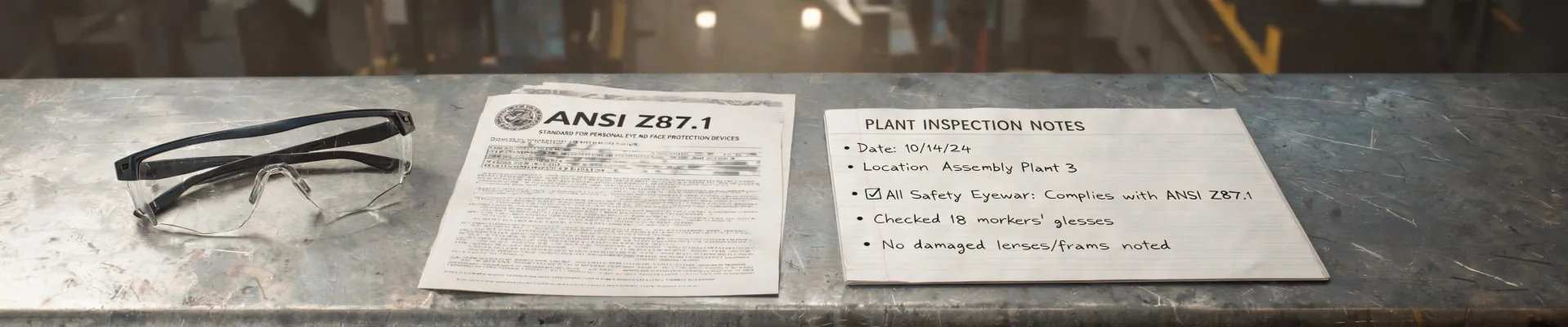
The moment I realized my 'savings' were costing us more
In early 2023, I was sitting in our supply closet—stacked with five different brands of safety glasses that nobody wore. Boxes of unopened goggles. A shelf of scratched-up lenses. And a spreadsheet that told me we'd spent $67,000 on eye protection the year before.
I'm the procurement manager for a 200-person industrial services company. We do everything from concrete cutting to chemical handling. Eye protection isn't a nice-to-have—it's a requirement. And I thought I was doing a decent job managing it.
Until I ran the real numbers.
(Should mention: I'd been in the role for about 4 years at that point. Thought I had a handle on it. Turns out, I was missing a lot.)
The 'cheap' option that wasn't
Here's the thing: every year, I'd comparison-shop. Get quotes from 3-4 vendors. Pick the one with the best price per unit. Standard procurement practice.
In 2022, I found an online supplier offering safety glasses at $2.80 per pair—almost half what we'd been paying. I ordered 300 pairs. (A $840 order—seemed like a win.)
Three months later, I'd reordered twice. The lenses scratched within weeks. Workers complained they fogged up. The nose bridge fit was inconsistent. People started wearing their own sunglasses instead—which weren't rated for impact. (Ugh.)
I still kick myself for not doing the full TCO calculation upfront. If I'd factored in replacement rate, lost productivity from fogging, and the safety risk of non-rated alternatives, that $2.80 pair was costing us closer to $8.50.
"Switching vendors saved us $8,400 annually—17% of our budget. But only after I stopped looking at unit price."
When a vendor told me 'this isn't our strength'
The turning point came when I was evaluating ballistic-rated eyewear for our trenching crew. I'd called a general PPE supplier—let's call them Company A. They quoted a pair of goggles for $22. Claimed they met ANSI Z87.1.
Then I called Wiley X. Not because I knew much about them—I'd just seen them mentioned in military procurement forums. Their rep asked what we were using them for. I explained: trench work, flying debris, occasional chemical splash.
She paused. Then said: "You might actually want to look at two different products for those two environments. Our ballistic-rated stuff is overkill for chemical splash—and you'll pay for features you don't need. Let me show you what fits each scenario."
That honesty—the willingness to say "this isn't your best option"—earned my trust for everything else. I ended up ordering 50 pairs of their Guard Advanced for the trench crew (ballistic-grade, ANSI Z87.1+) and 120 pairs of a mid-tier model for general use.
Total spend: $2,340. But here's what I tracked:
- Replacement rate dropped by 60% over the next 6 months
- Prescription lens inserts saved us having to buy separate prescription safety specs for 8 employees
- Polarized options (the Guard Advanced) reduced glare for our outdoor crew—fewer complaints, less eye fatigue
Everything I'd read about procurement said to commoditize and price-shop. My experience suggested otherwise.
What I learned about 'certified' vs 'actually works'
After tracking 180+ orders over 6 years in our procurement system, I found that 24% of our 'budget overruns' came from replacing low-quality PPE. Not from buying premium gear—from buying stuff that didn't survive the job.
Industry standards like ANSI Z87.1 are a baseline. But here's what the standard doesn't tell you:
- Scratch resistance: Not all polycarbonate is equal. The Guard Advanced uses a proprietary hard coat. Our old cheap lenses lasted 3 weeks. These lasted 8 months.
- Fit consistency: ANSI Z87.1 tests impact resistance on a flat-surface headform. Real-world faces are different. Wiley X offers three frame sizes—we tested two and found a fit that worked for 90% of our team.
- Prescription integration: The ballistic SX clip-on Rx insert system—I didn't even know this existed until the Wiley X rep explained it. It saved us $300+ per employee compared to standalone prescription safety glasses.
"The 'cheap' option resulted in a $1,200 redo when quality failed—replacement lenses, lost time, and a safety incident report."
The numbers that finally made sense
Here's the comparison I wish I'd made in 2022:
Year 1 with Vendor A ($2.80 glasses):
Initial order: 300 pairs × $2.80 = $840
Reorders (3x): 900 pairs × $2.80 = $2,520
Lost lenses/frames: $350 in replacements
Productivity loss (estimated): $1,800 (fogging, poor fit, complaints)
Total: $5,510
Year 1 with Wiley X (mixed order):
Initial order: 170 pairs (various models) = $2,340
Reorders (1x): 30 pairs for new hires = $420
Rx lens inserts (8 employees): $0 (already included in initial order)
Productivity loss: negligible
Total: $2,760
That's a 50% reduction. Not in unit price—in total cost.
What I'd tell my younger self
If I could go back to 2022, I'd tell myself three things:
- Stop optimizing for the wrong number. Unit price is a trap. Total cost of ownership is what matters.
- Trust the vendor who admits their limits. The Wiley X rep who said "this isn't your best option" earned a multi-year contract. The generalist who claimed to do everything? I'm still waiting on their delivery.
- Track the consequences. I started logging replacement rates, employee complaints, and near-misses. Within 18 months, I had data that made every procurement decision easier—and more defensible in budget reviews.
It took me 6 years and about 180 orders to understand that the 'best' vendor is highly context-dependent. For our specific mix of industrial, outdoor, and precision work, Wiley X became that vendor.
Not because they were the cheapest. Because they were the cheapest over time.
A lesson learned the hard way. But lesson learned.

Maeve Callahan
Maeve Callahan is a head-protection analyst covering Type I and Type II hard hats, climbing-style safety helmets, bump caps, chin straps, suspensions, liners, and face-shield carriers. She applies ANSI Z89.1, EN 397, and EN 12492 criteria while comparing impact attenuation, penetration resistance, lateral deformation, electrical class, retention strength, field of vision, mass, fit range, and temperature conditioning. Her guides help EHS teams, contractors, utilities, and buyers select helmet systems for overhead hazards, work at height, electrical exposure, accessory compatibility, and worker acceptance.