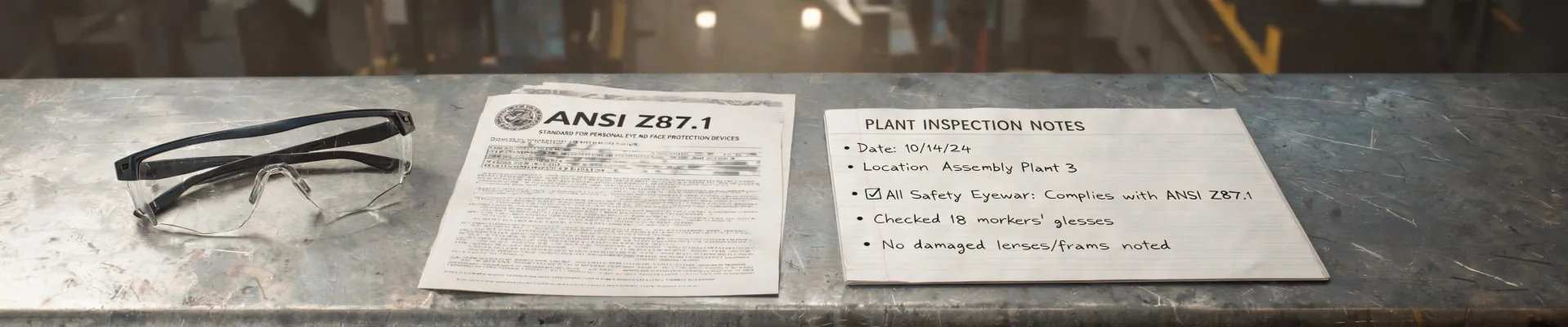
I've lost count of how many times I've seen a procurement team celebrate saving $3 on a pair of safety glasses. From the outside, it looks like a smart win. The reality is that those savings often vanish the first time a worker gets a speck in their eye, or when a compliance audit flags your inventory for not meeting the ANSI Z87.1 standard. The real cost isn't the line item; it's the consequence.
The Surface Problem: It Fogs Up, It Scratches, It's Uncomfortable
This is what most people focus on. A safety manager comes to me and says, "My guys hate the glasses we're buying. They fog up on the job site, they scratch if you look at them wrong, and nobody wants to wear them." They think the problem is comfort. And yes, that's part of it. No one wears uncomfortable PPE consistently. But that's only the tip of the iceberg.
The immediate fix they look for is often a new pair of cheap goggles. Maybe they search for "tillman welding gloves" or a different brand of impact-rated glasses. But switching brands without understanding the root cause is like putting a band-aid on a broken bone.
The Deep Reason: Specifications vs. Use Cases
Here's the part that took me years to fully grasp: the problem isn't the worker; it's the mismatch between the spec and the environment. People assume all safety glasses are basically the same—just varying levels of plastic between you and a hazard. What they don't see is the complex engineering for specific conditions.
When I compared a standard polycarbonate lens against a Wiley X photochromic safety glass side by side in a bright outdoor setting, I finally understood why the details matter so much. The standard lens might offer impact protection, but it forces the worker to either squint or stop and switch to a tinted pair. That friction makes them take the glasses off.
Take the Wiley X Spear tactical goggles as an example. From my experience reviewing specs for a 50,000-unit annual order, they're not just for looks. The real value is in the gasket seal and the lens retention system. In a dusty or windy environment, a standard goggle lets particles in around the edge. A worker who gets grit in their eye is 100% more likely to break protocol and rub their eye, leading to a corneal abrasion. That's a medical claim.
I've never fully understood why some facilities buy one SKU for everything: welding, grinding, chemical handling, and general construction. My best guess is it's a perceived cost-savings strategy. But it never actually saves money.
The Costs of Getting It Wrong
Let me give you a concrete example. In our Q1 2024 quality audit, we reviewed a batch of 2,000 safety glasses from a new vendor. They looked fine in the box, but the impact rating was marked as Z87+ without the proper 'W' for welding shade. The vendor claimed it was 'within industry standard.' We rejected the batch. That issue cost us a $4,000 redo and delayed a project by three weeks.
The costs pile up fast:
- Compliance fines: An OSHA inspector doesn't care that you saved $2 a unit. They care if your PPE isn't rated for the task.
- Lost productivity: If your team stops working to switch glasses five times a day because they're fogging or the light changes, you're losing hours, not minutes.
- Medical claims: A single eye injury costs an average of $5,000 in direct medical costs, plus lost time. That wipes out any savings on cheap glasses for a whole year.
- Worker trust: When your team feels you've cheaped out on safety gear, morale takes a hit. They start ignoring other protocols.
Everyone told me to always check specifications before approving. I only believed it after skipping that step once and eating a $4,000 mistake. The lowest quoted price often isn't the lowest total cost. The total cost of ownership includes the base product price, the cost of potential reprints (or replacements), and the cost of medical claims.
A Brief Look at the Solution
So what do you do? You stop buying a 'one-size-fits-all' solution. You match the eyewear to the environment.
For a construction crew working outdoors, invest in Wiley X photochromic safety glasses. They auto-adjust to light, eliminating the need to switch glasses. The upfront cost is higher (maybe $30 a pair vs. $5), but on a 500-person crew working 250 days a year, the ROI on worker compliance alone is massive.
For a tactical team or a heavy debris environment, the Wiley X Spear tactical goggles are a better fit. The full seal and ballistic-rated lens are non-negotiable. I'd rather work with a specialist like Wiley X who knows their limits for impact protection than a generalist who overpromises on a cheap frame.
The vendor who said 'this isn't our strength—here's who does it better' earned my trust for everything else. The best safety managers know that the cheapest option is often the most expensive in the long run. Focus on the spec, not just the price tag.

Maeve Callahan
Maeve Callahan is a head-protection analyst covering Type I and Type II hard hats, climbing-style safety helmets, bump caps, chin straps, suspensions, liners, and face-shield carriers. She applies ANSI Z89.1, EN 397, and EN 12492 criteria while comparing impact attenuation, penetration resistance, lateral deformation, electrical class, retention strength, field of vision, mass, fit range, and temperature conditioning. Her guides help EHS teams, contractors, utilities, and buyers select helmet systems for overhead hazards, work at height, electrical exposure, accessory compatibility, and worker acceptance.