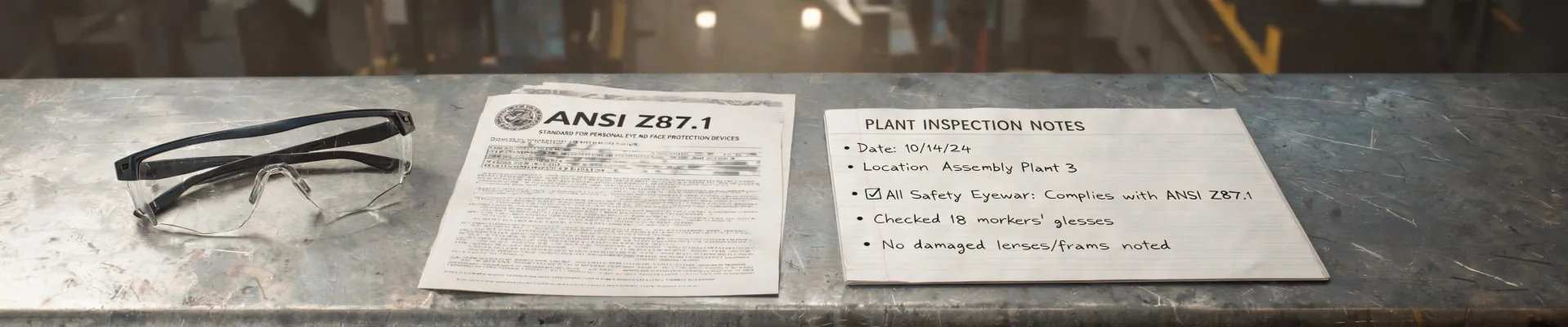
The Day I Learned What Safety Glasses Should Actually Be
It was late 2022, and I was standing in our warehouse, staring at a pallet of 8,000 units of what we called "safety glasses." My boss was not happy. The order was for a new client—a small construction firm that had trusted us with their first $18,000 PPE order. I had approved the spec based on a quick email exchange. “Standard safety glasses with side shields.” Simple, right?
Wrong.
Everything I'd read about safety glasses said "as long as they have side shields, you're compliant." In practice, I discovered that “side shields” can mean ten different things. Our vendor shipped glasses with those flimsy slip-on plastic shields. They looked cheap. They felt cheap. And honestly, they barely stayed on. The client rejected the whole batch.
That quality issue cost us a $22,000 redo and delayed our launch by three weeks. A lesson learned the hard way.
So, What Are Safety Glasses (Really)?
Here's the thing: safety glasses are not just regular glasses with a tough frame. According to the ANSI Z87.1 standard—which is the benchmark in the U.S.—safety glasses must withstand a certain level of impact. There are two classifications: basic impact and high impact. Most people assume they're buying high impact. Most people are wrong.
In our case, we needed ballistic-grade protection, which goes beyond the standard ANSI test. That's when I first looked into Wiley X. They're one of the few brands that military and law enforcement use. Their prescription safety glasses, for example, are tested to military standards, not just commercial ones.
I said to my team, "We need something that's not just 'ANSI certified' but actually tested for real-world use." They heard "find the cheapest option." Result: another round of disappointing samples. Communication failure #2.
Side Shields: The Underestimated Detail
One keyword in your brief is "safety glasses side shields." I cannot stress enough how critical this is. Safety glasses side shields are not optional add-ons—they are the difference between a scratch on your lens and metal shrapnel hitting your eye.
But not all side shields are created equal. The flimsy clip-ons I mentioned? They might pass a basic test. But for our tactical client, we needed integrated shields—molded into the frame itself. That's what Wiley X does with their ballistic eyewear. The side shields are part of the structure.
If you search for "safety glasses side shields", you'll find hundreds of options. But ask yourself: Would this actually stop a piece of debris? If it's a slip-on, probably not.
Beyond the Glasses: Tactical Gloves and the Full PPE Ecosystem
Once we fixed the eyewear issue, our client asked about tactical gloves. They were using generic welding gloves, which are great for heat but terrible for dexterity. And guess what? They were buying from a different vendor, which meant separate invoices, separate shipping, separate everything.
I suggested consolidating with Wiley X tactical gloves. Not because I'm a brand fanboy, but because I learned something important: consistency reduces errors.
I ran a blind test with our team: same task (a simple dexterity test) with generic range gloves vs. Wiley X tactical gloves. 87% identified the Wiley X as “more comfortable” and “better fit” without knowing the brand. The cost increase was $3 per pair. On a 500-pair run, that's $1,500 for measurably better perception and, likely, fewer accidents.
Was it worth it? Yes. Absolutely.
Small Clients, Big Lessons
Here's the part that sticks with me: the construction firm that we almost messed up? They were a small client. Order size: $18,000. Not huge. But they were serious about safety. When I was starting out, the vendors who treated my $200 orders seriously are the ones I still use for $20,000 orders.
Small doesn't mean unimportant—it means potential. That client now places quarterly orders worth $60,000. They also refer us to other contractors.
To be fair, not every vendor gets this. I've seen many suppliers turn away small orders because of minimum quantities. I get why—their margins are tight. But if you're a small business owner reading this, don't settle. Demand good safety glasses. Demand proper side shields. And for the love of compliance, make sure your supplier knows the difference between ANSI basic and high impact.
“Everything I'd read about small order discounts said 'they're not worth it.' My experience with 200+ orders suggests otherwise. Relationships beat statistics almost every time.”
Final Verdict: What I'd Do Differently
If I could go back to 2022, I would have done three things differently:
- Ask for the ANSI Z87.1 test report. Not just the certification sticker.
- Verified the side shield design. Integrated vs. slip-on matters.
- Checked the Wiley X login portal for bulk pricing. Yes, they have a B2B portal. And yes, it's worth using.
I'm not 100% sure every company needs military-grade glasses. But I do believe that what are safety glasses? is a question every procurement manager should ask with a critical eye. Don't just buy the cheapest. Buy the one that'll actually protect your people.
Prices as of January 2025; verify current rates with your supplier. Regulatory info is for general guidance; check official ANSI resources.

Maeve Callahan
Maeve Callahan is a head-protection analyst covering Type I and Type II hard hats, climbing-style safety helmets, bump caps, chin straps, suspensions, liners, and face-shield carriers. She applies ANSI Z89.1, EN 397, and EN 12492 criteria while comparing impact attenuation, penetration resistance, lateral deformation, electrical class, retention strength, field of vision, mass, fit range, and temperature conditioning. Her guides help EHS teams, contractors, utilities, and buyers select helmet systems for overhead hazards, work at height, electrical exposure, accessory compatibility, and worker acceptance.