The Day I Almost Cost Us a Contract
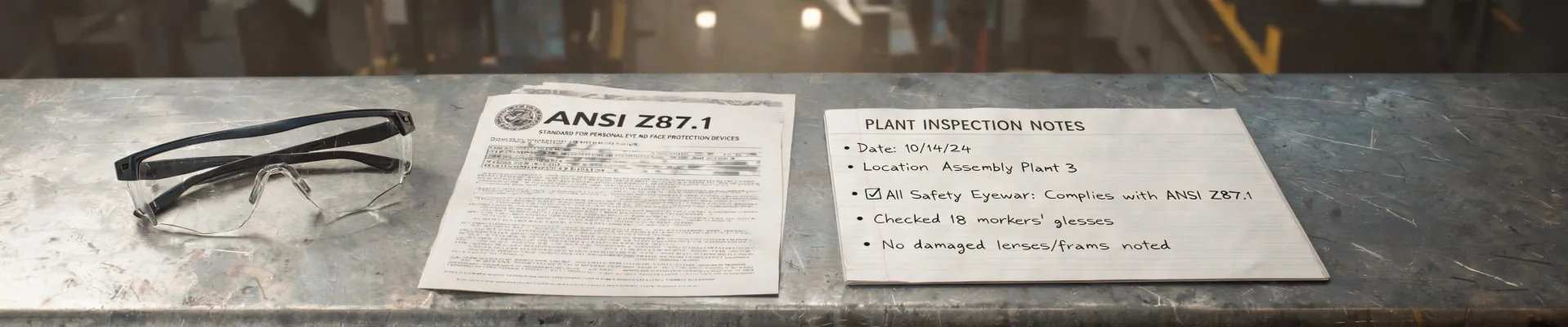
In March 2022, I placed an order for 600 pairs of safety glasses for a new construction site. I assumed any ANSI Z87.1 sticker was good enough. Total bill: $3,200. Three weeks later, our safety officer flagged them: not a single pair met the ballistic rating the client required. Every pair went back. $890 in return fees, a 2-week delay, and one very angry project manager.
That was my first year handling PPE procurement for a mid-sized industrial contractor. I've since placed orders for tactical gloves, hard hats, and prescription eyewear—and made plenty more mistakes. But that one taught me a lesson I still use today: choosing safety eyewear isn't just about the price tag or the basic rating.
What I Thought I Knew (and Why It Was Wrong)
When I first started buying eye protection, I assumed all ANSI Z87.1 glasses were interchangeable. A $5 pair from the hardware store? Same as a $20 pair from a safety supplier? Not even close.
Here's what I missed: ANSI Z87.1 is a baseline. It covers basic impact resistance—dropping a 1-inch steel ball from 50 inches. But ballistic threats are a different animal. The military uses MIL-PRF-31013, which tests against .22 caliber projectiles at 550 fps. A standard safety glass that passes Z87.1 might shatter under that.
The industry changed around me, and I didn't notice. Five years ago, most construction sites just wanted 'safety glasses.' Now, more contracts specify ballistic-rated or military-grade lenses, especially for high-risk environments like airports, chemical plants, and defense facilities.
The 'Fusion' Gap
I've recently started seeing more demand for Wiley X Fusion safety glasses—products that combine regular prescription correction with ballistic protection. When I first saw 'prescription safety glasses' offered by Wiley X, I assumed they were just regular safety lenses with a script. Wrong again. Their Fusion technology actually layers the prescription into the ballistic lens. You don't lose impact protection by going prescription. That's a huge advantage over cheap clip-on options.
The Hidden Costs That Bite You
Let me walk you through what happened with that $3,200 order—and why it wasn't just the return fees.
- Lost time: 2 weeks reordering, which pushed back the project schedule. Our client charged a $1,200 penalty for late completion.
- Reputation damage: The safety officer lost trust in our procurement. Every subsequent PPE order required extra approvals, slowing everything down.
- Hidden replacement costs: Even glasses that pass basic impact tests can fail in high-velocity scenarios. If an injury occurred, we'd be liable.
And this doesn't even touch on issues like polarization for outdoor work (reducing glare), anti-fog coatings for humid environments, or temple length adjustments for wearing under a hard hat. I've seen a team order a lift hard hat from another brand without checking compatibility with their eyewear—result: constant fogging and workers taking glasses off on site.
What I Now Do Differently
After that $3,200 disaster, I created a simple pre-purchase checklist. Here's the short version—because once you understand the problem, the solution is straightforward.
- Identify the threat level. Is it basic impact (ANSI Z87.1) or ballistic (MIL-PRF-31013)? If your job site involves tools, flying debris, or any projectile risk, go ballistic.
- Consider prescription needs. If your crew wears glasses, don't rely on over-glasses. Get a single integrated solution like Wiley X Fusion. The cost is higher upfront, but you avoid fogging, discomfort, and poor fit.
- Check environmental add-ons. Polarized lenses for outdoor, anti-scratch coating for abrasive dust, and a proper seal around the face if you're in chemical environments.
- Budget for the total cost. A $15 pair that lasts 3 months is more expensive than a $50 pair that lasts 2 years—especially when you factor in replacement labor.
I also make sure to cross-reference with other PPE. For example, if you're wearing a lift hard hat (like those from MSA or Fibre-Metal), the safety glasses need low-profile temples that don't interfere with the suspension system. And don't forget gloves—tactical grip gloves from Wiley X or similar brands help prevent dropping your glasses when adjusting them.
Quick aside on personal experience: I've tried wolverine work boots for myself on a recent job—they're good for general construction, but honestly, for targeted safety gear I stick with specialists. Similarly, I see people type 'brunt workwear discount code' into Google to save a few bucks on pants, but then spend 10x more on reordering cheap glasses. Prioritize your eye protection.
The Big Picture: Industry Evolution
What was best practice in 2020 is often insufficient in 2025. Standards update. New threats emerge. Today's Wiley X ballistic models aren't just heavier versions of old designs—they incorporate lightweight materials, adjustable vents, and interchangeable lenses. The fundamentals (impact protection) haven't changed, but the execution has transformed. If you're still buying based on a 2019 buying guide, you're likely overpaying for underperformance.
I've made my mistakes so you don't have to. The next time someone in your organization says, 'Just get the cheapest safety glasses that say ANSI,' send them this article. A $3,200 mistake is a cheap lesson—but a permanent injury is not.
Prices current as of January 2025; always verify rates and standards with your supplier.

Maeve Callahan
Maeve Callahan is a head-protection analyst covering Type I and Type II hard hats, climbing-style safety helmets, bump caps, chin straps, suspensions, liners, and face-shield carriers. She applies ANSI Z89.1, EN 397, and EN 12492 criteria while comparing impact attenuation, penetration resistance, lateral deformation, electrical class, retention strength, field of vision, mass, fit range, and temperature conditioning. Her guides help EHS teams, contractors, utilities, and buyers select helmet systems for overhead hazards, work at height, electrical exposure, accessory compatibility, and worker acceptance.