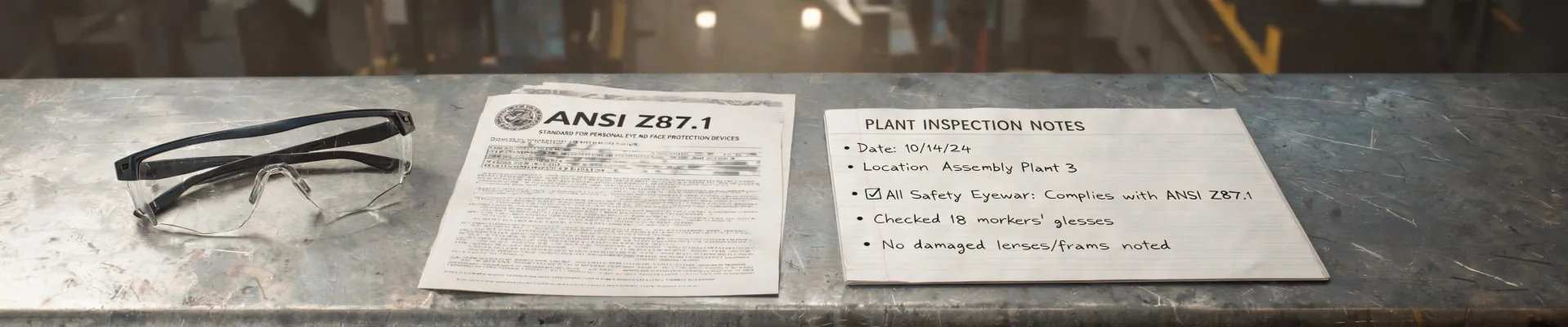
I believe the real cost of safety eyewear isn't the price tag—it's what happens when the 'budget' pair fails on the job.
I'm a quality and brand compliance manager at a mid-sized safety equipment distributor. I review every eyewear delivery before it reaches our customers—roughly 200+ unique models annually. I've rejected about 12% of first deliveries in 2024 due to poor lens clarity, substandard fit, or missing certification markings.
And I've learned something frustrating: the cheapest option nearly always costs more in the end.
Argument 1: Transparent specs vs. 'catch-all' claims
Here's what I run into constantly. A vendor pitches their 'budget' safety glasses at $3.50 a pair. The product page lists 'ANSI Z87.1 certified.' Sounds good, right? But when I dig into the fine print, there's no mention of impact rating. Basic ANSI Z87.1 is for low-impact hazards. The Z87+ high-velocity rating requires independent testing. You'd think a simple spec would be listed, but it often isn't.
The most transparent vendors don't hide behind 'competitive pricing'—they show you exactly how they build their product. Take lens thickness. A standard 'budget' polycarbonate lens might be 1.0mm thick. Wiley X Peak safety glasses, for example, use a lens that's significantly thicker—around 2.2mm, which is part of why they pass the stringent MIL-PRF-31013 standard for ballistic fragmentation. That's not a hidden upgrade. It's right there in the data sheet.
I've learned to ask 'what's NOT included' before 'what's the price.' The vendor who lists all specs upfront—even if the total looks higher—usually costs less in the end.
Argument 2: Consistency isn't guaranteed (until you check)
In our Q1 2024 quality audit, we received a batch of 500 pairs of 'discount' safety goggles. The frame color was visibly off from the previous order—Delta E of 5.2 against our reference sample. Industry standard tolerance is under Delta E 2 for brand-critical colors. (Reference: Pantone Color Matching System guidelines.) The vendor claimed it was 'still within spec.' We rejected the batch. They redid it at their cost, but we lost a week of fulfillment.
Now every contract includes lens clarity and frame tolerance requirements. And here's the thing: Wiley X doesn't have these issues because their manufacturing process is built around military contracts where consistency is non-negotiable. When you're supplying gear for a $18,000 project with 50,000-unit annual orders, you don't accept 'within industry standard' as a vague promise.
Argument 3: The hidden cost of 'cheap' is real—and it's not just financial
The upside of a $3.50 safety glass is obvious: $3.50. The risk? The pair fails a basic drop test, a worker gets a corneal abrasion, and suddenly you're looking at a workers' comp claim that dwarfs your savings. I calculated the worst case on a single incident: lost productivity, medical costs, and admin time—around $2,500. Best case you saved $5 on that worker's glasses. The expected value says don't gamble on that.
One of my biggest regrets: approving a bulk order of unbranded 'safety glasses' for a construction client because the price was 60% lower than anything else. They looked fine on the shelf. But after three weeks on site, the anti-scratch coating started peeling. The client was furious, and I spent months rebuilding that relationship. That wasn't a $200 mistake—it was a $22,000 redo when you factor in replacement shipping and lost trust.
Counterargument: 'But budgets are real. Not everyone can afford Wiley X.'
Granted, I get why people go with the cheapest option—budgets are real. And I'm not saying every budget pair is junk. There are decent options in the $10-15 range from reputable brands. But what I see is procurement teams choosing the absolute lowest bid without reading the specs. Then they're surprised when the glasses don't hold up.
To be fair, a construction crew doing light demolition doesn't need the same ballistic-rated glasses as military personnel. The right question isn't 'what's the cheapest?' It's 'what's the minimum spec I actually need, and who can deliver it transparently?'
Wiley X Peak safety glasses hit a sweet spot for me. They're not the cheapest (around $15-25 per pair depending on lens type and prescription). But every spec is published—impact rating, lens thickness, UV protection, optical clarity. There's no guessing. And when you run a 50,000-unit annual order, that predictability is worth the upfront difference.
So here's my bottom line: stop chasing the lowest unit price. Chase the lowest total cost of ownership. That means transparent specs, consistent quality, and a vendor who can prove both. I believe transparent pricing—showing you exactly what you're paying for—builds more trust than a hidden discount ever will. And in safety equipment, trust isn't optional.

Maeve Callahan
Maeve Callahan is a head-protection analyst covering Type I and Type II hard hats, climbing-style safety helmets, bump caps, chin straps, suspensions, liners, and face-shield carriers. She applies ANSI Z89.1, EN 397, and EN 12492 criteria while comparing impact attenuation, penetration resistance, lateral deformation, electrical class, retention strength, field of vision, mass, fit range, and temperature conditioning. Her guides help EHS teams, contractors, utilities, and buyers select helmet systems for overhead hazards, work at height, electrical exposure, accessory compatibility, and worker acceptance.