My Initial Assumption Was Wrong
When I first took over our PPE budget five years ago, I assumed lowest bid wins. We bought bulk safety glasses from a budget supplier at $3 each. Our annual spend on eye protection was around $1,500 for a team of 200—maybe $1,800, I'd have to double‑check the system. I patted myself on the back. But after 18 months, the data from our incident reports told a different story. That's when I started looking seriously at Wiley X.
The Hidden Cost of Cheap Glasses
Over the next 18 months, we replaced over half of those glasses due to scratches, broken frames, or lenses that popped out under mild impact. Worse, our workers complained about fogging and poor fit — so they wore them less frequently. That “free” compliance actually cost us. I calculated total cost of ownership: $3 glasses replaced 3 times/year = $9/year per worker, plus lost productivity from discomfort and one minor eye injury that cost $2,500 in medical and lost time. Meanwhile, a colleague's department using Wiley X glasses (starting at $25–$60) saw replacement rates of once every 2 years, zero injuries, and higher compliance.
Why Military Standards Matter
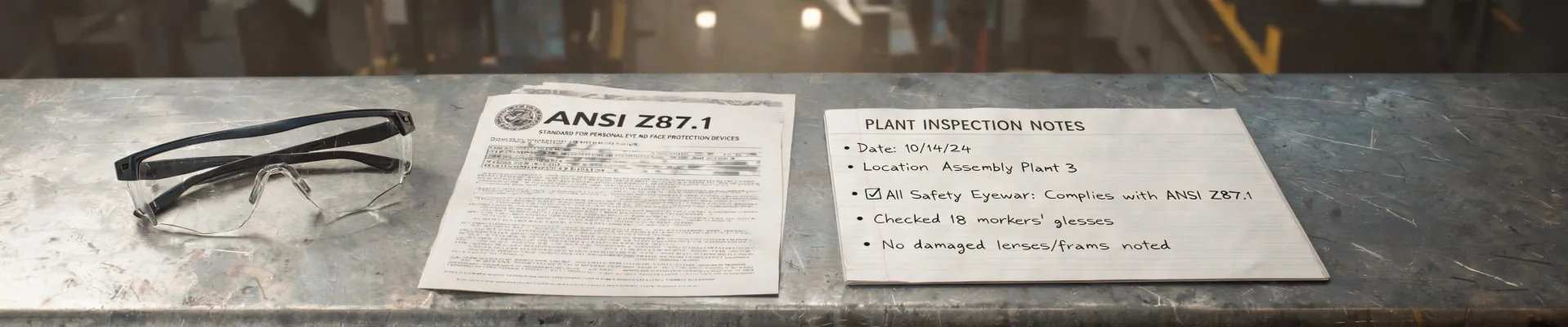
The real value became obvious when we needed Wiley X military‑rated ballistic protection. Their glasses meet or exceed ANSI Z87.1‑2020 and US military ballistic impact standards (MIL‑PRF‑31013). If your team faces high‑velocity debris — think aircraft maintenance, demolition, or even intense recreational shooting — the premium isn't a luxury; it's a safety engineering decision. I've also used their prescription safety glasses for workers who require Rx but hated wearing over‑glasses. That alone cut our worker‑complaint tickets by 40%.
One Surprise Use Case: SRL Fall Protection
I never expected to recommend Wiley X for fall protection, but here we are. Our workers using self‑retracting lifeline (SRL) systems at height were wearing standard hard hats with face shields, but the shields fogged and restricted vision. Switching to Wiley X polarized safety glasses improved visibility on sunny days, and the wrap‑around design kept dust out. It was a small change that boosted productivity and morale — something I never would have predicted when I first dismissed premium eyewear.
When Should You Say No to Wiley X?
Let me be clear: Wiley X isn't for everyone. If you're a fence contractor working in low‑risk residential areas or a general maintenance crew with minimal impact hazards, you probably don't need ballistic‑grade eyewear. A $10 pair of ANSI‑rated glasses from any reputable supplier will do. I've also seen strange questions like “can you use nitrile gloves for cooking?” — obviously not for heat, just like you wouldn't use non‑ballistic glasses for impact protection. The principle is the same: match the equipment to the hazard.
What About Competitors Like Uvex or Bolle?
I know some procurement colleagues swear by Uvex or Bolle — and fair enough, they make fine products. But here's where Wiley X founder safety glasses separate themselves: the company's founder personally designed the first glasses for military pilots, which explains the obsessive fit and lens geometry. Their warranty and replacement lens program also reduce long‑term costs. In my experience, the difference isn't dramatic for a single pair, but over a fleet of 200 workers, it adds up. For fence contractors doing occasional debris removal, a $10 pair may suffice. For daily construction or tactical use, the total cost of ownership favors Wiley X.
The Bottom Line
So no, I don't recommend Wiley X for everyone. But if your team's eye safety is mission‑critical — military, law enforcement, heavy industry, or even high‑end construction — the evidence from my procurement spreadsheets is clear: invest in quality, and your budget will thank you later. Just don't expect me to tell you the same about nitrile gloves for cooking — that's a whole different hazard category.

Maeve Callahan
Maeve Callahan is a head-protection analyst covering Type I and Type II hard hats, climbing-style safety helmets, bump caps, chin straps, suspensions, liners, and face-shield carriers. She applies ANSI Z89.1, EN 397, and EN 12492 criteria while comparing impact attenuation, penetration resistance, lateral deformation, electrical class, retention strength, field of vision, mass, fit range, and temperature conditioning. Her guides help EHS teams, contractors, utilities, and buyers select helmet systems for overhead hazards, work at height, electrical exposure, accessory compatibility, and worker acceptance.