-
The Assumption That Cost Us $3,200
-
The Transparency Trap: Low Price, Hidden Costs
-
Why 'Military Discount' Isn't Always a Bargain
-
The 'Are Loop Earplugs Worth It' Diversion
-
Why I'm Skeptical About Fence-Related PPE Assumptions
-
The Ariat Work Boots Parallel
-
How I Build a Reliable Pre-Order Checklist
-
Responding to the Obvious Objection
-
The Bottom Line: Transparency Builds Trust
The Assumption That Cost Us $3,200
In my first year sourcing PPE for a mid-sized industrial contractor, I submitted an order for 47 pairs of prescription safety glasses. The price looked right—competitive, even. I assumed all ANSI-rated lenses from the same brand would perform identically. I didn't verify. I didn't ask the right questions.
The result? A stack of frames that didn't meet OSHA compliance for our specific site. $3,200. Straight to rework. That's when I learned: not all prescription Wiley X safety glasses are ordered the same way.
Costly. Here's why.
Let me rewind. I'm a safety equipment procurement coordinator handling B2B orders for construction and industrial clients. I've been in this role for 6 years. I've personally made—and documented—14 significant ordering mistakes, totaling roughly $18,000 in wasted budget. Now I maintain our team's pre-order checklist to prevent others from repeating my errors. This is the checklist you need if you're buying prescription safety glasses for a crew.
The Transparency Trap: Low Price, Hidden Costs
Here's the core issue: In my experience, the vendor who quotes a suspiciously low price for prescription safety glasses almost always adds fees later. Frame customization. Lens tint. Anti-fog coating. Shipping. It's death by a thousand small charges.
I have mixed feelings about this. On one hand, I understand that bespoke orders involve variable costs. On the other, I've learned that the vendor who lists all fees upfront—even if the total looks higher—usually costs less in the end.
For example, in Q3 2023, we compared quotes for a 30-person order of prescription Wiley X safety glasses. Two vendors looked competitive at first glance ($145 and $152 per pair). The third came in at $178. But the first two added $18–$25 per pair for anti-fog and scratch-resistant coating. The third included it. Their total: $178 flat. No surprises.
The lesson? I've learned to ask 'what's NOT included' before 'what's the price.' Every time.
Why 'Military Discount' Isn't Always a Bargain
A search for Wiley X military discount brings up plenty of offers. And yes, the brand does offer a verified military discount program through authorized channels. But here's the catch: applying a military discount to a standard frame doesn't automatically mean you're getting a tactical-grade product with the right lens configuration for your environment.
In June 2024, I approved an order for 22 pairs of ballistic-rated frames with a military discount applied. The frames were genuine. The discount was real. But the prescription inserts weren't compatible with our new thermal lens line. $1,200 worth of inserts had to be replaced.
We assumed compatibility because the frames were the same series. Assumed. Didn't verify. Costly mistake.
The 'Are Loop Earplugs Worth It' Diversion
I know the title mentions are Loop earplugs worth it, and yes, that's a separate product category. But I've seen safety managers ask this exact question when comparing hearing protection alternatives to traditional foam plugs. The short answer from my experience: Loop earplugs offer decent noise reduction for intermittent use and are comfortable for all-day wear. But they aren't a replacement for certified hearing protection in high-noise industrial environments. Use them for low-level noise or focus, not for sustained 85+ dB zones. Worth it? For specific scenarios, yes. For general PPE inventory? Not really.
Why I'm Skeptical About Fence-Related PPE Assumptions
I'll be honest: when someone searches 'wood fence installation PPE,' they usually aren't thinking about prescription safety glasses. But if you're running a fence crew, your team needs impact-rated eyewear, especially when using nail guns, saws, or post drivers. I've seen fence crews use cheap hardware-store goggles. I've also seen the results: one guy lost partial vision from a ricocheted staple.
If your crew needs prescription lenses, standard over-glasses won't cut it. You need prescription-rated safety glasses that fit properly. I'd argue that ordering a bulk set of prescription Wiley X safety glasses for your fence team is a smarter move than buying cheap goggles three times a year.
The Ariat Work Boots Parallel
I'm not an expert on Ariat work boots, but I've seen the same assumption pattern in footwear procurement. 'All steel-toe boots offer the same protection.' Not true. Some have electrical hazard ratings. Some don't. Some are waterproof. Some aren't. The same logic applies to safety eyewear. Frame material, lens curve, and coating all matter. Don't assume product names tell the full story.
How I Build a Reliable Pre-Order Checklist
After the third rejection in Q1 2024, I created a pre-order checklist. It's saved us from at least 12 potential errors in the past 18 months. Here's the core structure:
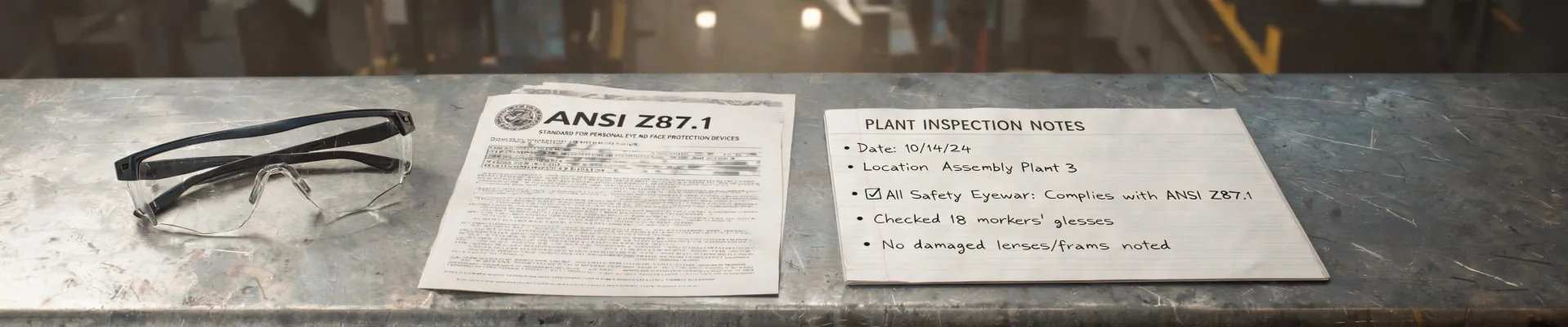
- Verify certification for each frame-lens combination: ANSI Z87.1 is the baseline, but certain industries (military, oil & gas) require ballistic-rated compliance. Confirm the exact model meets your site's requirements.
- Confirm prescription compatibility: Not all frames accept all lens configurations. Check the manufacturer's specifications before ordering.
- Ask for a full line-item quote: Every coating, every option, every fee. Ask for it in writing. Compare totals, not unit prices.
- Request a sample: For large orders (20+ pairs), ask the vendor to send a single pair for verification. A $50 sample cost has saved us thousands in mismatched specifications.
- Understand the return policy: Prescription eyewear is often non-returnable. Know this before you order. If the vendor offers a limited return window for defective products, that's a green flag.
Responding to the Obvious Objection
Someone will say, 'But a sample takes time. My crew needs glasses now.' I hear you. I've been there. But I'd argue that spending 5 extra days verifying a sample is faster than spending 3 weeks replacing an incorrect batch. In my experience, the frustration of a delayed order is temporary. The cost of a wrong order is permanent.
Another objection: 'Our vendor has always been reliable. Why start checking now?' Because every vendor can make a mistake. In November 2023, a long-time supplier sent us 15 pairs with the wrong lens base curve. They fixed it, but we lost two weeks. We've learned—never assume the proof represents the final product.
The Bottom Line: Transparency Builds Trust
If you want to avoid the mistakes I've made, demand transparency from your vendor before you commit. The vendor who hides fees until after you sign is a risk. The vendor who lists every cost upfront—even if the number looks higher—is the one you can trust.
In my opinion, the best way to buy prescription Wiley X safety glasses for your crew is to ask for a transparent quote that includes all options, request a sample, and verify compliance yourself. It's not the fastest path, but it's the cheapest in the long run.
I'm not saying every cheap quote is a trap. But I am saying every cheap quote deserves a second look. Personally, I've stopped assuming 'same brand' means 'same spec.' And I've started building checklists for every order.
Costly. But effective.

Maeve Callahan
Maeve Callahan is a head-protection analyst covering Type I and Type II hard hats, climbing-style safety helmets, bump caps, chin straps, suspensions, liners, and face-shield carriers. She applies ANSI Z89.1, EN 397, and EN 12492 criteria while comparing impact attenuation, penetration resistance, lateral deformation, electrical class, retention strength, field of vision, mass, fit range, and temperature conditioning. Her guides help EHS teams, contractors, utilities, and buyers select helmet systems for overhead hazards, work at height, electrical exposure, accessory compatibility, and worker acceptance.