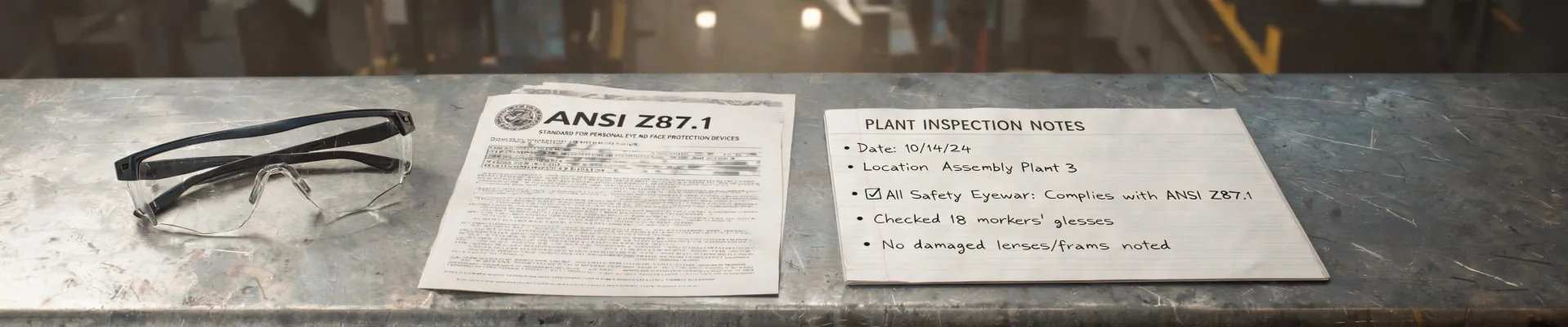
Three years ago, I thought I had safety glasses figured out. A pair of $12 generic ANSI-rated goggles, a stack of disposable visitors' specs, and one “tactical” pair from an outdoor gear brand that looked tough. I was the guy who bought 200 pairs for the shop floor and called it done. Then I made a mistake that cost $890 in medical bills, a week of lost productivity, and a serious dent in my credibility with the operations team.
That mistake: assuming all safety glasses are the same, and that the only difference was price.
The Surface Problem: “They’re Just Glasses, Right?”
Ask most procurement folks what they look for when buying safety eyewear and you’ll hear: price, fit, and whether it says “ANSI Z87.1” on the lens. Maybe color options. That’s it. I was exactly like that — until the day an operator’s “safety glasses” shattered on impact during a routine grinding task. A fragment hit his eye. Not a major injury, but he was out for four days. The root cause? The lens met the bare minimum impact requirement, but the frame wasn’t rated for high-mass or high-velocity impact scenarios. The glasses were “certified” for general use — not for the actual hazard on that line.
That’s when I started asking harder questions. What does “ANSI Z87.1” actually cover? And why do some glasses cost three times more than others if they all pass the same test?
The Deeper Cause: Certification Tiers Nobody Talks About
Here’s the thing most buyers don’t know: ANSI Z87.1 has multiple performance categories. Basic impact (Z87+) protects against a 1-inch steel ball dropped from 50 inches — about 0.2 joules. High impact (Z87+) adds a 3.1-gram steel ball shot at over 100 feet per second — around 0.6 joules. And ballistic impact, like MIL-PRF-31013, requires resisting a 0.22-caliber projectile at nearly 1000 feet per second. That’s orders of magnitude difference.
People assume “ANSI certified” means “good enough for everything.” Actually, the standard is the minimum floor. The certification tells you it passed a test, but not which test. And many generic “safety glasses” only meet the basic impact level. They don’t fail — but they don’t protect when you really need them.
The assumption is that cheaper glasses deliver comparable protection. The reality is that manufacturers cut corners on lens thickness, frame retention, and coating durability to hit a low price point. The glasses pass the test, but just barely. Real-world work scenarios — heavy debris, pressure washing, chemical splashes from multiple angles — aren’t covered by the standard’s narrow testing parameters.
I’m not 100% sure, but I believe the gap between “basic” and “military-grade” protection is about 5× the impact energy tolerance. Probably more.
The Real Cost of Cheap Safety Glasses
Let’s talk numbers. Before the incident, I was buying generic safety glasses at $5–8 per pair in bulk. After switching to Wiley X tactical sunglasses with ballistic-rated lenses, the per-unit cost jumped to around $50. That looks stupid on a spreadsheet. But here’s what I found when I calculated total cost of ownership over 24 months:
- Replacements: Cheap glasses scratched in two weeks. Operators tossed them and grabbed another pair. Our monthly spend hit $150 for a crew of 40. Wiley X lenses lasted 6–8 months with proper care. Replacement cost per year: ~$100 per person vs. ~$30. The cheap option appears cheaper.
- Wasted time: Operators spent 10 minutes every three weeks searching for replacements or adjusting loose frames. At 40 people, that’s 400 hours lost per year. Even at $20/hour, that’s $8,000 gone.
- Medical incident: The four-day absence and follow-up visits cost $890 out-of-pocket (deductible) plus 120 hours of lost productivity ($2,400). Total: ~$3,300 from one event.
- Compliance gap: We almost failed a safety audit because some glasses didn’t have proper marking. Fines could have been $10k+.
When I added it up, the “cheap” option cost us roughly $15,000 year over year. The premium option? About $8,000. Half the total cost.
The Mindshift: From Unit Price to TCO
I used to think: why pay $80 for a pair of Wiley X military glasses when I can get six pairs of basic goggles for the same money? The mistake was comparing unit price without context. After the incident, I started tracking: frequency of replacement, downtime from poor fit, number of near-miss complaints, and the cost of one real injury. That’s when the numbers flipped.
Seeing our cheap glasses vs. premium glasses side by side over 12 months made me realize: the premium option was actually cheaper. The expensive glasses paid for themselves in reduced replacement frequency alone. And they provided an extra safety margin that basic glasses couldn’t.
I now calculate TCO before any safety gear purchase. That includes: unit cost, expected lifespan, replacement rate, training time (if any), risk of injury, and audit risk. The formula isn’t complicated — it just requires tracking actual data instead of price tags.
A Practical Approach: What to Look For
Here’s my current checklist when evaluating safety eyewear — born from my mistakes:
- Know your hazards. Grinding? Impact risk? Chemical splash? UV exposure? Select a certification level that matches the actual risk, not the minimum legal requirement.
- Look for ballistic ratings. For industrial or tactical environments that involve high-velocity debris (military, law enforcement, construction, metalworking), ANSI Z87+ isn’t enough. Seek MIL-PRF-31013 or similar. Wiley X explicitly lists their ballistic rating for most models.
- Check the frame. Polycarbonate lenses are standard, but the frame’s retentive strength matters. A lens can pass impact testing alone — but mounted in a weak frame, it can eject on side impact. Look for one-piece wraparound designs or robust thermal polymer frames.
- Prescription compatibility. If any operator needs RX, buying non-prescription glasses and hoping they wear contacts is a recipe for failure. Prescription safety glasses from Wiley X or similar are built with the same impact standards as the non-RX versions. That’s a TCO win — one pair that works, instead of two.
- Replaceability of parts. Can you buy replacement lenses instead of a whole new pair? That dropped my annual cost by 60%.
Is the premium option worth it? In my experience — yes. But it depends on context. For a retail clerk facing occasional splash risk, basic glasses are fine. For a welder, a mechanic, or a tactical operator, the extra cost is cheap insurance. The mistake is applying one standard everywhere without asking “what’s the worst that could happen?”
The Bottom Line
I still make mistakes. Last month I ordered Merrell tactical boots for a crew and overlooked the fact that half needed steel toe — my fault. But when it comes to safety glasses, I don’t gamble anymore. The $5 glasses that look like a deal? They cost me $15,000. The $80 Wiley X ballistic glasses that I initially rejected as expensive? They saved about $7,000 per year and gave me peace of mind. That’s TCO thinking. Simple.
If you’re shopping for safety eyewear, don’t just ask “what are safety glasses?” Ask: safety from what? At what total cost? The answer changes everything.

Maeve Callahan
Maeve Callahan is a head-protection analyst covering Type I and Type II hard hats, climbing-style safety helmets, bump caps, chin straps, suspensions, liners, and face-shield carriers. She applies ANSI Z89.1, EN 397, and EN 12492 criteria while comparing impact attenuation, penetration resistance, lateral deformation, electrical class, retention strength, field of vision, mass, fit range, and temperature conditioning. Her guides help EHS teams, contractors, utilities, and buyers select helmet systems for overhead hazards, work at height, electrical exposure, accessory compatibility, and worker acceptance.