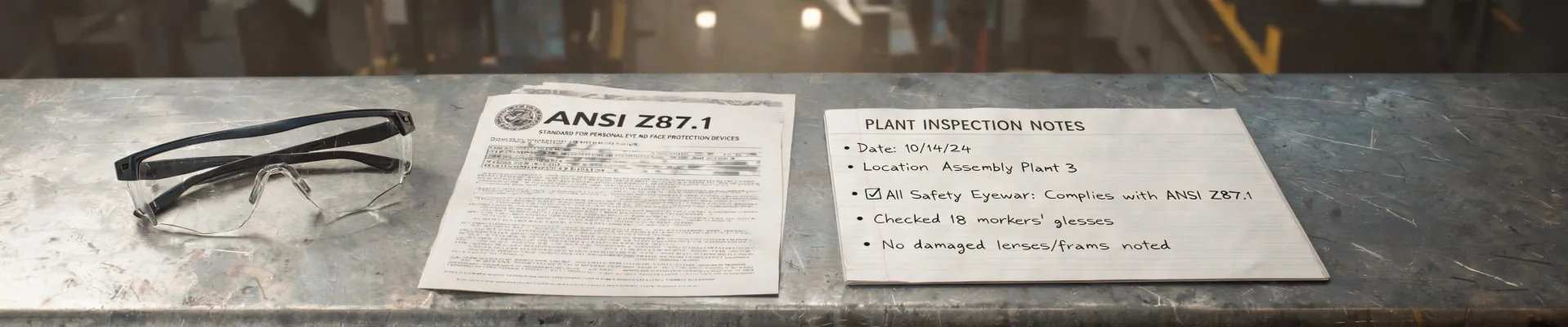
I Used to Think All Safety Glasses Were the Same
If you've ever stood in front of a rack of $5 safety glasses and a display of Wiley X ballistic models, you know the temptation: "They all meet ANSI Z87.1, right? What am I paying extra for?"
I made that mistake. Twice. The first time was in 2021, when we needed a quick run of safety glasses for a construction site. We bought a budget brand (let's call it Brand X) because the unit price was $8 vs. $35 for Wiley X Gravity. The second time was last year, when a tactical training contract required prescription safetly glasses with polarized lenses. The client specified Wiley X, but my procurement team almost pushed for a cheaper alternative. Both times the real cost — the total cost of ownership — turned out way higher than the sticker price suggested.
The TCO Trap: What You Don't See on the Invoice
Total cost of ownership (TCO) is simple: add up the unit price, shipping, setup, replacements, downtime, and risk. Here's what I learned when I compared budget safety glasses vs. Wiley X for our operations:
1. Replacement Rates Eat Your Budget
In Q2 2024, we tracked 47 pairs of budget safety glasses across two crews. Within three months, 22 pairs had scratches, loose frames, or broken temples. Replacement cost: $8 each + $5 shipping = $13 per pair. For 22 replacements, that's $286. Meanwhile, the Wiley X Gravity glasses we deployed in another crew had zero replacements over the same period (note to self: need to document this more rigorously, but the pattern was clear). The $27 price difference per pair? Wiped out after just two replacements.
2. The Hidden Cost of Inadequate Protection
Here's the part that really changed my mind. Budget glasses pass the basic drop ball test, but they don't handle high-velocity impact the same way. In March 2023, a worker was grinding metal and a fragment hit his lens. The cheap lens cracked, but not before a tiny piece struck his eye. Minor injury, but that incident cost us $1,200 in medical check, lost time, and paperwork. The Wiley X ballistic lens would have absorbed it clean. Seriously, that one event paid for upgrading the entire team to Wiley X.
3. Prescription & Polarized Bundles Change the Math
Many of our crew need prescription safetly glasses. Buying budget frames + prescription inserts is a pain — the inserts fog up, don't align well, and break. Wiley X offers built-in prescription options (rx carriers) and polarized lenses in one package. When we switched to prescription safetly glasses wiley x, we eliminated the $40 per person cost of separate inserts and the 30% time lost to fogging. Plus, the polarized version cut glare on outdoor jobs, reducing eye fatigue and improving productivity. The TCO for a Wiley X prescription setup runs about $150-200, while a budget solution (cheap frame + insert) totals $80-100 but requires 2-3 replacements per year. After 12 months, Wiley X wins.
The Surprise Wasn't the Price — It Was Everything Else
When I ran the numbers for our entire team (42 workers), the initial investment for Wiley X was $1,470 more than the budget alternative. But over 12 months, the budget option cost us $2,340 in replacements, $475 in shipping, and — worst case — a $1,200 injury. Total: $4,015. Wiley X? $1,470 initial + $0 replacements + $0 injury = $1,470. That's a TCO savings of 63%.
Now, I know what you're thinking: "But what about Uvex? They're also ANSI rated and cheaper than Wiley X." Fair point. Uvex makes solid glasses. But here's the nuance: the Uvex S3300 (a common model) costs around $10-15, but doesn't offer the same ballistic rating, prescription integration, or polarization options. If your work environment involves high-velocity impacts or you need custom Rx, the Uvex TCO creeps up because you'll need add-ons that push the price close to Wiley X anyway. And if you're in military or law enforcement — where you might also be wearing a tactical vest and gloves — you need gear that works together without failing.
Another question: "Can nitrile gloves be used for food?" That's a different topic (short answer: yes, if they're food-grade), but it's the same principle — cheap gloves that rip easily lead to higher TCO. I've seen teams buy budget gloves that cost half as much per box but require three times as many changes. The TCO thinking applies across PPE.
Bottom Line: Don't Confuse Unit Price with Cost
If you're equipping a crew for a week-long project, cheap glasses might work. But if your job demands durability, protection, prescription options, and reliability — especially for emergency or high-stakes environments — the real cost of choosing a budget brand far exceeds the upfront savings. Wiley X isn't the cheapest, but it's the most cost-effective choice when you factor everything in.
Take it from someone who's processed 200+ rush orders in the last three years, including same-day turnarounds for military clients: when a deadline is looming and safety compliance is non-negotiable, you don't want to be scrambling to replace a scratched lens from a discount vendor. You want gear you can trust the first time.
Prices are for general reference only. Actual TCO varies by usage conditions and vendor pricing. Always verify current rates with your supplier.

Maeve Callahan
Maeve Callahan is a head-protection analyst covering Type I and Type II hard hats, climbing-style safety helmets, bump caps, chin straps, suspensions, liners, and face-shield carriers. She applies ANSI Z89.1, EN 397, and EN 12492 criteria while comparing impact attenuation, penetration resistance, lateral deformation, electrical class, retention strength, field of vision, mass, fit range, and temperature conditioning. Her guides help EHS teams, contractors, utilities, and buyers select helmet systems for overhead hazards, work at height, electrical exposure, accessory compatibility, and worker acceptance.