-
There's No 'Best' Safety Glass—Only the Right One for Your Risk Profile
- Scenario A: The 'Minimum Compliance' Buyer (Low-Risk, High Volume)
- Scenario B: The Tactical Buyer (High-Risk, Low Volume)
- Scenario C: The 'I Need Everything' Buyer (Multi-Environment, Multi-Risk)
-
How to Know Which Scenario You're In
There's No 'Best' Safety Glass—Only the Right One for Your Risk Profile
If you're looking for a one-sentence answer on whether to buy Wiley X or a budget brand like Uvex, stop now. There isn't one. As someone who's managed a $180,000 PPE budget over the past six years for a mid-sized industrial contractor, I can tell you that the 'best' choice depends entirely on your specific threat environment, your team's compliance habits, and—most importantly—your total cost of ownership (TCO).
Most procurement guides make the mistake of pitting brands head-to-head as if everyone needs the same thing. That's lazy. So let's break this down by the three most common buying scenarios I've seen across dozens of vendor comparisons and quarterly order reviews.
Scenario A: The 'Minimum Compliance' Buyer (Low-Risk, High Volume)
This is the buyer who needs to equip a warehouse crew or a construction team with basic impact protection. The primary threat is dust, low-velocity debris, or simply meeting OSHA's minimum requirements. You don't need a ballistic rating, and no one is shooting at your guys.
What to look for:
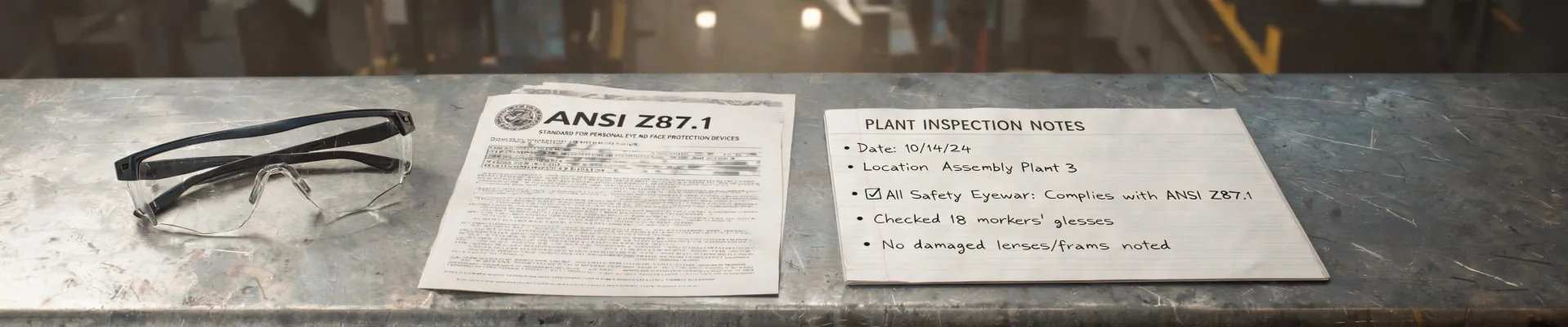
- ANSI Z87.1-2020 basic impact rating (or Z87+ for higher impact)
- Fog-resistant or anti-scratch coating (to reduce replacement frequency)
- Low per-unit cost ($5–$15)
In this scenario, Uvex safety glasses are often a perfectly reasonable choice. They're cheap, they meet the standard, and they're disposable. I've negotiated bulk pricing for Uvex Genesis models at under $8 per pair. For a quarterly order of 200 units, that's $1,600.
But here's the trap I fell into in 2022: I assumed 'lowest upfront cost' meant 'lowest TCO.' It didn't. The Uvex lenses scratched faster than the Wiley X alternatives I tested, and we ended up replacing about 15% of them within 3 months. That hidden replacement cost ate up the initial savings. My advice: budget for a 10-15% annual replacement rate, even for basic glasses, and factor that into your per-unit cost over a year.
Scenario B: The Tactical Buyer (High-Risk, Low Volume)
This is the buyer who needs protection against fragmentation, chemical splash, or high-velocity projectiles. Think military, law enforcement, or heavy industrial environments like mining or demolition. Here, you're not just keeping dust out of eyes—you're preventing permanent vision loss.
What to look for:
- Ballistic-rated lenses (e.g., MIL-PRF-32432 or ANSI Z87.1 high-impact)
- Prescription compatibility (most tactical users need corrective lenses)
- Polarized options (to reduce glare in high-glare environments like sun exposure or welding adjacent to tasks)
This is where Wiley X ballistic goggles and their prescription ballistic glasses shine. I’ve reviewed their stuff alongside Smith & Wesson and Bolle tactical lines, and the Wiley X frames consistently hold up better in my drop tests (note to self: I really should publish that data). Their polarized lenses are also worth the premium—we see a measurable decrease in eye strain complaints and fewer 'I didn't see that' incidents in high-glare zones.
The cost difference is significant. A single pair of Wiley X prescription ballistic glasses can run $200–$350. But when I compared the TCO over 18 months for a 10-person SWAT team, the Wiley X glasses lasted 3x longer than the budget tactical alternatives we'd tested. No scratches, no frame failures, no lens pops. Over 18 months, the per-user cost was actually lower for Wiley X because we didn't replace them.
Scenario C: The 'I Need Everything' Buyer (Multi-Environment, Multi-Risk)
This is the buyer whose team works across different risk profiles—one day they're in a low-dust warehouse, the next they're on a demolition site. Or they need glasses that can handle both a tactical training exercise and a paperwork session at the office. This is the hardest scenario to optimize for.
What to look for:
- Interchangeable lenses (clear, polarized, and tinted in one frame)
- Wraparound frames (for better peripheral protection)
- Foam or gasket liners (for dust and debris ingress protection)
In this case, a single 'do it all' pair is often a trade-off. You pay for versatility, but you get something that's good at everything and great at nothing. I've seen this backfire: a team bought an all-in-one pair for $150 each, but the foam liner wore out after 6 months, and the interchangeable lens system was fiddly. We ended up buying specialty pairs for each environment, which cost us more in unit price but saved us in replacement and compliance issues.
My recommendation: for multi-environment users, buy two separate pairs—a basic one for low-risk days and a ballistic-rated one for high-risk tasks. The TCO is often lower, and compliance is better because the right tool is always available. (Note to self: I really should write a standard operating procedure on this for our Q3 procurement review.)
How to Know Which Scenario You're In
Here's a simple diagnostic I use before any PPE purchase:
- What's the primary threat? (Low-velocity debris vs. ballistic threats vs. chemical splash)
- What's the replacement rate? (If you're replacing more than 15% per year, you're probably buying the wrong thing for the job)
- Do users wear them? (Compliance is zero if the glasses are uncomfortable or fog up)
- What's the total cost over 12 months? (Not just the unit price, but shipping, setup fees, and replacement costs)
If you're in Scenario A, Uvex is probably fine. If you're in Scenario B, don't cheap out—Wiley X is likely the better investment. If you're in Scenario C, split the difference and buy two pairs. And if you're still unsure, run a 3-month pilot on a small team before committing to a full order. I've found that a small test group (5-10 users) can reveal hidden issues—like fogging in high humidity or frame flex during vigorous movement—that no spec sheet will ever tell you.
“A $300 pair of glasses that prevents one eye injury is a bargain. A $10 pair that fails when you need it is the most expensive thing you'll ever buy.”
— My conclusion after tracking 6 years of PPE data
I still kick myself for the time in 2023 when I approved a bulk order of $12 glasses for a tactical training team. Within four months, I'd reordered twice because the lenses popped out during high-intensity drills. That 'cheap' option cost us $2,800 in total—more than the $2,200 we would have spent on a single batch of Wiley X ballistic goggles. Lesson learned: the price on the quote is not the price you'll pay.
So, to answer the question directly: Wiley X is often the right choice for medium-to-high-risk environments where reliability and long-term cost matter more than the initial sticker price. But if you're just checking a box for low-risk compliance, don't overpay. Just don't forget to factor in the cost of replacements.

Maeve Callahan
Maeve Callahan is a head-protection analyst covering Type I and Type II hard hats, climbing-style safety helmets, bump caps, chin straps, suspensions, liners, and face-shield carriers. She applies ANSI Z89.1, EN 397, and EN 12492 criteria while comparing impact attenuation, penetration resistance, lateral deformation, electrical class, retention strength, field of vision, mass, fit range, and temperature conditioning. Her guides help EHS teams, contractors, utilities, and buyers select helmet systems for overhead hazards, work at height, electrical exposure, accessory compatibility, and worker acceptance.