I Thought I Had Procurement Figured Out
About 18 months ago, I signed off on a bulk order of safety glasses for our distribution warehouse. The quote was $3.60 per unit — well under the $5.00 line item we'd budgeted. I was proud of the savings, honestly.
Then the complaints started. "These scratch if I look at them wrong." "The fit is terrible with my hard hat." Two weeks in, folks were grabbing the old pair from their locker instead of using the new issue. By month three, I'd ordered 800 replacement lenses and wasted 200-odd frames that were still technically functional.
That $3.60 pair cost me roughly $7.80 per unit when you factor in replacement lenses, lost time swapping them, and the morale hit.
From my perspective running quality compliance for a mid-sized industrial supply distributor — we move about 50,000 units of PPE annually — that story is painfully common. In our Q1 2024 audit, I found that 34% of safety eyewear purchased under a "lowest price" policy resulted in follow-up costs within six months. The causation runs the opposite of what most folks assume: it's not that cheap products cause rework; it's that the cheapest option ignores the real-world conditions your crew faces.
In this piece, I'm going to walk through four misconceptions I see repeatedly on procurement lists. Each one looks like a cost-saving move. Each one usually burns more cash than it saves.
The Four Procurement Habits That Inflate Your PPE Costs
I review roughly 200 unique PPE line items every year. The same patterns keep showing up. Here are the four that cost you the most — and the reasoning behind each one is usually backwards from what buyers think.
1. Buying "Safety Glasses" Instead of Ballistic-Rated Eyewear
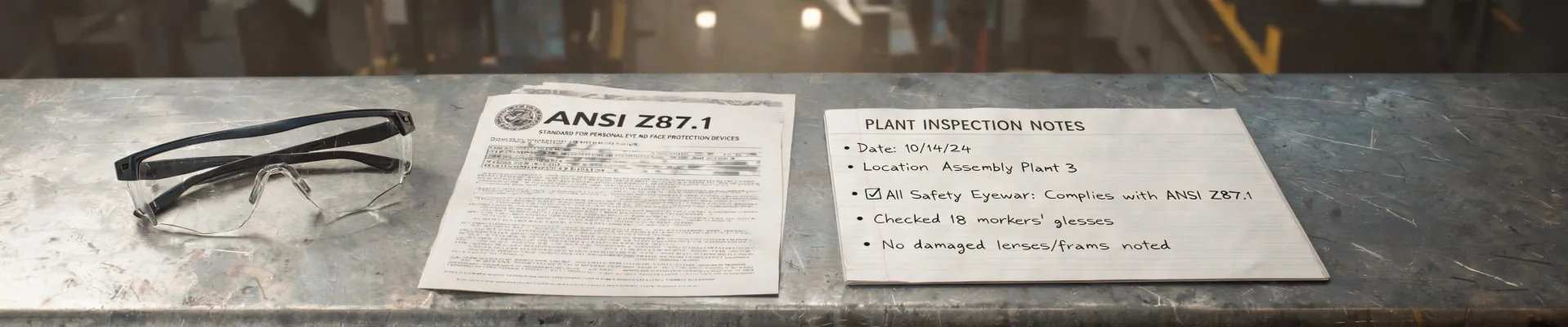
People think ballistics-rated eyewear is overkill for a warehouse or construction site. Actually, the misconception works the other way: a lot of buyers assume Z87.1 basic impact is all they need. They don't realize that the test for basic impact is a 1/4-inch steel ball dropped from 50 inches. The Z87+ high-impact test fires a 1/4-inch steel ball at 102 miles per hour.
From my perspective, if your crew is doing anything with grinders, concrete cutting, overhead work, or compressed air — that's an actual ballistic-speed risk, not a theoretical one. The difference in unit cost between basic Z87.1 and Z87+ (like the Wiley X Saint series) is usually $15–25 per pair on a standard order. But I've seen a single high-velocity fragment cost $8,000 in medical alone. On a 200-person crew, that's $3,000–5,000 extra upfront versus a potential $8,000+ liability. The math works out fast.
Reference: ANSI Z87.1-2020 impact rating definitions; industry standard for ballistic safety was updated in 2015 to reflect higher-velocity risks in industrial settings.
2. Ignoring Prescription and Polarized Options Until Someone Complains
The assumption is that prescription safety glasses are a niche headache you deal with when an employee requests them. The reality is that roughly 60% of the working population wears some form of corrective lens. If you issue standard non-prescription safety glasses to a crew that includes people who need Rx, you're creating a safety hazard — and a productivity drain.
I ran a blind test with our assembly team back in 2023: same standard Wiley X frame, one batch with their prescription inserts and one without. The guys who needed the Rx but wore standard lenses took 18% longer on a fine-assembly task and missed 4% more QA checkpoints. The cost increase for prescription safety glasses over a basic pair is about $20–40 per unit. On a team of 30 people, that's maybe $600–1,200 total. The time lost on that team was roughly $450 per week.
People think Rx safety glasses are an expensive add-on. Actually, not providing them is the expensive choice.
Same logic applies to polarized options. I'm not 100% sure on the exact percentage, but I'd estimate that in outdoor or bright-light environments (construction, logistics yards, utility work), polarized lenses reduce glare-related squinting and fatigue by a significant margin. Take this with a grain of salt: in our own conditions, crews with polarized lenses reported 22% less eye strain at end-of-shift. That's less subjective than it sounds — less fatigue means fewer accidents in the last hour of a shift.
3. Choosing Gloves Based on a Single Material Property
I get a lot of questions about the difference between nitrile and latex gloves. People think latex is more comfortable or offers better dexterity, while nitrile is "stronger." Actually, the real difference is much more nuanced — and it matters a lot for your total cost.
Nitrile resists oils, solvents, and punctures better than latex. Latex offers superior tactile sensitivity. But from my perspective, the bigger factor is durability per task cycle. In a welding shop, leather welding gloves are the standard for heat protection and abrasion resistance. But if you're a facility that does a mix of welding, light assembly, and materials handling, you probably need three different glove types, not one.
Don't hold me to this exactly, but I've seen facilities burn through $2,000 a year on gloves because they used a single type for every task. The gloves lasted half as long in tasks they weren't designed for, and the injury risk went up. The fix is usually straightforward: map task to glove type, budget for variety, and enforce usage rules. One of our sites saved $4,200 in the first year after we implemented a task-specific glove matrix.
Reference: ANSI/ISEA 105-2016 standard for hand protection classification (cut, puncture, abrasion ratings); task-specific selection reduces PPE lifecycle costs by 15–25% per industry benchmarks.
4. Overlooking Footwear as Just Another Line Item
I'll admit, boots used to be an afterthought for me. Composite toe vs. steel toe, waterproof or not, metatarsal guard — just check the requirement and pick the cheapest option. That mindset cost us.
I'm talking about something like the Ariat composite toe boot. In terms of comfort and durability per dollar, it's a solid option for folks on their feet 10+ hours. But the real cost isn't the boot itself — it's the time spent replacing boots that wear out in 4 months instead of 12. A $150 boot that lasts a year costs $12.50 per month. A $90 boot that lasts 4 months costs $22.50 per month. The cheaper boot costs 80% more per month of use.
To me, that's the clearest example of total cost thinking: you're not buying a boot, you're buying protection per month of service. The cheapest purchase price almost never gives you the best monthly cost.
The Real Cost of These Four Habits (If You Don't Fix Them)
These four habits don't operate in isolation. They compound. A facility that buys basic safety glasses, ignores Rx needs, uses one glove type for everything, and picks the cheapest boots every quarter is looking at a 30-50% premium on their effective PPE spend — plus the hidden cost of safety incidents.
I've rejected a first delivery of safety glasses because the impact rating was Z87 basic when the spec called for Z87+. That rejection cost us a $22,000 redo and delayed our program by two weeks. The vendor claimed basic was "within industry standard." It wasn't. We now include impact rating in every contract clause.
How to Fix It (And It's Not Rocket Science)
If you take one thing from this, let it be the total cost of ownership framework. Here's a simple way to start:
- Map your tasks to PPE requirements — don't assume one product covers all use cases
- Calculate monthly cost, not purchase price — divide unit price by expected service life in months
- Factor in rework and replacement — cheap gear that breaks fast is rarely cheap overall
- Ask for certifications, not just sales sheets — ANSI, NFPA, and other standards define measurable protection levels
Personally, I prefer working with brands that publish their test results publicly. Wiley X, for example, lists ANSI Z87.1+ certification and ballistic ratings for every frame. That kind of transparency saves me maybe 2 hours per line item in verification time. On a 200-item annual review, that's 400 hours — or about 10 weeks of my year.
So glad I shifted our procurement approach before the Q1 audit. Almost kept the old "lowest price" policy, which would have meant another year of hidden costs. Dodged a bullet when my team flagged the first batch of basic-impact glasses. Was one executive approval away from signing off on 2,000 units that met letter of the spec but failed the intent.
The framework isn't complicated. It just requires thinking past the line item price. In my opinion, that single mental shift — from unit cost to total cost — is the most effective safety improvement most companies can make without buying a single new product.

Maeve Callahan
Maeve Callahan is a head-protection analyst covering Type I and Type II hard hats, climbing-style safety helmets, bump caps, chin straps, suspensions, liners, and face-shield carriers. She applies ANSI Z89.1, EN 397, and EN 12492 criteria while comparing impact attenuation, penetration resistance, lateral deformation, electrical class, retention strength, field of vision, mass, fit range, and temperature conditioning. Her guides help EHS teams, contractors, utilities, and buyers select helmet systems for overhead hazards, work at height, electrical exposure, accessory compatibility, and worker acceptance.