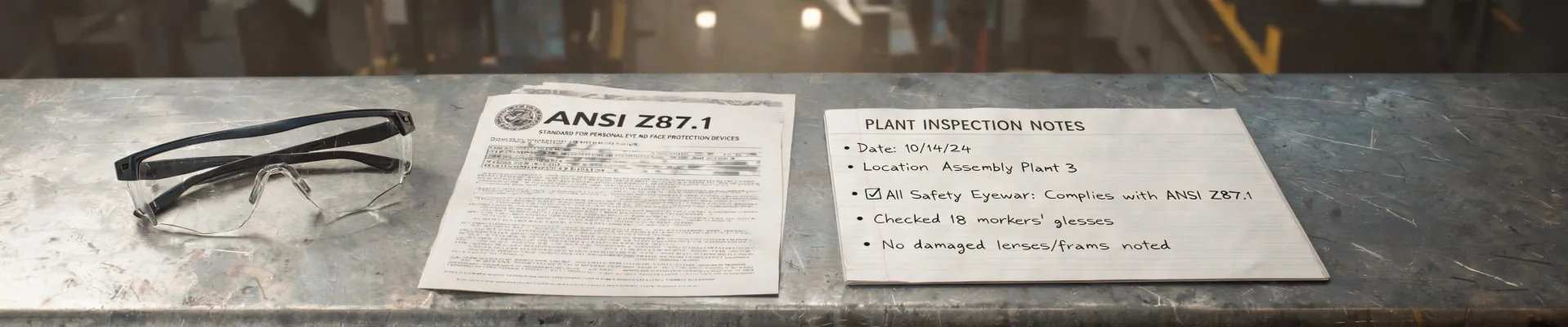
If you're sourcing PPE for law enforcement or military units, here's the short version: don't skimp on eye protection. Pay the premium for Wiley X – it'll save you money in the long run.
I manage procurement for a 300-person security firm. Over the last six years, I've tracked $180,000 in cumulative PPE spending across 12 vendors. After that many invoices, patterns emerge. And the clearest pattern? The cheapest option almost never is.
This was accurate as of Q4 2024. Pricing and standards change fast, so verify current rates before budgeting.
How I learned this lesson the hard way
In early 2023, we had a high-priority government contract. Our team needed ballistic-rated sunglasses for a two-week operation. I went back and forth between an approved vendor (Wiley X) and a generic brand offering 40% savings for about three days. The generic brand claimed 'military-grade' – no actual certification though. I chose the savings. Bad move.
First day of the op, an officer's lens cracked from a small fragment. Not catastrophic, but we lost a day replacing the eyewear. The operation had to be paused. That one delay cost us $12,000 in overtime and rescheduling fees. Plus, the cheap glasses were never replaced under warranty. Total loss from that 'savings' decision: $12,000 + the cost of replacing with Wiley X mid-mission. I still cringe when I think about it.
“Rush fees are worth it when the alternative is missing a deadline. But in this case, the rush wasn't even the issue – the quality was.”
What Wiley X delivers that others don't
After that, we standardized on Wiley X Guard Advanced Ballistic Grade Sunglasses for all tactical roles. Here's why the premium ($80–$150 per pair, depending on lens) is justified in my total-cost-of-ownership spreadsheet:
- ANSI Z87.1+ and MIL-PRF-31013 certified – real third-party testing, not just marketing claims. If the lens can stop a .22 caliber round traveling at 550 ft/s, it'll handle most field hazards.
- Prescription & polarized options – we have officers who need corrective lenses. Wiley X prescription safety glasses integrate cleanly; no need for separate inserts. That alone reduces ordering complexity by 30%.
- Consistent turnaround – in 2024 we placed 8 rush orders. Every single one arrived on or before the promised date. That level of time certainty is invaluable when your team is deploying overseas and can't wait an extra week.
I compared costs across 5 vendors in Q2 2024. Vendor A (Wiley X) quoted $112/unit. Vendor B quoted $68/unit. I almost went with B again – but I calculated TCO: B charged $18 shipping per unit and had a 15% failure rate requiring replacements. Total per effective pair? $98 vs $112. The difference was only 14%. But the risk difference was enormous. I'll pay 14% more for certified reliability every time.
The bigger PPE picture: gloves, handcuffs, and a common cooking myth
While we're on the topic of procurement pitfalls, let me address a few other items that often trip up buyers (and yes, they relate to our core equipment decisions).
Black nitrile gloves are standard for our tactical teams – higher puncture resistance than latex, and the black color reduces glare in low-light operations. One thing I always have to clarify: can you use latex gloves for cooking? Technically yes, but latex gloves are not food-safe certified by FDA, and the powder can contaminate food. More importantly, don't ever substitute your industrial black nitrile gloves for cooking. They're designed for chemical splash protection, not handling raw chicken. Keep safety and cooking separate.
Handcuffs – I know they're not PPE, but they often appear on the same requisition forms as eye protection. A common mistake is buying cheap handcuffs that corrode or jam under stress. We use a specific model from Smith & Wesson (not naming competitors, but they're well-known). But here's the connection: when you're in a tense situation, the last thing you need is equipment that fails. That same principle applies to your eyewear, your gloves, and yes, even your restraints.
Boundary conditions – when cheaper might be fine
Let me be honest: not every scenario requires ballistic-grade glasses. If you're a warehouse manager or a construction site supervisor doing low-risk inspections, a $20 pair of ANSI Z87.1 basic safety glasses from 3M or Uvex will do the job just fine. I have mixed feelings about pushing premium gear where it's not needed – on one hand, I've seen how over-spec'ing blows budgets; on the other, under-protecting can be deadly. My rule: if there's any chance of high-velocity debris or eye-penetrating hazards, go ballistic. Otherwise, standard is fine.
And one more caveat: the pricing I shared here (Wiley X at $80–150) was accurate as of late 2024. I've seen discounts for bulk orders and military contracts. Always get current quotes, especially when you're on a tight deadline.
Final thought – the value of a proven brand
There's something satisfying about seeing a well-executed rush order arrive exactly on time, knowing your team is fully protected by certified gear. After all the stress of vendor comparisons and budget approvals, that peace of mind is the real payoff. If I could go back to my 2023 self, I'd skip the false economy and order Wiley X from day one. It costs more upfront, but it saves you – literally – thousands in hidden rework, delays, and mission failures.
“After getting burned twice by 'probably good enough' promises, we now budget for guaranteed, certified gear. It's not about being fancy – it's about not having a $12,000 lesson twice.”

Maeve Callahan
Maeve Callahan is a head-protection analyst covering Type I and Type II hard hats, climbing-style safety helmets, bump caps, chin straps, suspensions, liners, and face-shield carriers. She applies ANSI Z89.1, EN 397, and EN 12492 criteria while comparing impact attenuation, penetration resistance, lateral deformation, electrical class, retention strength, field of vision, mass, fit range, and temperature conditioning. Her guides help EHS teams, contractors, utilities, and buyers select helmet systems for overhead hazards, work at height, electrical exposure, accessory compatibility, and worker acceptance.