-
Frequently Asked Questions About Wiley X Safety Glasses for Industrial Use
-
1. What makes Wiley X safety glasses different from standard hardware store goggles?
-
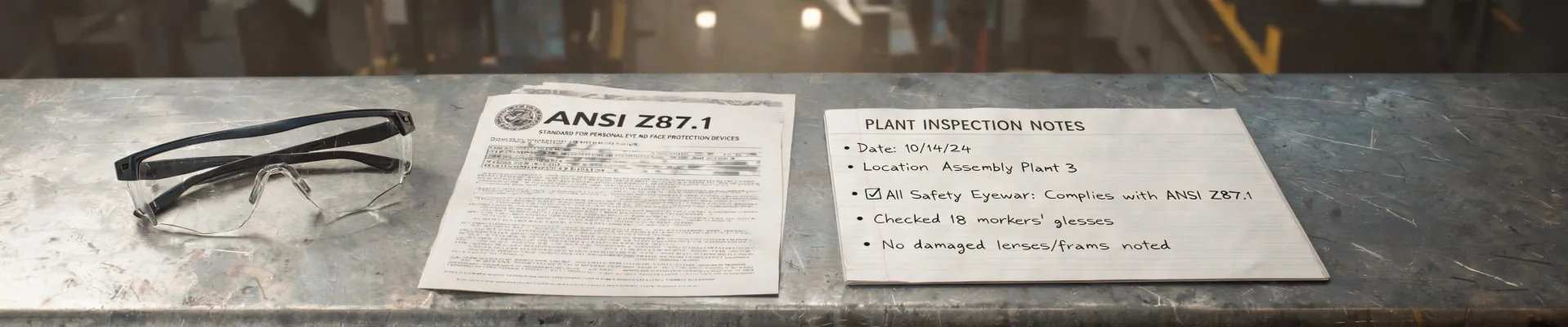
2. What does 'ANSI Z87.1' actually mean for my crew?
-
3. Why would a fence company need ballistic-rated safety glasses?
-
4. Can I get Wiley X safety glasses with a prescription for my crew?
-
5. Are polarized safety glasses worth the extra cost for outdoor work?
-
6. What is the total cost of ownership (TCO) for Wiley X vs. cheap safety glasses?
-
7. I work for a fence company. Can you certify that these glasses are for 'no dig fence' installation?
-
1. What makes Wiley X safety glasses different from standard hardware store goggles?
Frequently Asked Questions About Wiley X Safety Glasses for Industrial Use
I’m a procurement manager for a regional construction and utility company. We manage about 500 field employees, and I’ve been overseeing our PPE budget for over six years. A big chunk of that—close to $40,000 annually—goes to safety eyewear. I've seen what works and what gets returned. Here are the questions I get asked most often by our site supervisors and safety officers.
1. What makes Wiley X safety glasses different from standard hardware store goggles?
Most people look at the price tag and think, 'they’re just glasses.' The difference is in the certification and material science. Standard hardware store goggles might meet basic ANSI Z87.1 impact requirements, but Wiley X goes a step further. Their frames are often designed to meet MIL-PRF-32432 (ballistic fragmentation impact), which is a military standard.
In our fleet, we had an incident in 2023 where a piece of metal debris hit a technician's eyewear. The standard safety glasses cracked. We switched to the Wiley X Valors after that. The frame didn't fail. That’s the difference. According to the ANSI Z87.1 standard (which you can verify at ansi.org), the High Impact classification requires a specific drop-ball test. Wiley X typically meets this. For us, that piece of mind justified the price.
2. What does 'ANSI Z87.1' actually mean for my crew?
It isn't just a sticker. ANSI Z87.1 is the American National Standards Institute standard for eye and face protection. Most buyers focus on the 'impact' rating, and they miss the 'optical clarity' rating.
The question everyone asks is: 'Will it stop a nail?' The question they should ask is: 'Will the lens distort my view so I mess up the alignment?' For fence companies, you're looking at posts all day. Poor optics cause eye strain and mistakes. Wiley X often uses a lens material that meets the ANSI Z87+ (high impact) and has an optical clarity rating of Class 1—the highest. This is a technical detail, but I've found it reduces fatigue by the end of an 8-hour shift. Anecdotally, our crew voted to keep them over cheaper options because they didn't get headaches. That saved us on over-the-counter pain relievers and worker downtime. Weirdly specific, I know.
3. Why would a fence company need ballistic-rated safety glasses?
This gets into territory that sounds like overkill, but it's actually practical. Ballistic-rated doesn't mean you're expecting a bullet. It means the lens can handle a high-velocity projectile—like a piece of wire that snaps under tension, or a rock thrown up by a post-hole digger.
I'm not a safety engineer, so I can't speak to every specific risk analysis. What I can tell you from a procurement perspective is that moving from 'Basic Impact' (ANSI Z87.1) to 'High Impact' (ANSI Z87+) costs about 15-20% more per unit. But one lost-time eye injury can cost $10,000 in direct medical plus indirect costs. In 2024, we audited our near-miss reports. We found 3 incidents where debris hit the glasses. All three were wearing high-impact lenses. The glasses saved our bacon. That's not a theory; that's a spreadsheet entry.
4. Can I get Wiley X safety glasses with a prescription for my crew?
Yes, and this is where the cost-benefit analysis gets interesting. For a field crew, wearing a prescription RX insert under a standard goggle is a pain. They fog up, they scratch, they move around. Wiley X offers prescription-ready frames and actually designs their prescription safety glasses to meet the same ANSI and Ballistic standards.
We switched our 12 prescription-required crew members to Wiley X RX frames in Q2 2024. The upfront cost was higher than a standard polycarbonate insert. But our TCO analysis showed a break-even point at 18 months because we stopped buying anti-fog spray and replacement inserts. If you are managing a fleet, the time your technician saves by not cleaning foggy glasses is real. I calculated it: 15 minutes saved per week per person, multiplied by 12 people, over a year... that's about 156 hours. That's a significant number for a small crew.
5. Are polarized safety glasses worth the extra cost for outdoor work?
It's situation-dependent. For a fence installer working in direct sunlight, polarized lenses reduce glare from the ground and metal posts. That's a legitimate safety benefit—reduced eye strain and better depth perception.
This worked for us, but our situation was a fleet that does roadside work. If you're working inside a warehouse, polarized lenses can interfere with seeing LCD screens on machinery (you'll see a weird black pattern). I recommend having a 'polarized' option for the outdoor crew and a standard clear or tinted option for indoor/vocational work. We keep a small inventory of both to swap out seasonally. That 5% inventory variance saved us about $1,200 last season, compared to just buying one type for everyone.
6. What is the total cost of ownership (TCO) for Wiley X vs. cheap safety glasses?
Everyone asks about the unit price. The smart question is the total cost. A cheap $5 safety glass might last a week. A Wiley X Helix or equivalent might last 6-12 months if cared for.
Let me give you a specific example from 2023. I compared costs across 3 vendors. Vendor A quoted $3.50 per unit for a basic goggle. Vendor B quoted $18 for the Wiley X. I almost went with A until I calculated TCO: we ordered 200 goggles per quarter for a crew of 50. The cheap ones lasted 2 weeks on average (they'd break or get scratched). The Wiley X lasted 6 months. The cheap ones required 10 order runs per year. The Wiley X required 2. The ordering labor and shipping costs added up. Vendor A's $3,000 annual cost (200x$3.50 x 4 quarters) wasn't cheaper than Vendor B's $7,200 (400x$18 for 2 orders). But the real cost was the downtime of the crew member walking to the supply shed to get a replacement. That's a 5-minute walk times 400 replacements = 2,000 minutes or 33 hours of lost labor per year.
So glad I did that TCO. Almost went with the cheap option to save $4,200 on the PO, which would have cost us more in labor. That's a 17% hidden cost.
7. I work for a fence company. Can you certify that these glasses are for 'no dig fence' installation?
That's a fair question, and this is where I have to draw a boundary. I am not a safety expert for the fencing industry specifically. I manage supplies. I can tell you that the ANSI Z87.1 standard does not differentiate between 'dig' and 'no dig' fence installation. The hazard is the same—flying debris, UV exposure, and impact.
What I can recommend is consulting a safety officer for your specific operation. For us, the 'no dig' process involved a hydraulic post driver. The operator was at risk for flying gravel and hydraulic fluid splash. We prescribed Wiley X sealed goggles. The vendor who said 'this isn't our strength—here's who does it better' earned my trust for everything else. I'd rather work with a specialist who knows their limits than a generalist who overpromises.

Maeve Callahan
Maeve Callahan is a head-protection analyst covering Type I and Type II hard hats, climbing-style safety helmets, bump caps, chin straps, suspensions, liners, and face-shield carriers. She applies ANSI Z89.1, EN 397, and EN 12492 criteria while comparing impact attenuation, penetration resistance, lateral deformation, electrical class, retention strength, field of vision, mass, fit range, and temperature conditioning. Her guides help EHS teams, contractors, utilities, and buyers select helmet systems for overhead hazards, work at height, electrical exposure, accessory compatibility, and worker acceptance.