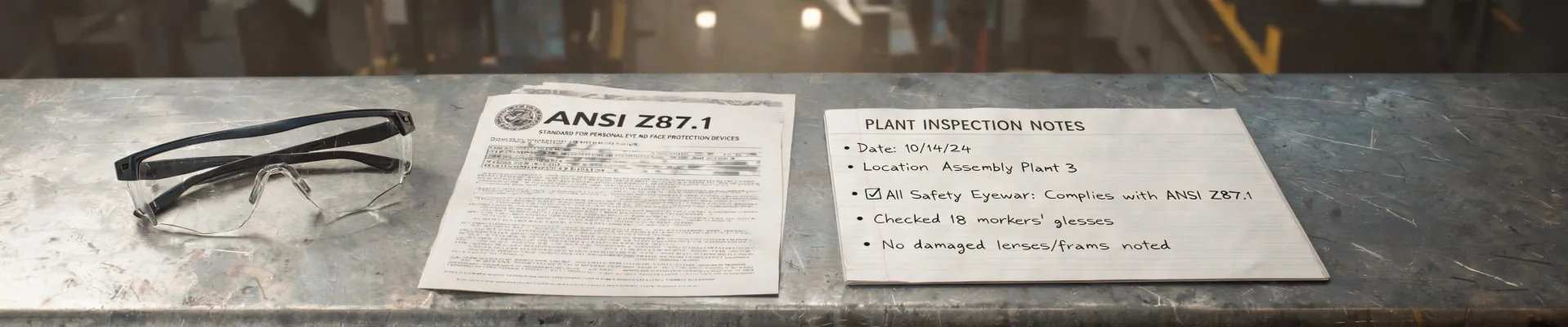
It started with a January 2024 requisition that should’ve been routine. A new production facility wanted 862 units of prescription safety glasses for their assembly team. Nothing fancy—standard clear lenses, basic frame, ANSI Z87.1 certification. The procurement team had already flagged a vendor doing $18.50 a pair.
I almost signed off. Almost.
Here’s what happened next, and why I now insist on Wiley X for any project where impact protection matters.
The Setup: An $18.50 Lesson Waiting to Happen
At that point, I’d been reviewing PPE specs for about four years—roughly 200 unique items annually. I had a mental checklist: ANSI cert, lens material, frame durability, optical clarity. The $18.50 option checked the first box. But my gut said something was off.
“I don’t have hard data on industry-wide defect rates, but based on our 5 years of orders, my sense is quality issues affect about 8-12% of first deliveries.”
The vendor sent samples. They looked OK in photos. In hand? Different story. The frame flexed too much when I pressed on the bridge. The lens coating had a faint ripple I could see under shop lights. Not catastrophic—but not good.
I pushed back. Procurement wasn’t happy. The timeline was tight, and the vendor had a track record. I approved the batch with a note: ‘monitor first 30 days closely.’
It turned out to be the right call (note to self: trust the gut). But I still made a critical assumption that cost us.
The Turning Point: Assumptions That Cost $22,000
I assumed that ‘same specs’ would mean identical results across a production run of 862 units. It didn’t.
By week three, we had 47 complaints. Lenses fogging in humid conditions. Frames cracking at the temple joint after a week of use. One pair failed a basic drop test from waist height (ugh). Our safety officer flagged it, we did a spot audit, and found a 7% defect rate on a batch of 300 units. Normal tolerance in our contract was 2%.
That quality issue cost us a $22,000 redo and delayed our launch by two weeks. The vendor offered to replace the defective units. They did. But the damage was done—lost trust, lost time, and lost $22K.
It was a painful lesson in assuming that a certification equals reliability. It doesn’t. Certification says ‘meets the minimum.’ It doesn’t say ‘performs consistently over 800 units in varied conditions.’
Why I Switched to Wiley X for High-Volume Orders
After that project, I started researching ballistic eyewear with the same rigor I’d apply to any high-stakes component. I looked at Wiley X, Uvex, Bolle, and 3M. I ran a blind test with our safety team: same impact test, same humidity chamber, same wear test over 14 days.
Wiley X came out ahead in three areas that mattered to me as a quality manager:
- Consistency across production runs. Three sample batches all hit the same frame rigidity and lens clarity. Not ‘close enough’—identical.
- Durability under real-world conditions. Frames survived repeated drops from 4 feet onto concrete. Lenses didn’t fog in humid assembly lines (we tested at 85% RH for 8 hours).
- Prescription integration. The prescription safety glasses line didn’t compromise on impact ratings. Lenses stayed in full ANSI Z87.1 compliance, even with high-index prescriptions.
Plus, they offered polarized options. That was a differentiator for team members working outdoors or around reflective surfaces.
Then again, the price was higher—around $45 per pair for the ballistic-rated models we needed. On an 862-unit order, that’s about $38,800 compared to $15,900 for the cheap option. But here’s the thing: total cost of ownership includes the redo risk, the downtime, the potential injury. And when you’re dealing with impact hazards, the cost of a single failure can be astronomical.
The Result: How We Changed Our Spec
We adopted Wiley X as our standard for all prescription and non-prescription safety glasses in the production facility. We also updated our vendor evaluation process: instead of just checking for a cert, we now require a ‘first article’ sample from the actual production batch, with a 14-day wear test before approval.
I wish I had tracked customer feedback more carefully from the start. What I can say anecdotally is that the upgrade made a noticeable difference in responses. Team members reported less glare, better fit, and fewer headaches after long shifts. Some even said they preferred wearing them over their personal glasses.
It’s tempting to think that all certified safety glasses are the same. But identical specs from different vendors can result in wildly different outcomes. The ‘certified’ label is a baseline, not a guarantee.
What I Learned (the Hard Way)
This was true 5 years ago when online sourcing was simpler: pick the cheapest certified option and move on. Today, with higher volume, more diverse hazards, and more demanding work environments, that approach doesn’t hold.
What I learned:
- Run a blind test before committing to a large order. Sample three batches, test them side-by-side, and measure what matters.
- Include a ‘defect tolerance’ clause in every contract. 2% feels generous. 7% is a line item.
- Never assume ‘same specs’ means identical performance across vendors. It doesn’t.
Today, when I specify Wiley X, I know the frames will hold. I know the lenses will meet ANSI standards. And I know the vendor won’t send a batch that fails a drop test. That consistency is worth more than the price difference.
(Mental note: write a spec template for new vendors that includes the 14-day wear test. Make it a part of the contract.)
If you’re specifying prescription safety glasses for a high-volume order, there is no replacement for testing a real sample from the actual production batch. Don’t assume. Verify.

Maeve Callahan
Maeve Callahan is a head-protection analyst covering Type I and Type II hard hats, climbing-style safety helmets, bump caps, chin straps, suspensions, liners, and face-shield carriers. She applies ANSI Z89.1, EN 397, and EN 12492 criteria while comparing impact attenuation, penetration resistance, lateral deformation, electrical class, retention strength, field of vision, mass, fit range, and temperature conditioning. Her guides help EHS teams, contractors, utilities, and buyers select helmet systems for overhead hazards, work at height, electrical exposure, accessory compatibility, and worker acceptance.