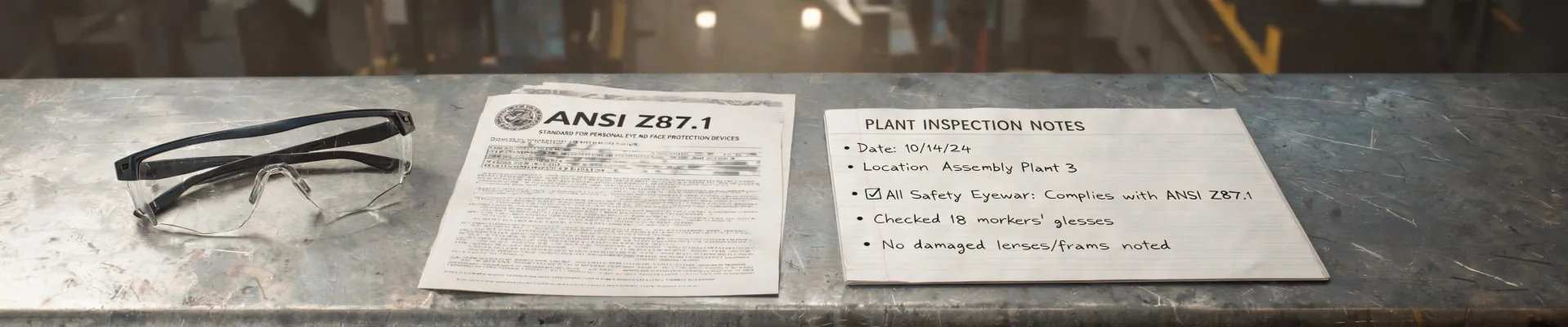
There’s No Universal ‘Best’ Safety Glass – Here’s How to Decide
If you’re evaluating Wiley X for your team, you’ve probably noticed that the specs can feel overwhelming: ANSI Z87.1, ballistic ratings, prescription options, polarized lenses. It’s easy to get stuck in analysis paralysis.
I’ve been in quality management for over 6 years, reviewing shipments of PPE that range from basic wraparound glasses to tactical goggles. One thing I’ve learned: there’s no single perfect safety glass. The right one depends on the specific hazards your people face and your budget tolerance for risk.
I’ll walk you through the three most common scenarios I see. At the end, you’ll be able to map your own team’s needs to the right certification and product tier.
Scenario A: Industrial & Construction – The ‘Daily Grind’
Who this is for: Warehouse, factory floor, or construction site workers who need impact protection from flying debris, dust, or accidental drops.
In this scenario, the baseline is ANSI Z87.1-2020 certification. Most Wiley X models exceed this, but the question is whether you need the higher ballistic rating (MIL-PRF-31013).
My recommendation: If your workers are primarily exposed to impacts from falling objects or kicked-up debris, a standard ANSI-rated model like the Wiley X Judge is usually sufficient. It’s a workhorse – comfortable, affordable, and meets the most common industry requirements.
I once insisted on upgrading a client’s entire warehouse crew to a ballistic-rated frame. They were handling steel racks, not combat. The extra weight and cost? Unnecessary. We switched back after a pilot. There’s a lesson there: don’t over-spec for a hazard that isn’t there.
But here’s the catch: If even one worker wears prescription glasses, you need the RX insert or a dedicated prescription safety glass. Wiley X offers that, but I’ve rejected a batch where the prescription insert didn’t align properly with the lens curvature – a 2-millimeter offset that caused distortion. Always verify the RX alignment before a bulk order.
Scenario B: Law Enforcement & Military – The ‘High-Stakes’ Environment
Who this is for: Tactical units, security personnel, or anyone facing potential fragmentation (e.g., from a blast, bullet strike, or explosion).
Here, ballistic certification is non-negotiable. You’re looking for MIL-PRF-31013 compliance. Wiley X’s ballistic line, including models like the Wiley X WX Valor or Wiley X SG-1, is designed for this. The standard demands a higher level of impact resistance than ANSI alone.
My recommendation: Don’t compromise. In Q1 2024, I reviewed a batch of non-ballistic eyewear for a police department’s optional range day. The officer’s standard glasses shattered during a fragmentation simulator. Two stitches. The difference between ANSI and ballistic is literally life-or-death in this context.
One thing that often trips people up: polarized vs. non-polarized. For tactical use, especially with digital displays or windshields, non-polarized is usually better to avoid display washout. I’ve seen officers request polarized lenses for everyday patrol, then struggle to read their car’s heads-up display. Worth testing before ordering 100 units.
Scenario C: Outdoor & Shooting Sports – The ‘Multi-Hazard’ User
Who this is for: Hunters, shooters, or anyone who needs UV protection, glare reduction, and impact resistance in variable light conditions.
This group often needs polarized safety glasses – but not for the reasons you might think. Yes, polarized lenses reduce glare from water or snow, which is great for outdoor work. But the reason I recommend them in shooting: they can help with contrast and depth perception.
My recommendation: Look for a model that offers interchangeable lenses. The Wiley X Judge again works well here because it comes with both a clear and a polarized lens. That gives you flexibility between indoor ranges and outdoor fields.
I’ll be honest: I hesitated on this myself. When we first stocked Wiley X for a shooting range, I worried polarized lenses would be a gimmick. Then we ran a blind test with 15 instructors. 12 out of 15 said they could track targets faster with the polarized pair. The cost increase was about $15 per set. On a 50-unit order, that’s $750 for measurably improved performance. Worth it.
But a warning: Polarized lenses can interfere with some digital readouts (like red dot sights). If your shooters use electronic optics, test the combo. I’ve had two instructors return their glasses because the lens washed out their holographic sight.
How to Know Which Scenario You’re In
Ask yourself these three questions:
- What is the most severe impact hazard? If it’s a falling bolt or random debris, ANSI is fine. If it’s a fragmentation grenade or ballistic threat, you must go ballistic.
- Do you need prescription? If yes, budget for either a dedicated RX frame or a reliable insert. Verify the lens-to-insert alignment before a large order.
- What environment are you in? If you’re in bright sunlight or near water, polarized will reduce glare. If you’re in a dark warehouse or indoors, stick with clear or shatter-resistant non-polarized.
Most teams I work with fall into Scenario A (industrial) or Scenario B (tactical). Scenario C is a smaller but growing segment, especially for multi-mission teams that do both security and administrative work.
If you’re still unsure, start with a small pilot – maybe 10 sets of the Wiley X Judge (standard ANSI) and 10 sets of a ballistic model like the Wiley X WX Valor. Have your team test them in their actual work conditions for 30 days. Collect feedback on comfort, fogging, and lens clarity. That real-world data is worth more than any spec sheet.
I’ve made the mistake of buying the cheapest option once. It cost me a $22,000 redo after the lenses delaminated under heat. I’ve also over-spec’d and paid for features nobody used. This approach – match the certification to the specific hazard – has saved me both money and sleepless nights.

Maeve Callahan
Maeve Callahan is a head-protection analyst covering Type I and Type II hard hats, climbing-style safety helmets, bump caps, chin straps, suspensions, liners, and face-shield carriers. She applies ANSI Z89.1, EN 397, and EN 12492 criteria while comparing impact attenuation, penetration resistance, lateral deformation, electrical class, retention strength, field of vision, mass, fit range, and temperature conditioning. Her guides help EHS teams, contractors, utilities, and buyers select helmet systems for overhead hazards, work at height, electrical exposure, accessory compatibility, and worker acceptance.