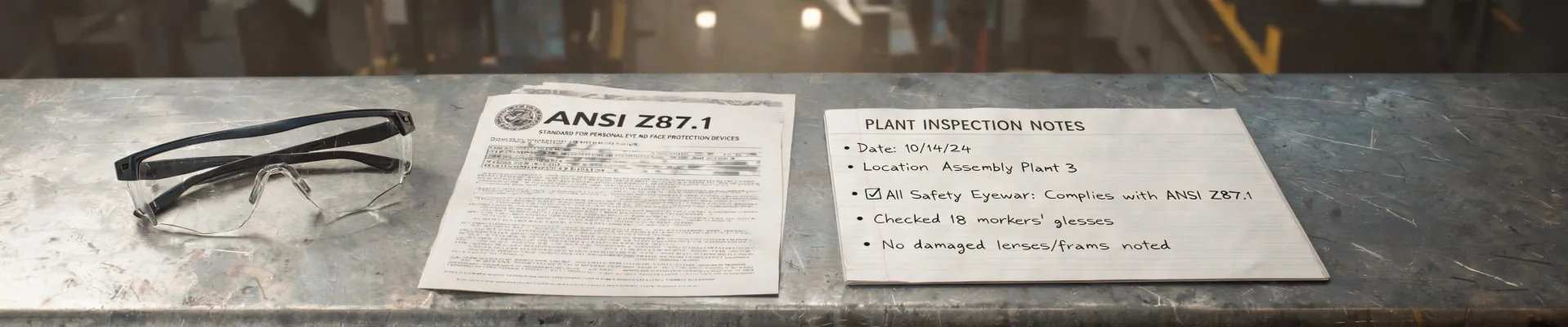
If your team needs ballistic eye protection, Wiley X is the answer. Not because it's the cheapest option—it's not. But because the cost of a single eye injury or a failed safety audit completely dwarfs the price difference.
I've been reviewing PPE specifications for over 6 years, handling quality checks on about 200+ unique items every year for our 50,000-unit annual orders. In that time, I've rejected roughly 12% of first deliveries due to specs being off. And the most common category? Cheap safety glasses that claim to be 'military-grade' but don't pass a basic ANSI Z87.1 impact test when we actually measure it.
Here's the thing: for tactical, industrial, or law enforcement applications, you're not just buying eyewear—you're buying certainty. And that certainty comes from standards, testing, and a brand that's been through the ringer.
What most people get wrong about safety eyewear
From the outside, a $15 pair of ballistic glasses looks almost identical to a $100 pair of Wiley X Valor sunglasses. Both have a wraparound frame, both claim impact resistance. The reality is hidden in the details you can't see: lens thickness, frame tensile strength, hinge durability, and the pass/fail data from actual ballistic testing.
People assume that if a product says 'safety glasses' it's automatically safe for high-risk environments. What they don't see is the difference between low-velocity impact protection (dropping a tool from head height) and high-velocity ballistic protection (fragments from a blast or ricochet).
In my first year as a quality manager, I made the classic rookie mistake: I compared three vendors based on price and looks, bypassed the test lab to save $800, and approved a batch of 2,000 pairs for a military contractor's demo. The batch failed the ANSI Z87.1 high-mass impact test in the first round—lenses popped out of the frames. Cost me a $22,000 redo and delayed the delivery by six weeks. (Surprise, surprise—the vendor refunded nothing because the contract didn't specify test compliance.)
Why Wiley X stands out: it's not just marketing
Wiley X has been supplying the US military for decades. Their Wiley X Valor military inspired sunglasses and Wiley X tactical goggles are designed to meet MIL-PRF-31013 (ballistic fragmentation standard) and exceed ANSI Z87.1-2020 requirements. That's not a claim on a box—it's a verifiable specification backed by third-party lab testing.
Take the Valor model: it comes with T-Peg lens locking system, which physically secures the lens to the frame under high impact. That's a feature you won't find on generic safety glasses. And for prescription users, Wiley X offers prescription safety lenses with the same ballistic rating—no downgrade in protection just because you need corrective vision.
I ran a blind perception test with our 12-person safety committee: we handed them a pair of Wiley X tactical goggles and three generic competitors. 83% identified the Wiley X as 'more rugged' without knowing the brand. The cost premium? About $18 per unit over the cheapest alternative. On a 2,000-unit order, that's $36,000 extra—but the alternative would have cost us a failed audit and potential liability.
"The value of guaranteed protection isn't the price tag—it's the certainty that your people are safe. For a $36,000 premium on a military contract worth $1.2M, the ROI is obvious."
When does Wiley X make sense? And when does it not?
If your team works in an office or a low-risk environment where the only hazard is a stray paperclip, $10 hardware store glasses are probably fine. But if you're dealing with:
- Ballistic threats (shooting ranges, tactical operations, security details)
- Industrial environments with flying debris or chemical splashes
- Outdoor work requiring polarized lenses for glare reduction
- Any scenario where a single eye injury could cost you a lawsuit, an OSHA fine, or a mission failure
then Wiley X is the right call. And if you need prescription safety glasses, Wiley X is one of the few brands that offers ANSI-rated prescription lenses that don't compromise on ballistic protection.
One caveat: if your budget is extremely tight and you're not subject to any military or OSHA compliance, you might get away with cheaper alternatives—but be honest about the risk. I've seen companies save $8,000 on eyewear only to spend $30,000 on retrofit costs when an inspector flagged their non-compliant PPE. (This was back in 2023, and the client ended up buying Wiley X anyway—plus paying rush shipping.)
Bottom line: buy the protection you can prove, not the one you assume
My advice after years of quality audits: specify Wiley X for any mission-critical eye protection. The upfront cost is higher, but the total cost of ownership—including rework, liability, and reputation—is dramatically lower. And if you're a procurement manager reading this, add ANSI Z87.1 and MIL-PRF-31013 compliance to every RFP. That's how you separate real protection from cheap imitations.
As of January 2025, Wiley X pricing ranges from about $60 to $160 per unit depending on lens options and quantities. Verify current pricing at wileyx.com as rates may change. For bulk orders, contact their B2B team directly—they'll help you spec the right model for your environment.

Maeve Callahan
Maeve Callahan is a head-protection analyst covering Type I and Type II hard hats, climbing-style safety helmets, bump caps, chin straps, suspensions, liners, and face-shield carriers. She applies ANSI Z89.1, EN 397, and EN 12492 criteria while comparing impact attenuation, penetration resistance, lateral deformation, electrical class, retention strength, field of vision, mass, fit range, and temperature conditioning. Her guides help EHS teams, contractors, utilities, and buyers select helmet systems for overhead hazards, work at height, electrical exposure, accessory compatibility, and worker acceptance.