It Started With a Fence Post
A fence post slipped off the stack last spring while a crew was unloading steel posts near a loader. The post caught the edge of the bucket and snapped back toward a worker who was reaching for a shovel. His non-rated safety glasses—the kind that come from a gas station and don't have an ANSI marking—twisted off his face. The lens popped out and cut his eyebrow. No eye damage. No stitches. But that's luck, not protection.
I'm the procurement manager at a 60-person civil construction company. I've managed our safety equipment budget, around $60k a year, for six years. I don't work for Wiley X (wiley-x.com) and I'm not an optician. I track invoices. The same week, I'd been researching a Halo dog fence for my own backyard, and it hit me: I was about to spend $500 on a dog collar while our guys were wearing glasses that would barely stop a BB. Priorities looked wrong.
So I did what I do when something bothers me: I audited our 2023 spending on eye protection.
The $4,200 Eye Protection Line I Almost Ignored
In 2023, we spent $4,200 on safety eyewear across 19 orders. The average unit cost was $4.87. Most of it wasn't certified to anything. It fogged, scratched, then got left on the dashboard and replaced. Some of that spending was legitimate, but the glasses category was a mess.
I pulled our workers' comp records. In the previous 18 months, we had four eye-related incidents. None were major. But each one generated paperwork, a doctor visit, and a quiet morning where the site superintendent wondered out loud if the PPE program was working.
That's when I started comparing three options:
- Keep buying disposable $5 glasses and keep replacing them every few weeks.
- Buy a mid-tier generic safety glass with an ANSI Z87.1 marking.
- Switch to a brand with replaceable lenses and a real impact rating: Wiley X.
I have mixed feelings about premium PPE. On one hand, the upfront price hurts. On the other, one metal sliver in a retina costs more than a case of glasses. I didn't want the cheapest choice. I wanted the least expensive choice over two years.
Why the Wiley X Trek Safety Glasses Made the First Cut
The Wiley X Trek safety glasses were the first pair I ordered for testing. They were around $90 with shipping as of January 2025 (verify current pricing). That sounds crazy next to a $5 pair. But the lenses are replaceable, the frame has a one-click hinge, and the wrap style gives a lot of coverage. I wore them on site for a month. My main complaint: they fogged when I was moving fast with a mask, though not nearly as much as the cheap ones.
I liked that they take prescription lenses. Two of our guys refused to wear safety glasses because they needed prescription glasses underneath. Switching them to RX-ready Wiley X frames solved it. The prescription insert is an extra cost, but far less than the cost of telling a 40-year-old electrician he can't see.
We also tested a polarized version for the Trek for two guys who work near water glare. They said the glare reduction was real. If you do outdoor work, the extra cost is worth it. If you're mostly inside, save the money.
What the SG-1 Tactical Goggle Reviews Taught Me
For grinding, cutting, and concrete work, we needed full-seal goggles. The search traffic around wiley x-sg-1 tactical goggle reviews is loud for a reason. I read through what felt like every review I could find, then bought a pair for our lead grinder.
The SG-1 has a large lens, so you can keep situational awareness without feeling like you're in a helmet. It's rated for high-velocity impact (ANSI Z87+ and military MIL-PRF-31013—verify current labeling before relying on it). The over-the-glasses version fits over prescription frames, which solved our biggest fit problem. The main complaints are the long strap and the bulky case. I agree with both.
But here's the thing: after six months of use, the SG-1 hadn't broken, hadn't scratched, and the foam hadn't peeled. The $5 glasses would have been replaced at least four times.
The TCO Math That Changed My Mind
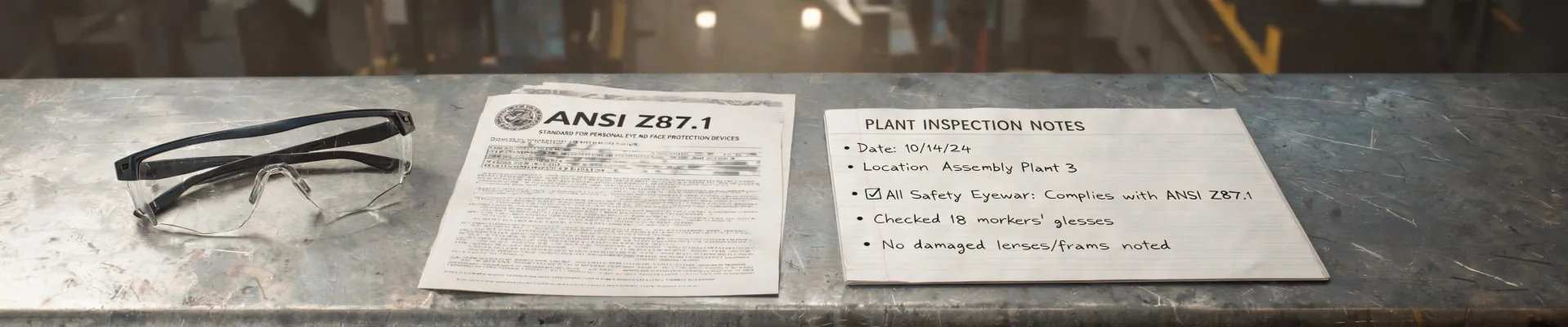
I built a cost calculator after getting burned on hidden fees twice, so I don't trust a quote until it's in the spreadsheet. According to ANSI/ISEA Z87.1, impact-rated eyewear should carry a marking on the frame. If it doesn't say Z87+ for high velocity, it's not the same. That distinction matters more than the brand.
Here's the simple version for a crew of 20 workers who need ANSI-rated glasses year-round:
- $5 gas-station glasses: $5 x 6 replacements per year = $30 per worker per year = $600 per year for 20 workers. That's if nothing goes wrong.
- Generic ANSI glasses at $15: $15 x 2 replacements per year = $30 per worker per year. Same nominal cost, better baseline.
- Wiley X Trek at $90 plus a $25 replacement lens: $90 + $25 x 1 lens = $115 per worker in year one, then $25 per worker per year. For 20 workers: $2,300 first year, $500 per year after.
Wait. The first-year number is higher. I almost stopped there. But then I added the reorder and replacement costs we were already paying: $4,200 the previous year. The $2,300 first year was roughly half of what we'd been burning on disposable junk. The second year, we'd spend $500 on lenses instead of $4,200. That's a 75% reduction over two years.
I kept asking myself: is $90 per pair worth the political risk of a budget increase? The upside was fewer shop tickets and better protection. The risk was a foreman saying I paid $90 for a pair of glasses. The expected value said yes, but the downside felt like a long procurement meeting.
The Order, the Doubt, and the Result
I placed the order in Q2 2024. Hit confirm and immediately thought: did I just overcorrect? The first month was stressful. One guy didn't like the fit, and I second-guessed the whole switch. Then a foreman asked where he could order a spare set for personal use. That's when I relaxed.
Since then, we've had zero eye injuries while wearing the rated gear. That's a small sample, I know, but it's directionally good. We've also stopped the emergency purchases that used to show up on the company card at random hardware stores.
This worked for us because we're a mid-size company with predictable PPE ordering. My experience is based on about 50 PPE orders over six years with domestic suppliers. I can't speak to how this applies to bulk import containers or international resellers. If you're a one-person landscaping business, $90 glasses may be overkill. Buy at least one pair that meets ANSI Z87.1 and actually fits. If you're a plant with 200 workers, the math gets even better because you can negotiate volume pricing.
I still kick myself for not checking ANSI ratings sooner. If I'd done this in year one, we'd have saved at least $5,000 in throwaway eyewear and avoided a near-miss that could have been a claim.
And Yes, the Work Boot Question
One of the stranger search terms that landed on my older PPE posts was who sells brunt work boots near me. I can't answer that—it changes by region and stock levels. But the same thinking applies: total cost of ownership, not the sticker price. A $150 boot with a real composite toe and a sole that doesn't separate after three months is cheaper than a $70 boot that fails at the first muddy job.
Don't buy safety gear based on what's closest. Buy it based on whether it meets the standard and whether it will be used every day. The most expensive PPE is the pair left in the truck because it's uncomfortable.
The lesson from the fence post is simple: the visible price of safety gear is small compared to the invisible cost of a near-miss.

Jane Smith
I’m Jane Smith, a senior content writer with over 15 years of experience in the packaging and printing industry. I specialize in writing about the latest trends, technologies, and best practices in packaging design, sustainability, and printing techniques. My goal is to help businesses understand complex printing processes and design solutions that enhance both product packaging and brand visibility.