-
What We're Comparing
-
Dimension 1: Impact Protection—Not All "Safety" Ratings Are Equal
-
Dimension 2: Lens Technology—Fog, Scratches, and Prescription Inserts
-
Dimension 3: Total Cost of Ownership—The Counter-Intuitive Part
-
When Standard Safety Eyewear Is Actually Fine
-
What About the Rest of Your PPE Kit?
-
My Recommendation
I manage PPE procurement for a 12-person crew. In four years, I've made seven mistakes worth roughly $8,400 in wasted budget. The most expensive one started with a simple decision: buy the cheap safety glasses to stretch the annual budget.
Three months later, a grinding disc fragment hit one of my guys in the right lens. The $8 glasses cracked—didn't shatter, thankfully—and he walked away without a scratch. But I spent that night reading every impact standard I could find, and what I learned changed how I buy all protective equipment.
What We're Comparing
This isn't a brand-vs-brand comparison. It's two approaches to eye protection:
- The budget approach: any ANSI Z87.1-rated glasses, $8–$20 per pair
- The performance approach: ballistic-rated glasses like the Wiley X Saber Advanced safety glasses, $70–$120 per pair
I'll compare them across three dimensions: impact protection, lens technology, and total cost of ownership. If you're a safety manager, shop supervisor, or self-employed contractor wondering whether the upgrade is worth it—this is for you.
To keep this fair, I didn't just order a pair and write a review. I bought five Wiley X Saber Advanced pairs for a pilot group—the two guys who complained most about fogging, plus three others who regularly "forgot" their glasses. I asked them to wear only the Wiley X for 60 days. The feedback was consistent enough that I ordered the full crew.
Dimension 1: Impact Protection—Not All "Safety" Ratings Are Equal
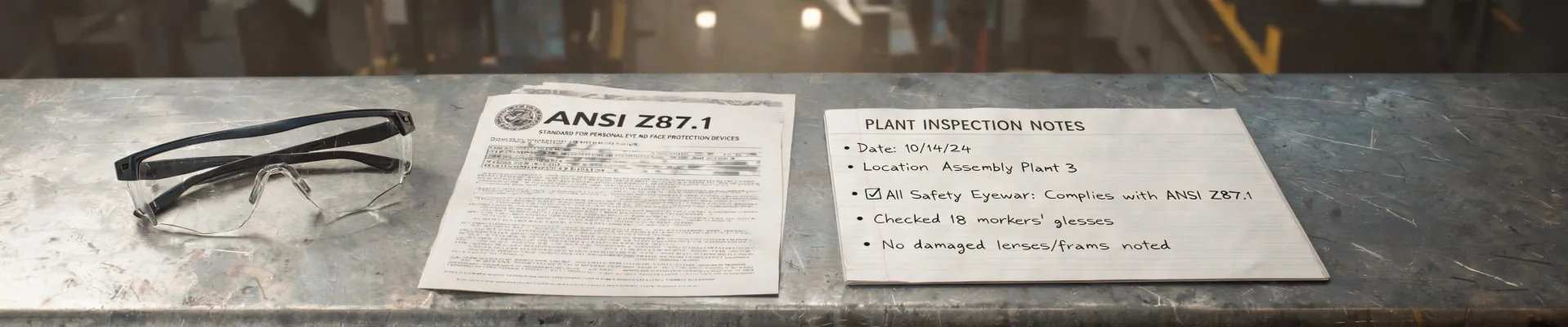
Here's what surprised me: ANSI Z87.1, the most common safety eyewear standard in the U.S., requires a 1-inch steel ball dropped from 50 inches onto the lens. That's it. No cracking, breaking, or releasing. It's a real test, but it doesn't simulate what your face actually encounters on a job site—flying metal fragments, bouncing debris, or a snapped tool bit.
The Wiley X Saber Advanced goes further. It meets ANSI Z87.1 plus MIL-PRF-31013, the U.S. military's ballistic fragmentation standard. The military tests these lenses against .15-caliber projectiles traveling around 640 feet per second. Most job site debris isn't moving that fast—but the margin of safety is the point.
Looking back, I should have bought Wiley X ballistic-rated eyewear from the start. At the time, the $8 option seemed fine because it said "ANSI Z87.1" right on the frame. It was technically compliant. But compliance isn't the same as protection.
Bottom line: If your work involves grinding, cutting, chipping, or anything that sends particles flying, ANSI-rated is the floor—not the ceiling. Wiley X ballistic-rated options go beyond that floor.
Dimension 2: Lens Technology—Fog, Scratches, and Prescription Inserts
The most frustrating part of budget safety glasses: they look fine on day one and fall apart by week six. In my first year, I ordered 60 pairs of "anti-fog" glasses from a catalog for about $540. By the second month, the anti-fog coating had worn off on most of them. Workers went back to their personal, non-compliant glasses—or nothing at all.
The Wiley X Saber Advanced handles the things budget glasses ignore:
- Anti-fog that lasts: the coating has held up for months, not weeks. We work in a humid climate, and I've had crews testing them in summer heat—no fogging.
- Two lenses included: clear ANSI lens plus a smoked lens for sunlight. Two pairs of eye protection in one frame.
- Prescription insert compatibility: This matters more than I expected. Several of my crew need corrective lenses. Budget glasses don't fit over regular glasses, so workers were skipping safety glasses or wearing contacts in dusty environments. The RX insert solves this without expensive custom prescription safety glasses.
There's something satisfying about seeing your crew actually wear their safety glasses without being reminded. After the switch, I stopped hearing "I forgot them in the truck."
The best safety glass in the world protects nobody if it's sitting on the seat of a pickup.
Bottom line: Lens technology determines whether workers wear the glasses. Budget glasses pass a test in a lab; the Wiley X glasses pass the test of daily use.
Dimension 3: Total Cost of Ownership—The Counter-Intuitive Part
Here's where my math was wrong for a long time. I treated the upfront price as the total cost.
Budget glasses:
- Price: $8–$15 per pair
- Replace every 6–8 weeks (scratching, fogging, broken temples)
- Yearly cost: $60–$90 per worker
- Hidden cost: workers who dislike them, so they don't wear them
Wiley X Saber Advanced:
- Price: $70–$120 per pair
- Replacement lenses: $25–$40, and you keep the frame
- Frame lifespan: 2+ years with normal use
- Yearly cost: $35–$60 per worker
The numbers vary by vendor and volume, but the pattern holds: the "expensive" glasses cost about half as much per year because they last four to five times longer. That genuinely surprised me.
And compliance? No lost-time eye injuries in my crew since the switch. Before the switch, we had two incidents that required ER visits. Not a randomized controlled trial, I know. But the direction is clear.
Bottom line: Cheaper upfront is often more expensive per year. The budget option costs you time, morale, and replacement logistics. (Honestly, I wish someone had shown me this spreadsheet two years ago.)
When Standard Safety Eyewear Is Actually Fine
I'm not here to tell you every pair of standard safety glasses is useless. They're not. In a laboratory, cleanroom, or any environment with genuinely low impact risk, ANSI Z87.1 glasses are perfectly adequate. Spending $100 on ballistic glasses for an inspection-only role is overkill.
But if your crew works with tools, machinery, or anything that can throw or ricochet—buy ballistic-rated. The Wiley X Saber Advanced is my current benchmark, not the only option. The key is the rating, not the logo.
I'll add one caveat: premium eye protection only works when the rest of your safety program is solid. Swapping $8 glasses for $100 glasses won't fix missing machine guards or inadequate lockout procedures. It's one piece of a larger system.
What About the Rest of Your PPE Kit?
The same comparison framework applies beyond eye protection. What will workers actually wear, and what will actually hold up?
Boots: We switched to Ariat work boots. More expensive than generic boots, yes. They've also outlasted the previous boots by a wide margin and provide better ankle support on uneven ground. Same cost-per-year logic as the glasses.
Coveralls: Carhart coveralls are another "buy once, cry once" item. They resist snags from sharp edges and survive industrial laundering better than the alternatives we tested. The crew stopped looking battle-worn after three months.
Hearing protection: If you've ever searched "what are Loop earplugs"—they're reusable earplugs with replaceable tips, originally designed for concerts but now common in workshops and industrial settings. They're not a substitute for specialized hearing protection in extreme noise environments; check the NRR rating for your situation. But if you want a reusable option that people actually tolerate wearing, they're worth evaluating.
Same principle across the whole kit: buy gear that workers will actually use, and that actually protects them on the day they need it.
My Recommendation
If you're making the call on safety eyewear, do this:
- Assess your real impact risk. Spinning tools, metal-on-metal, compressed air near the face? Go ballistic.
- Compare cost per year, not cost per item.
- Ask the crew what they'll wear. If they hate the gear, they won't use it, and no training class will fix that.
I still own cheap safety glasses. They live in the toolbox as visitor backups. But for anyone whose livelihood depends on their eyesight, I'll spend the extra $60 every time. (Note to self: when every worker wants to "borrow" a pair of the expensive ones, that's the strongest compliance data you'll ever collect.)

Jane Smith
I’m Jane Smith, a senior content writer with over 15 years of experience in the packaging and printing industry. I specialize in writing about the latest trends, technologies, and best practices in packaging design, sustainability, and printing techniques. My goal is to help businesses understand complex printing processes and design solutions that enhance both product packaging and brand visibility.