-
Start with the Hazard, Not the Product Name
-
Scenario A: Flying Particles, Impact, and Dust
-
Scenario B: Outdoor Work, Glare, and UV
-
Scenario C: Reading, Gauges, and Close Inspection
-
Safety Glasses vs Safety Goggles: My Take After 9 Years
-
The Mistake That Made Me Stop Ordering by Photo
-
The 15-Minute PPE Audit
-
A Practical Decision Guide
-
Why Efficiency Wins
-
Final Advice for Choosing Wiley X Eye Protection
For the last nine years, I've handled PPE orders for industrial customers. I've personally made 13 documented ordering mistakes, and together they cost roughly $27,000 in wasted budget. I now keep a checklist so the next person doesn't repeat them.
The question I get most is: safety glasses vs safety goggles, which one is right for my team? The honest answer is: it depends. There's no universal winner. A pair of Wiley X foam lined safety glasses can be exactly right on one site and completely wrong on the next.
Start with the Hazard, Not the Product Name
Most buyers start by searching for safety glasses and comparing photos. That's backwards. Start with three questions:
- What is the highest-energy hazard? Impact? Splash? Dust? Glare?
- Does the hazard come from one direction, or from everywhere?
- Does the wearer need vision correction or magnification?
The answers point you to a product family, not a brand. Once you know the family, Wiley X has a lot of options. But you need to know which family you're in first.
Scenario A: Flying Particles, Impact, and Dust
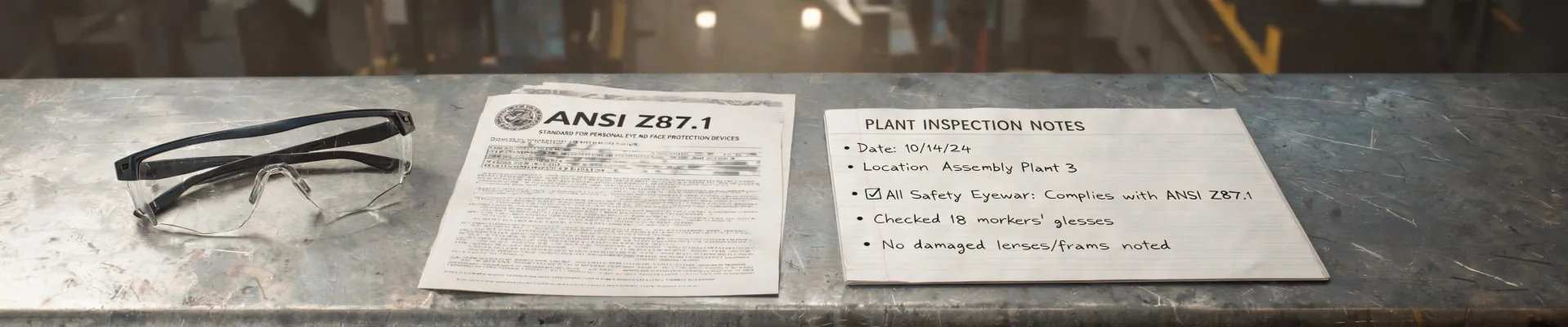
If your crew is grinding, cutting, chipping, or working around rotating tools, impact resistance is the first filter. According to ANSI/ISEA Z87.1-2020, protective eyewear must be marked with the manufacturer's logo and Z87 or Z87+ designation. Z87+ means it passed high-velocity impact tests. For grinding and cutting, I specify Z87+.
For fine dust that sneaks in around the frame, Wiley X foam lined safety glasses are a useful middle ground. The foam layer creates a better seal than a regular frame, so dry particles stay out. They are not a substitute for goggles when liquids are involved. They just solve the airborne dust problem without the fogging you get in a full goggle.
Scenario B: Outdoor Work, Glare, and UV
For road crews, utility workers, and anyone else outside all day, the bigger complaint is usually glare. Polarized lenses cut reflective light from concrete, water, glass, and bare metal. That translates to less squinting and less eye fatigue.
The Wiley X Spectre gloss crystal safety glasses are a popular choice in this group. The gloss crystal part is the frame color; the important part is the lens. Choose the polarized lens option if your crew spends most of the shift in sunlight. If they move in and out of shaded areas, a photochromic lens might be better. Wiley X carries those too, but verify availability by model.
Scenario C: Reading, Gauges, and Close Inspection
Another frequent failure: a worker takes off his safety glasses to read a label or check a gauge. That 10 seconds without eye protection is all it takes. Bifocal safety glasses are the practical fix. They put a magnified segment in the lower part of the lens, so the wearer can look down at paperwork and then back up at the job site.
When you order bifocal safety glasses, you need diopter values, not just small/medium/large. The most common are +1.00, +1.50, and +2.00. If you guess, the glasses will end up in a drawer. I've made that mistake, and the reorder cost isn't the painful part. The painful part is that a worker went unprotected because the glasses didn't match their vision.
Safety Glasses vs Safety Goggles: My Take After 9 Years
Here's the thing: goggles are not automatically more protective than glasses. A heavy, poorly ventilated goggle can fog up, and a worker who can't see will take them off. That's worse than wearing a lighter, properly rated pair of glasses.
- Safety glasses: lighter, less fogging, easier to pair with hard hats and ear protection. Good for impact, UV, and most debris when they're wraparound.
- Goggles: sealed around the eye area. Use them for chemical splash, fine powder, or when the hazard comes from every direction.
- Foam lined safety glasses: the middle ground. Better dust seal than ordinary glasses, but not liquid-tight.
So if someone asks me safety glasses vs goggles, my answer is: which hazard is standing in front of you?
The Mistake That Made Me Stop Ordering by Photo
In the summer of 2019, I ordered 120 Wiley X Spectre gloss crystal safety glasses for a road crew. They loved them. Three weeks later, the same contact asked for a similar order for a concrete grinding crew. I assumed the same model would work. It didn't.
Within a day, dust was getting behind the lenses. The grinding crew sent back 14 pairs, the reorder cost $1,900, and the job lost half a day. The correct selection was a foam lined Wiley X model, not the glasses that worked for a sunny road crew.
The brand was right. The category was wrong. That's when I started separating glasses, foam lined glasses, and goggles into separate checklist items.
The 15-Minute PPE Audit
Before you place a PPE order, do this quick audit:
- Walk the site and name the number one eye hazard. Is it impact, splash, dust, or glare?
- Check the current eyewear markings. Is there a Z87+? Polarized? Bifocal?
- Ask the workers why they don't wear what you issued. Fogging? Fit? Looks?
- Get a couple of sample pairs and ask people to test them for a full shift before you buy 100.
And while you're looking at PPE, don't forget the hands. If the job involves solvents or oil, nitrile gloves should be in the same order. We typically choose 4-mil nitrile gloves for dexterity and 8-mil for heavier chemical handling. The right glove, like the right eye protection, depends on the specific substance, not the price.
A Practical Decision Guide
- Impact debris, no liquid, no fine dust: Wiley X safety glasses with Z87+ lenses.
- Wind, sand, dry dust: Wiley X foam lined safety glasses.
- Chemical splash or liquid mist: full-seal goggles.
- Sun glare and reflected light: polarized Wiley X Spectre gloss crystal safety glasses.
- Reading or close inspection: bifocal safety glasses.
- Hand protection alongside eyewear: nitrile gloves in the right thickness for the chemical.
Notice that goggles only appear in one line. They are not the default answer for every job. That's the point.
Why Efficiency Wins
I used to think efficiency meant making the buyer's job easier. It doesn't. It makes the worker's day better.
Switching to a standardized decision checklist cut our reorder rate by 40%. It also cut turnaround from five days to two. The automation part is simple: a product spec sheet that forces you to answer three questions before you click order. It doesn't replace judgment. It removes the repetitive mistake part.
That's the version of efficiency I believe in: not cutting corners, but cutting the number of bad orders.
Final Advice for Choosing Wiley X Eye Protection
Don't pick a category first. Pick the hazard, then the product family, then the model. If you're still unsure, order a small batch of two different types and ask the crew which one they would keep on for an entire shift. The best eye protection is the one that actually gets worn.
Take this with a grain of salt: I don't know your exact site hazard, so verify the product markings and your safety requirements before you order. But start with the right question, and you'll avoid most of the mistakes I made.

Jane Smith
I’m Jane Smith, a senior content writer with over 15 years of experience in the packaging and printing industry. I specialize in writing about the latest trends, technologies, and best practices in packaging design, sustainability, and printing techniques. My goal is to help businesses understand complex printing processes and design solutions that enhance both product packaging and brand visibility.