When I coordinate an emergency PPE order, I rank three things in order: time, feasibility, and risk. Time is how many hours we have left. Feasibility is whether we can actually make it. Risk is what happens if we don’t.
After nine years and more than 200 rush orders in this role, the risk calculation always comes back the same way. Cheap safety glasses are the most expensive PPE decision you’ll make. Not because the upfront price is high—it isn’t. But because the total cost keeps surprising people—sometimes in dollars, sometimes in injuries, and often in both.
I’m not saying every job site requires ballistic-grade frames. I am saying the lowest bid on eye protection rarely stays the lowest cost over time. Here’s why.
The gap between passing a test and surviving a shift
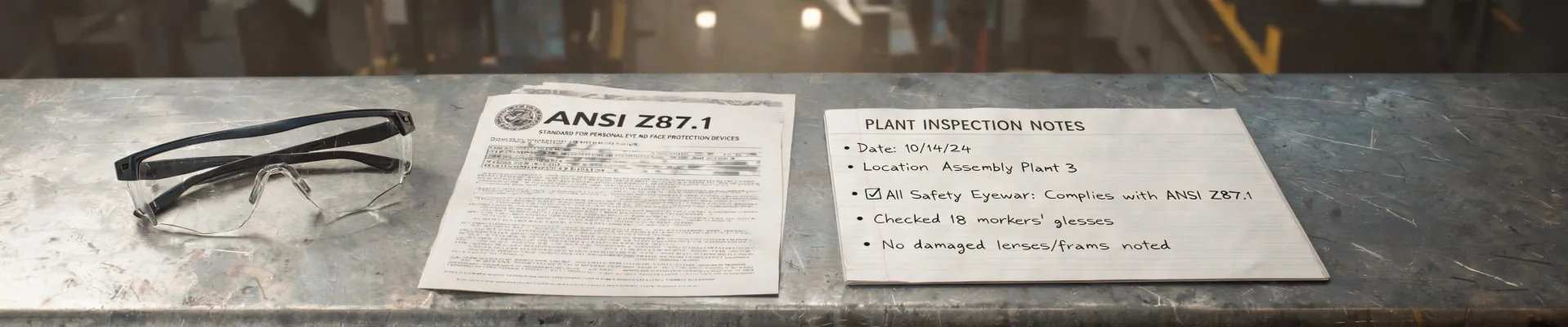
I’m not a safety engineer, so I can’t break down the lab protocols behind every rating. What I can tell you from nine years of procurement is that standards like ANSI/ISEA Z87.1-2020 set a floor, not a ceiling. They tell you a product survived a defined impact test. They don’t tell you how that product behaves at hour eight of a hot, dusty shift—or whether anyone wants to keep wearing it.
The CDC’s NIOSH division estimates that roughly 2,000 U.S. workers sustain job-related eye injuries requiring medical treatment every day. Industry estimates cited by OSHA put the cost above $300 million per year in lost productivity, medical expenses, and worker compensation. And under OSHA’s general industry standard, 29 CFR 1910.133, employers are required to provide suitable eye protection. A serious violation citation now runs into five figures.
In March 2024, a facilities manager called me on a Tuesday afternoon. He had 340 workers, a corporate safety audit scheduled for Friday, and a pallet of low-cost safety glasses that were scratching and fogging so badly his own safety officer pulled them from service. A normal replacement order takes 7 to 10 days. We had 72 hours. We placed the order that evening, paid for expedited shipping, and had a mixed shipment of Wiley X safety glasses prescription-ready frames and impact-rated plano lenses on his dock by Thursday morning. The audit passed. The contract survived. His comment stuck with me:
“That was a stupid thing to try to save money on.”
If your crew can’t see clearly, the spec sheet doesn’t matter
For a lot of buyers, the central question is whether Wiley X safety glasses prescription lenses are worth the premium over generic safety eyewear. After years of fielding emergency calls, my answer is yes.
Here’s the data point that should reframe your purchase: depending on the study you look at, anywhere from 60% to 75% of American adults need some form of vision correction. On a crew of 340, that’s roughly 200 people making daily compromises with over-glasses that don’t fit—or skipping eye protection entirely. Both paths lead to the same place: an incident report that never should have been written.
This is where Wiley X founder safety glasses changed the game. The founder started the company on a simple conviction back in the late 1980s: protective eyewear should be something people actually want to wear. That founding principle still drives the lineup—frames that look like normal sunglasses but carry ANSI Z87.1 certification and, in many cases, meet the military’s MIL-PRF-31013 ballistic standard.
I’ve started calling genuinely good eye protection an “invisible fence.” It works quietly, continuously, without demanding attention. It doesn’t slide off when someone bends over a toolbox. It doesn’t fog at the exact moment they’re grinding close-up. It doesn’t press so hard behind the ears that they think about taking it off “for just a second” next to a cut-off wheel. The invisible fence is exactly what eye protection should be: strong enough to stop a hazard, subtle enough to be forgotten.
One experience convinced me this matters more than any spec sheet. In 2023, I watched two crews on the same site doing the same work side by side. One crew had generic store-brand safety glasses. The other had Wiley X frames with polarized lenses and prescription inserts. Over a full day, the first crew kept pulling their glasses off to wipe fog, adjust the nose pads, and read labels up close. The second crew basically forgot they were wearing anything. Compliance isn’t a training problem. Most of the time, it’s a comfort and clarity problem.
The same cheap trap shows up across your whole PPE system
The pattern repeats in every category, which is why I take glove questions as seriously as lens questions. Clients ask about black nitrile gloves constantly because they’ve learned that the cheapest disposable gloves split, sweat, and rip at the worst possible moment. And the “are latex gloves food safe?” question comes up in nearly every food-processing conversation.
Quick answer: yes, latex gloves are food-safe on paper. But the FDA has banned powdered latex gloves, latex sensitivities are a genuine workplace problem, and for most commercial and industrial work, nitrile is the better all-around choice. Black nitrile gloves became the default in shops because they hold up against oil, chemicals, and abrasion—and they don’t look or feel like clinical medical gloves, which sounds minor until you realize how many workers skip gear that makes them feel like they’re in an exam room.
The deeper lesson is that PPE works as a system, and your crew reads the system. I’ve walked through facilities with excellent ballistic eyewear in stock and torn, cheap gloves at the dispenser. You don’t need a safety audit to understand the message that sends.
Visiting clients read it too. They don’t need a clipboard to evaluate your safety culture—they look at your crew’s gear and know in seconds whether you bought equipment because it was compliant or because it was inexpensive. Premium PPE isn’t just a procurement expense. It’s brand communication.
“But we can’t afford the premium”—run the total cost, not just the unit price
I hear this pushback on almost every call, and honestly, it’s fair. Equipping 340 people with $45 safety glasses instead of $6 safety glasses is roughly a $13,000 difference upfront. That’s real pressure on a quarterly budget.
But the total cost doesn’t end at the invoice. A single serious OSHA violation is a five-figure citation. A lost-time eye injury brings medical bills, a workers’ comp premium increase, schedule disruption, and weeks of paperwork. And when a compliance audit fails because the eyewear is visibly failing, you end up in the rush-order channel with rush-order pricing. I’ve handled hundreds of those calls, and the panic buy is always more expensive than the right buy.
I had my own gut-versus-spreadsheet moment in 2022. The numbers said a low-cost replacement lens vendor was acceptable—specs looked close, delivery windows looked similar, and the price was meaningfully lower. But my gut was uneasy. Every email took four days to get a reply. Every call went to voicemail. I went with my gut and paid the difference. A few months later, that vendor showed up in an industry recall notice—not for the exact product line I’d have ordered, but close enough that I still tell the story. Looking back, I should have trusted my gut sooner.
I can only speak to the industrial, construction, and tactical environments I work in. If you run a low-risk office, you don’t need ballistic-rated military frames—buy what your actual risk assessment calls for. And I’m not claiming budget brands can’t make decent eyewear for the right tasks. What I am saying is that using budget gear in high-risk roles is a bet with someone else’s eyes.
Protection is a message
After more than 200 rush orders—most triggered by a cheap first purchase gone wrong—I keep arriving at the same conclusion. The quality of your safety eyewear reflects the standard you expect from your whole operation. You can see it in how crews wear their gear, how compliance scores trend, and how clients look at your facility.
Wiley X founder safety glasses came from that exact conviction: protection and usability belong in the same frame. When you issue equipment your crew will actually wear, you’re not just spending money. You’re telling everyone who works for you—and everyone who works with you—that safety isn’t the corner where this company cuts costs.
The next time a client calls at 4 p.m. with a deadline emergency, I’ll tell them what I’ve told every client for nine years: the $40 gap between a budget pair of safety glasses and a pair that truly protects is the cheapest insurance you’ll ever buy. I’ve watched that decision play out from both sides, and I know which one I’d stake my reputation on.

Jane Smith
I’m Jane Smith, a senior content writer with over 15 years of experience in the packaging and printing industry. I specialize in writing about the latest trends, technologies, and best practices in packaging design, sustainability, and printing techniques. My goal is to help businesses understand complex printing processes and design solutions that enhance both product packaging and brand visibility.