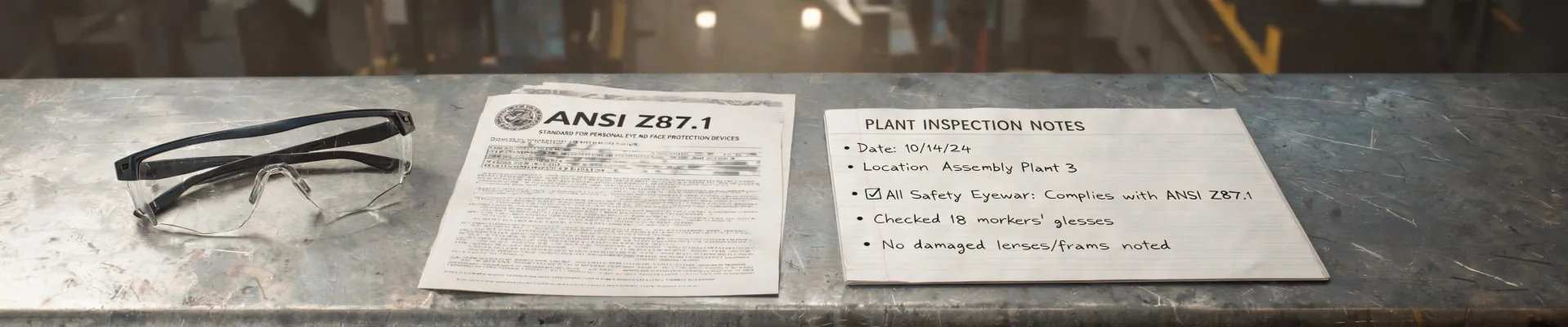
If you're buying safety eyewear for a crew, start with the standard—not the brand name or the cool factor. I've spent about eight years handling PPE orders, and I've personally made and documented 14 significant mistakes that added up to roughly $8,600 in wasted budget. The most expensive lesson? Wiley X clear safety glasses and Wiley X military issue sunglasses are both good, but they are not interchangeable. Tinted ballistic sunglasses look great in a catalog and fail hard for someone working indoors under fluorescent lights. And if your team includes people who wear corrective lenses, prescription safety glasses are not a nice-to-have upgrade; they're part of the actual fit test.
So here's the 30-second version: choose clear Wiley X safety glasses for indoor and mixed-condition work, choose Wiley X military issue sunglasses only for outdoor and tactical roles, and get prescription safety glasses for anyone who needs them. Then check your glove selection separately—because nitrile gloves vs latex gloves is a chemical compatibility decision, not a preference. And please search by model number, not by phrases like "horizontal fence ideas," or you'll spend an afternoon looking at backyard cedar instead of reading ANSI Z87.1 labels.
Why I have a checklist now
I'm not a safety engineer. I'm a procurement coordinator who learned the hard way. In my first year (2017), I submitted an order for "military issue sunglasses" because I wanted something tough. The vendor heard "tinted ballistic sunglasses." We received 27 pairs of dark Wiley X sunglasses that sat in a cabinet for six months (surprise, surprise). The crew worked indoors. About half of them couldn't see color-coded wiring without taking the glasses off. $1,890 went to the shelf, and we lost a week while we scrambled for clear lenses.
That was the first big one. Since then, I've documented every mistake—including the time I approved RX inserts for 12 people because they were cheaper than custom prescription safety glasses. The inserts fogged, shifted, and got blamed for every headache on the job. We caught the problem when a technician took the insert out and taped his regular glasses to the frame. That was the moment I stopped treating prescription safety glasses as an upgrade and started treating them as the main requirement.
Wiley X clear safety glasses vs. military issue sunglasses
Let's clear up something that confused me for years: "Wiley X military issue sunglasses" is not one specific product. It's a family of frames with ballistic features and tinted lenses. Some are built to MIL-PRF-31013; others use the same impact platform but are marketed as standard ANSI Z87.1. The tint is the part that matters most. A dark lens that works on a firing range or a sunny job site is a problem in a workshop where the lighting is already marginal.
What most people don't realize is that "military issue" in a product name is not a spec. It's a marketing term unless the product listing tells you the actual standard. As of January 2025, Wiley X publishes impact ratings for specific models, so check the current product page. If the page doesn't say Z87.1 or MIL-PRF-31013, that's a red flag.
For general industrial use, I now default to Wiley X clear safety glasses. Clear lenses let you read labels, see chemical color codes, and work in mixed lighting without constantly swapping eyewear. That sounds obvious, but I used to think "more protection" meant tinted or mirrored lenses. Actually, a lens you keep on your face is more protection than a lens that gets stuffed in a pocket because you can't see through it.
People think expensive safety eyewear costs more because of the logo. Actually, it costs more because the manufacturer paid for impact testing to maintain a certification. That's not a marketing line; it's a real cost.
Prescription safety glasses: the thing I got backwards
Here's the part I wish someone had told me: prescription safety glasses are not the same as safety glasses with an RX insert. The insert sits behind the lens, close to your eye. It can fog, collect dust, and shift when you're moving. A custom lens in a Wiley X frame is more expensive and way more comfortable. For a 10-hour shift, comfort wins.
If you're ordering for a team, don't ask "Do you need prescription safety glasses?"—ask "Do you wear glasses or contacts at work?" People who wear contacts all the time will say no. Then they take the contacts out after 12 hours and can't drive home safely. I've caught 47 potential errors in the past 18 months using a simple pre-order checklist, and that question is on it.
Nitrile gloves vs latex gloves: not a preference question
Gloves are part of the same story. I once ordered 10 cases of nitrile gloves because I remembered reading that nitrile is more puncture-resistant than latex. The SDS for the chemical we were using specifically required latex. My supervisor caught it before we opened the cartons, but the order had to go back—$880 in return shipping and a two-day delay.
People think "nitrile gloves vs latex gloves" has one winner. Actually, the winner depends on what you're handling. Nitrile holds up well against many oils and solvents; natural rubber latex often performs better with certain aqueous solutions and provides good elasticity. The only correct source is the safety data sheet for the specific product. If your glove supplier can't explain that, find another supplier. And if a vendor says "this glove works for everything," run—that's a vendor who doesn't know their own products.
What "horizontal fence ideas" taught me about searching
This one is silly, but it belongs here. A while ago, I needed a visual barrier to keep people from walking through a work area. I did what any normal person would do: I searched "horizontal fence ideas." I got pictures of cedar fences, not OSHA-compliant barricades. It took me almost an hour to remember that the right approach is to search by the actual hazard and standard—temporary barrier, 42-inch height, high-visibility marking—rather than an aesthetic phrase.
The same principle applies to safety eyewear. Searching "Wiley X clear safety glasses" is good. Searching "clear safety glasses" is okay. Searching "cool sunglasses that are safe" is useless. Use the model family and the standard. That's why I write "ANSI Z87.1+ clear lens" in every purchase request now.
Where my expertise stops
I'm not going to pretend I'm an optician, a chemist, or a ballistic testing lab. My experience is in B2B procurement, not in designing lenses or selecting chemical-resistant polymers. If a worker has a complicated prescription or the job involves unusual chemicals, I defer to the optometrist and the safety data sheet. A good vendor will tell you when their product isn't the right fit. I've had suppliers say "this isn't our strength—here's who does it better," and that earned my trust for every future order.
Standards change, and model lines change. The ANSI Z87.1 rating I checked in January 2025 might not match a frame bought five years ago. Don't assume an old pair of Wiley X glasses is still compliant just because it's still in one piece. Inspect the lens for scratches, check the frame for cracks, and verify the current standard before you reissue it.
Bottom line: start with the hazard, then the standard, then the model. Clear Wiley X safety glasses for most work, military issue sunglasses for outdoor and tactical roles, prescription safety glasses for anyone who can't see without them, and the right glove material for the chemical—not for your preference. I still make mistakes, but they cost less now because I document them. You're welcome to skip the expensive part and use my checklist.

Jane Smith
I’m Jane Smith, a senior content writer with over 15 years of experience in the packaging and printing industry. I specialize in writing about the latest trends, technologies, and best practices in packaging design, sustainability, and printing techniques. My goal is to help businesses understand complex printing processes and design solutions that enhance both product packaging and brand visibility.