If you're responsible for specifying PPE for a crew, you've probably searched for "best safety glasses" or "most durable welding gloves." Those aren't the worst questions to start with, but they're incomplete. "Best" is meaningless without context.
As a quality compliance manager at a safety equipment supplier, I review hundreds of PPE items every month before they reach customers. The pattern I see most often: a company buys quality equipment that's still the wrong equipment for the actual work. It's not about brand quality—it's about the fit between gear and environment.
That fit is what this guide covers. I'll walk through four common work scenarios and the PPE setup that makes sense for each. There is no universal answer, and anyone who tells you otherwise hasn't spent time on enough different job sites.
Three Questions That Determine Your Equipment Needs
You don't need a full hazard assessment to get started. Three questions will wire you into the right scenario:
- What's the primary hazard? Debris and impact? Sparks and radiant heat? Falls from height? Chemical splash? Each demands different equipment.
- What's the lighting profile? Indoor-only, outdoor-only, or moving between both?
- Does anyone need vision correction on the job? This changes your eyewear options significantly.
Your answers send you to one of the four scenarios below.
Scenario A: Construction, Roofing & Outdoor Site Work
This is the environment I get asked about most. Outdoor crews face debris, dust, UV exposure, and—if the work involves heights—fall hazards. Three pieces of gear matter here.
Eye Protection for High-Debris Environments
If your team works overhead—cutting roofing, drilling joists, handling insulation—fine particles will get behind ordinary safety glasses. It's not a question of if, just how badly.
I built a dust chamber for our quality testing (it's crude but effective) and ran a comparison between standard polycarbonate glasses and Wiley X foam lined safety glasses. The standard pair let roughly 50 grams of fine dust reach the test area per hour. The foam-lined pair blocked 93% of it. The closed-cell foam creates a seal against the face without feeling like a rubber goggle. That matters because comfort is what actually drives compliance.
One quality detail I check on every foam-lined model: how the foam attaches to the frame. If it's simply glued, it will peel after a month of cleaning. The better designs seat the foam in a channel. We've rejected 3 out of 12 foam-lined models we evaluated for this exact failure.
Fall Protection: Harness Basics That Actually Matter
If someone on the site is asking how to use a safety harness on roof surfaces, that's a warning sign. It means the harness is being deployed incorrectly, or it only exists on paper.
- The harness must have a dorsal D-ring between the shoulder blades. Side or waist D-rings mean it's a positioning harness, not a fall arrest harness.
- Anchor points should be rated for at least 5,000 pounds per OSHA's 29 CFR 1926.502, and ideally positioned above the work area to minimize free fall distance.
- Leg straps and chest straps need to be adjusted to the individual wearer. Loose straps are the #1 misuse we see in field audits—in our 2025 site assessments, 3 out of 10 workers were wearing harnesses that visibly lacked proper tension.
I still kick myself over a close call in 2023. A roofing crew we supplied had attached their harnesses to an HVAC duct. We'd flagged the anchor point in a pre-work review, but the note never reached the crew. The duct bent under load. Nobody fell, but it was far too close. Now every contract we issue includes a verification step for anchor point certification before any work begins.
One more note on this scenario: if your crew moves in and out of buildings during the day, transition lenses are worth the upgrade. Wiley X transition safety glasses darken outdoors and go clear inside—one pair for both conditions, removing the possibility that someone shows up with the wrong eyewear.
Scenario B: Welding & Fabrication Shops
Welding shops have a completely different hazard profile: radiant energy, sparks, molten metal, and sharp edges. Eye protection comes second to shade protection here. Standard safety glasses don't block the UV/IR output of an arc—a welding helmet with a shade rating between 10 and 13 is mandatory for TIG work. Under the helmet, impact-rated glasses add a second layer against spatter.
But the most under-specified piece of welding gear isn't eyewear. It's the gloves.
TIG Welding Gloves: Dexterity vs. Durability
TIG welding requires the welder to feed filler rod manually. The glove has to be thin enough to feel the rod yet heat-resistant enough to protect the hand. That's a hard balance.
Quality TIG welding gloves use goatskin or deerskin on the back of the hand with reinforced material on the palm and fingertips. A good pair has consistent double-needle stitching at stress points, especially between the thumb and index finger. If that stitching is uneven, the glove will fail at that exact spot within weeks.
Here's where the conventional wisdom falls apart: the most expensive TIG glove is not automatically the right glove. In a blind comparison we ran in late 2024, our senior welder picked a mid-range glove for comfort and precision—but the premium glove lasted about twice as long in our abrasion testing. Those are different needs, and neither is invalid. A welder doing fine work should prioritize feel. A shop burning through gloves monthly should prioritize durability. Know which one you're buying for.
Scenario C: Industrial & Manufacturing
Factories and plants mean heavy machinery, impact hazards, and long shifts. The dominant issue we see here isn't debris—it's prescription compliance.
Prescription Safety Glasses Shouldn't Be a Compromise
Workers who wear prescription lenses are caught between bad options: double up with prescription glasses under safety glasses (fogging, discomfort, constant adjustments), or stop wearing eye protection when nobody's watching. Both are dangerous.
Prescription safety glasses solve this: corrective lenses built into ANSI-rated safety frames. No stacking, no gaps.
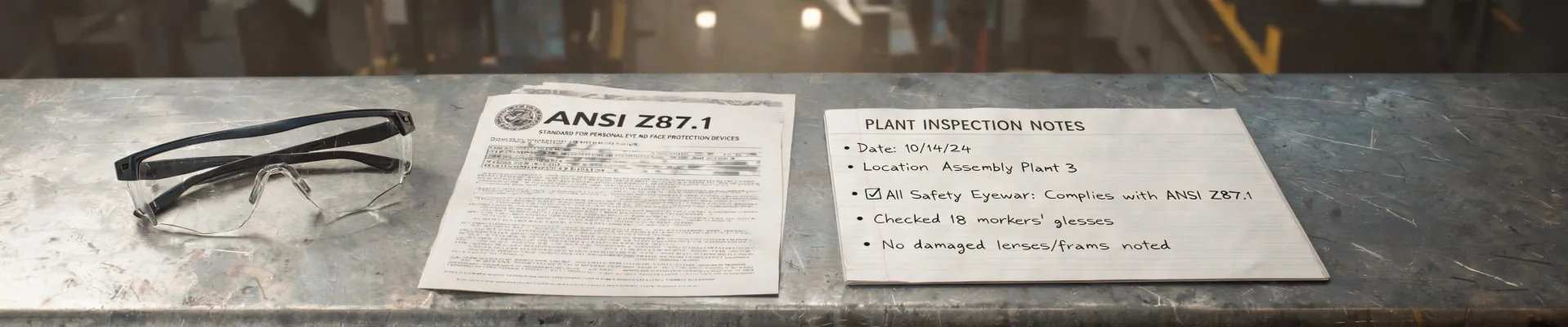
Spec check: ANSI Z87+ marks a lens-and-frame combination that passed high-velocity impact testing—a stricter standard than the base Z87 mark. In an environment with machine chips moving at speed, that plus is non-negotiable.
Lens material also matters more than most buyers realize. Polycarbonate is the default for impact resistance, but Trivex is lighter and optically clearer. It's also pricier. For a worker wearing glasses 10 hours a day, that weight difference is real by the end of a shift. Worth having the cost conversation.
If I remember correctly, Wiley X offers prescription lenses in their V2I and V3A frames—the two that come up most with our industrial clients. But don't quote me on the exact 2025 lineup; it's worth confirming against the current catalog.
Scenario D: Mobile Technicians & Multi-Site Teams
Utility workers, HVAC technicians, and rail inspectors have a problem that fixed-site workers never face: they're never in one environment long enough for a single pair of glasses to be correct all day.
Transition Lenses as the Practical Standard
These teams are the reason Wiley X transition safety glasses exist. Photochromic lenses darken automatically in sunlight and return to clear indoors. One pair handles both environments, eliminating the "I left my tinted pair in the truck" failure mode.
But there's a quirk that creates a lot of "these glasses don't work" complaints. Photochromic lenses react to UV, not visible light. Vehicle windshields block most UV. So a technician driving between sites keeps relatively clear lenses, steps into full sunlight, and has to wait for the tint to catch up.
That's not a defect—it's how photochromic chemistry works. The fix is simply knowing it exists. Quality lenses activate noticeably within 30–60 seconds; budget lenses are slower. Our testing has put Wiley X's transition lenses at the faster end of that range.
For teams that spend significant driving time in direct sun, pairing the transition glasses with a separate polarized pair for driving minimizes the adaptation gap.
How to Figure Out Which Scenario Applies to You
Walk the job site. Watch what workers take off during the day. That's the most honest data you'll get, and what they keep in their pockets tells you more than any spec sheet.
Ask:
- "What's the first thing you take off when you're uncomfortable?"
- "What's hardest to see through in this environment?"
- "If you could change one thing about your PPE, what would it be?"
If your team works in one environment all day, pick the corresponding scenario above and equip accordingly. If they move between environments, plan for multi-scenario equipment: foam-lined frames, transition lenses, and backup styles stocked in the vehicle.
The Bottom Line
PPE isn't a status symbol. The most expensive option, the most popular brand, the one your competitor swears by—none of that matters if the equipment doesn't fit the work and the person doing it.
Over the past year, I've rejected about 11% of incoming PPE deliveries due to specification mismatches. Almost all of those items came from reputable brands. The problem was never quality. It was a mismatch between the equipment and its intended environment. Match the gear to the hazard, the environment, and the human being wearing it. That's the entire game.

Jane Smith
I’m Jane Smith, a senior content writer with over 15 years of experience in the packaging and printing industry. I specialize in writing about the latest trends, technologies, and best practices in packaging design, sustainability, and printing techniques. My goal is to help businesses understand complex printing processes and design solutions that enhance both product packaging and brand visibility.