If you've ever stood in the PPE aisle wondering why one pair of safety glasses costs $8 and another costs $80, this one's for you. I've been handling PPE procurement for a construction company since 2017, and I've made enough mistakes to fill a small dumpster—roughly $11,000 worth, to be honest. In this comparison, I'm putting cheap gear against compliant gear: safety glasses, work boots, and gloves. The standard I'm using is simple: protection, real cost, and whether anyone will actually wear them.
Protection Standards: Looking Safe vs. Being Safe
The first mistake everyone makes? Buying gear that looks like PPE but wasn't tested like PPE. I learned this the hard way.
Eye protection: Wiley X Saint vs. unbranded glasses
Early on, I ordered 30 pairs of no-name safety glasses from an online marketplace. They were $4 each. When they arrived, the lenses had a visible wave pattern when you tilted them. Still, I put them in the rotation. Then a worker took a glancing impact from a nail gun kickback, and the lens cracked—not shattered into safe pieces, cracked into sharp shards. Nobody got hurt, but that was luck, not design.
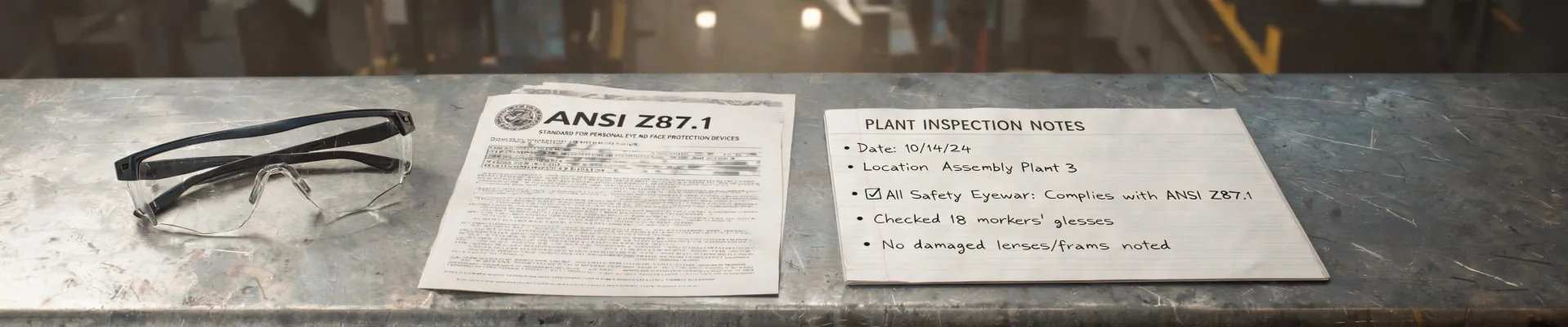
The Wiley X Saint safety glasses I now issue are a different category. They're tested to ANSI Z87.1-2020, which includes high-velocity impact testing. That standard isn't just marketing copy; it's a specific test where a steel ball hits the lens at a set speed. The Saint also covers a bigger chunk of your orbital area than typical economy glasses. Looking back, I should have checked for the Z87.1 marking from day one. At the time, I assumed "safety glasses" meant "safe." It doesn't.
Footwear: Work boots vs. fashion rubber boots
Here's where I get to embarrass myself. A client once asked if her Chanel rubber boots would work for a site walk. She wasn't joking—wet weather was coming, and they were waterproof. I had to explain that while those are lovely boots for city puddles, they are not work boots. Work boots are supposed to meet ASTM F2413-18 for impact and compression resistance. A rubber fashion boot has a cute tread and maybe a designer logo. That's not a replacement for a steel or composite toe.
The most frustrating part: plenty of people make this mistake at every price point. You'd think spending more money would equal more protection, but fashion brands aren't designing for drop tests. They're designing for Instagram.
Hand protection: leather gloves vs. "tactical" mystery gloves
Hands are easy to ignore until you screw them up. I once bought a batch of "heavy duty" gloves that looked great in the product photo. The packaging just said "leather" with no test data. Two weeks in, the stitching failed on a concrete job. That's when I started checking for ANSI/ISEA 105 ratings. It's a standard that grades gloves on cut, puncture, and abrasion resistance. Real leather work gloves—like the kind from a company that actually sweats the details—will have a rating and a clear material breakdown. Cheap ones won't.
Real Cost: How "Cheap" Gets Expensive
Let's do the math. That $4 pair of glasses cost $4. The Wiley X Saint costs more—honestly, it costs a lot more. But here's what I didn't account for back then: replacement frequency.
The cheap glasses scratched within a week. Fogged up constantly. Workers stashed them in their pockets and sat on them. I was reordering every month. I estimate the cheap route cost me about $1,400 over a year, not counting downtime when someone couldn't see clearly and had to stop work. The Wiley X glasses with a military discount (Wiley X offers a solid military discount if you qualify, by the way) cut that replacement cost way down—because the optics are better, the lenses are more impact-resistant, and people don't treat them like disposable junk.
Same story with boots. A $70 pair of generic work boots lasted one guy three months. A $170 pair with good soles and a real safety rating lasted him over two years. That's $70 vs. $85 per year, and the expensive boots had fewer injuries and better comfort. But there's a catch—the expensive boots only win if they fit properly and meet the right ASTM rating. The most expensive boot is worthless if it's not the right boot for your environment.
Gloves are where I finally wised up. Instead of buying three cheap pairs a month, I bought two good pairs and taught the team how to care for them. That's actually where the "how to clean leather gloves" thing comes in. If you wash them with harsh detergent or dry them in the sun, they'll stiffen and crack. I ruined a pair that way. Now we hand-wash them in cold water with saddle soap, air-dry them away from direct heat, and condition them with leather conditioner. It adds maybe 10 minutes of maintenance per month, and it basically doubled the glove lifespan.
Daily Usability: The Feature Nobody Puts in the Spec Sheet
This is the dimension that surprised me. I expected the expensive stuff to be safer. I didn't expect it to be easier to live with.
Take the Wiley X Saint. It has a few design details I used to dismiss: adjustable temples, interchangeable lenses, and the option of RX inserts. For a guy who wears prescription glasses, that's a game-changer. He doesn't have to choose between seeing clearly and not getting metal in his eye. The glare reduction on the polarized version also means people keep them on instead of whipping them off in the sun. A safety glasses that sits in the truck because it's uncomfortable protects exactly nobody.
Boots are the same way. A composite toe boot is lighter than a steel toe in cold weather, because steel conducts cold like a heat thief. If your crew works outdoors in winter, the "nice" boot is arguably the more compliant one—because they'll actually wear it. Fashion rubber boots? They're fine for a rainy commute. For a worksite, they belong in the "I don't want to learn this lesson" category.
The reverse is also true. I once bought a premium pair of gloves that had great ratings but were so thick I couldn't tie a knot. Workers hated them, so they didn't wear them. That's a lesson in the other direction: the best protection is the protection you'll actually use, but only if it's still protecting.
Which Should You Choose?
Here's my shortcut, after all the expensive trial and error:
- If you work in an environment with impact hazards, flying particles, or UV glare, get real safety glasses. The Wiley X Saint is my go-to because of the Z87.1 rating and the optical clarity. If you have prescription needs, get the RX version. And if you're military or law enforcement, the Wiley X military discount is the rare case where the better option is also the budget-friendly option.
- If you stand on concrete, work around heavy objects, or walk through debris, get work boots that meet ASTM F2413-18. Don't buy fashion rubber boots for the job site. You'll waste money and—far worse—risk your feet.
- If you use your hands for anything rougher than typing, get rated leather gloves and maintain them. Clean them the right way: cold water, saddle soap, air dry, condition. That's the "how to clean leather gloves" answer that took me too long to learn.
I still own a pair of cheap safety glasses. They're in my car for emergencies. If you're doing a task that genuinely has zero impact risk, maybe the cheap stuff is fine. But if you're betting your eyesight, your feet, or your hands on a $4 piece of plastic, take it from someone who made that bet and lost: it's not a bargain. It's just a bill you haven't been sent yet.

Maeve Callahan
Maeve Callahan is a head-protection analyst covering Type I and Type II hard hats, climbing-style safety helmets, bump caps, chin straps, suspensions, liners, and face-shield carriers. She applies ANSI Z89.1, EN 397, and EN 12492 criteria while comparing impact attenuation, penetration resistance, lateral deformation, electrical class, retention strength, field of vision, mass, fit range, and temperature conditioning. Her guides help EHS teams, contractors, utilities, and buyers select helmet systems for overhead hazards, work at height, electrical exposure, accessory compatibility, and worker acceptance.