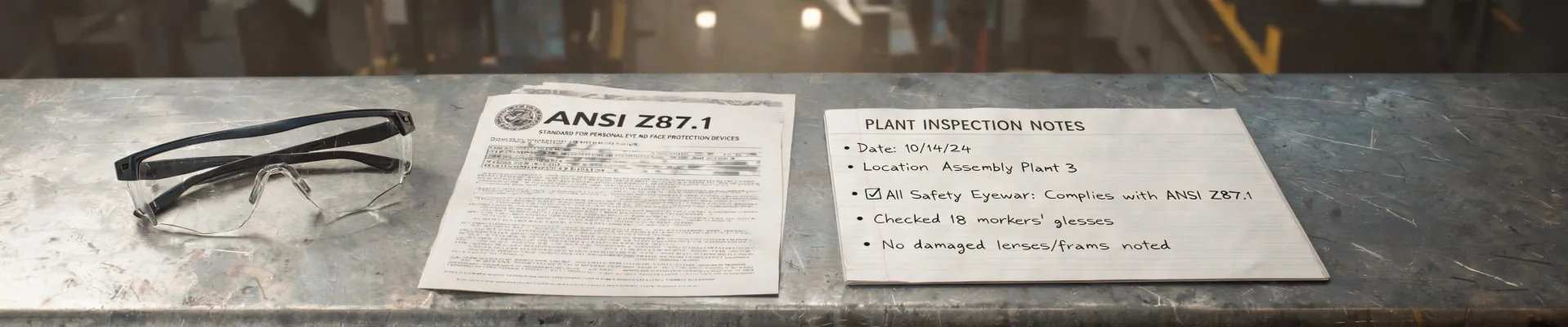
I'm a quality and compliance manager at a safety equipment distributor. I review incoming PPE before it goes to customers—roughly 200 items a week. In our Q1 2024 audit, we found two vendors saying 'ANSI approved' when the lenses weren't even stamped. I sent those batches back. When I set up our verification protocol in 2022, the first-pass failure rate dropped from around 9% to under 2%. That's the lens I see these purchase decisions through.
Look, there's no single best PPE kit. Not for you, not for your crew, not for anyone. A pair of Wiley X safety glasses that makes sense on a tactical range is not automatically the right choice for a lab bench. The same is true for boots, coveralls, and fire extinguisher inspections.
Here are the three scenarios I get asked about most:
- You need Wiley X prescription safety sunglasses because you can't see without correction but still need impact protection.
- You're building a field kit and searching for tactical boots near me or a durable layer like Carhartt coveralls.
- You're the person responsible for the building, which is why the search bar says where to get a fire extinguisher inspection near me.
Each one has a different answer. Let's walk through them.
Scenario 1: Wiley X Prescription Safety Sunglasses
If you need corrective lenses and you're exposed to impact, flying debris, or strong sunlight, Wiley X prescription safety sunglasses are a legitimate answer. The brand's reputation is built around military and ANSI-rated impact protection, not just tinted lenses. That matters.
For prescription wearers, there are two routes. One is a Wiley X frame with an RX insert behind the standard lens. The other is a Wiley X frame with your prescription built directly into the lens. I get asked which is better all the time. Honestly, for all-day wear, full prescription lenses tend to work better. Inserts can fog, and the extra layer makes it harder to see in bright peripheral light. I don't have hard data on insert vs full-lens satisfaction, but based on feedback from our customers, full RX wins more often than not. Inserts make sense if several people share the same frames and need different prescriptions.
Whatever option you choose, check the markings. ANSI/ISEA Z87.1 is the baseline for occupational eye protection in the U.S. If the lens is marked Z87+, it also meets the higher mass and high-velocity impact requirements. That's the rating to look for if you're grinding, hammering, chipping, or cutting. If you need ballistic-rated protection, ask whether a particular model meets MIL-PRF-32432. Not every pair of Wiley X glasses does. The box will tell you. So will the lens marking.
Wiley X Safety Glasses Nearby: What to Ask Before You Go
If you searched for 'Wiley X safety glasses nearby,' don't assume the first tactical or workwear retailer has a full prescription line. Many stores stock plano (non-prescription) models and a few display frames, but the prescription service is done by an outside lab. That's fine, but you need to ask about it beforehand.
Call and ask whether they carry prescription safety sunglasses in stock, whether an optician can measure pupillary distance on site, what the return policy is if the frame doesn't fit, and whether they can adjust the frame after the lenses are installed.
A store that can do all four is worth more than the lowest online price. I still kick myself for once buying a pair of safety glasses online without trying them on. The specs looked right on paper, but the frame dug into the back of my ears by lunch. Fit is not a cosmetic detail. It's a compliance issue.
That said, if you only need reading glasses for close work and you're not around impact hazards, you probably don't need a ballistic frame. Basic Z87+ reading safety glasses from a trusted brand will do the job. I'm not going to push a $200 pair of Wiley X prescription safety sunglasses on someone who just needs emergency backup readers. Buy the right level for the hazard.
Scenario 2: Tactical Boots Near Me and Carhartt Coveralls
Field work is a different decision tree. You're not just choosing between one pair of safety glasses and another. You're assembling a kit that has to work in cold, mud, sun, and possibly on uneven terrain. The two things that bite people hardest are boots and outer layers.
Tactical Boots Near Me: A Fit-First Approach
When you search 'tactical boots near me,' you get a list of retailers that sell boots. But the real task is not 'find a tactical boot.' It's 'find a boot that fits your arch, ankle shape, and workday.'
I can't tell you which brand to buy because your feet are not my feet. But I can tell you to go somewhere you can walk around in them for ten minutes. I don't have hard data on how many people buy the wrong size online, but based on the return requests I see, it's a third or more. Sizes vary by brand, and some 'tactical' boots are closer to hiking boots than work boots. That's fine in the field, but less fine on a concrete warehouse floor.
Fit checks: if you're on hard surfaces all day, look for a boot with good shock absorption and a wider contact sole. If you're on slopes or loose gravel, ankle support and lugged outsoles matter more than cushioning. If you need a safety toe, composite is lighter in cold weather than steel.
I still regret buying a heavily recommended boot online without trying it on. The return process took weeks, and my feet paid for it in the meantime.
Carhartt Coveralls: A Layer That Needs a Second Look
Carhartt coveralls are easy to recommend for dirty work, cold weather, and jobs that wreck your regular clothes. They're tough, they have the right pockets, and a full zip makes them much easier to get in and out of than a bib style. But there's a misconception that I have to flag every time: heavy cotton duck is durable, but it is not automatically flame-resistant.
If you're welding, doing electrical work, or exposed to flash fire, regular Carhartt coveralls are not a substitute. You need a garment that's labeled FR and tested to the applicable standard, such as ASTM F1506 for arc flash or NFPA 2112 for flash fire. That thinking comes from the old era when 'cotton is safe because it doesn't melt.' Cotton doesn't melt, but it can ignite. Carhartt makes FR versions of their coveralls. The label will say it.
Scenario 3: Where to Get a Fire Extinguisher Inspection Near Me
This is the scenario where people ask the right question for the wrong reason. 'Where to get a fire extinguisher inspection near me' is a local search. But before you pick a contractor, you need to know whether you need a monthly visual check, an annual maintenance inspection, or a hydrostatic test. They are not the same thing.
In the U.S., OSHA 29 CFR 1910.157 requires portable fire extinguishers to be maintained in a fully charged and operable condition. NFPA 10 is the standard that lays out how. The short version: someone in your building should do a quick visual check every month, and a certified inspector should do the annual maintenance inspection. If the extinguisher has been used, or if it's damaged, it needs service right away, not next January.
When you search for fire extinguisher inspection near me, look for a licensed fire protection contractor. Avoid a general handyman who says he can 'check them.' Ask for proof of liability insurance and ask if the technician is licensed or certified in your state. The inspection tag should include the date, the technician's name or license number, and what was done.
Hydrostatic testing is a separate interval. Depending on the type of extinguisher, it can be every 5, 10, or 12 years. Your contractor should be able to look at the manufacturer's label and give you the exact interval. If they don't, that's a red flag.
I can only speak to U.S. requirements. Your local fire marshal may have stricter rules, and some insurance companies have their own audit requirements. A good contractor will know the difference.
How to Know Which Scenario You're In
If you're still reading and wondering which path applies, here is my practical shortcut:
- If you're a worker who needs to see clearly and protect your eyes, start with the hazard. Dust and glare point toward Wiley X prescription safety sunglasses or Z87+ safety glasses. Fragments and projectiles point toward high-impact or ballistic-rated models.
- If you're building a field kit, start with fit. Try on tactical boots before you buy them. Buy Carhartt coveralls with the job-specific layer in mind, and if there's a risk of fire, buy the FR version.
- If you're a facility manager or small business owner, start with standards. NFPA 10 and OSHA are not optional. Find a licensed fire extinguisher inspection contractor and put the inspection schedule on your calendar before the fire marshal asks for it.
No scenario is exclusive. A facility manager might also be a weekend hunter who wants Wiley X safety glasses and a pair of lined coveralls for cold weather. That's fine. Just don't buy one item and assume it covers all the others.
Bottom line: buy the level of protection your work demands, not the level a marketing photo suggests. I've made the expensive mistake of trusting a label without checking the rating. It's a mistake you don't need to repeat. The right gear is out there, and it usually starts with a question, not a checkout button.

Maeve Callahan
Maeve Callahan is a head-protection analyst covering Type I and Type II hard hats, climbing-style safety helmets, bump caps, chin straps, suspensions, liners, and face-shield carriers. She applies ANSI Z89.1, EN 397, and EN 12492 criteria while comparing impact attenuation, penetration resistance, lateral deformation, electrical class, retention strength, field of vision, mass, fit range, and temperature conditioning. Her guides help EHS teams, contractors, utilities, and buyers select helmet systems for overhead hazards, work at height, electrical exposure, accessory compatibility, and worker acceptance.