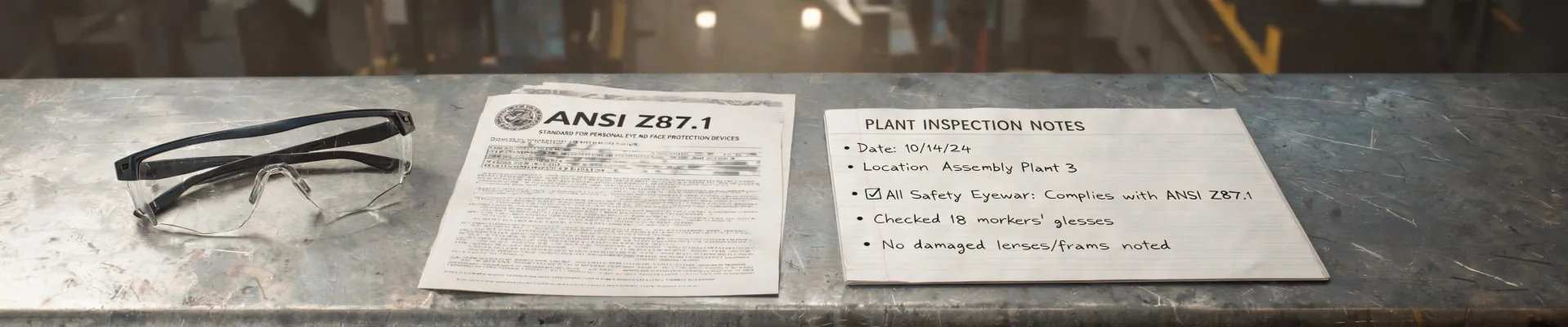
When our CFO asked why we were spending $4,200 a year on safety glasses, I didn't have a good answer ready.
It was Q2 2024, budget review season. She'd pulled up a supplier catalog on her screen—ANSI Z87.1-rated safety glasses, eight dollars a pair. "These meet the same standard as the ones we're currently buying, don't they? So why are we paying more?"
I'm the procurement manager at a 140-person construction and manufacturing company. I've managed our PPE budget—roughly $60,000 annually—for six years, tracked every order in our system, negotiated with dozens of vendors. I should have had a crisp answer. Instead, I mumbled something about "better durability" and promised to look into it.
So I looked. And what I found turned my entire approach upside down.
The cheap glasses were the most expensive thing we ever bought. The invoice just never said so.
The Commodity Trap
For most of my career, I treated safety glasses like printer paper. Same standard, same protection, buy the cheapest. It's the kind of thinking that gets approving nods in budget meetings.
It's also wrong—and I say that carefully, because I'm not a safety engineer. I can tell you what the data shows, but the technical details should be verified with your safety officer. My data, though, is unambiguous.
First, ANSI Z87.1 is a baseline, not a badge of excellence. It tests basic impact resistance. It does not tell you how a frame behaves when dropped on concrete two or three times a week. It does not measure whether a lens stays optically clear after months of UV exposure. It doesn't guarantee the lens stays seated in the frame when something heavy hits it at speed.
Second, we're inconsistent about how we evaluate PPE. A site supervisor will spend twenty minutes researching a Milwaukee hard hat—suspension type, Type I vs. Type II rating, accessory compatibility with welding shields. But safety glasses? "It's got the sticker. Get the cheapest ones." I've watched that exact conversation happen more times than I can count.
And third, "meets the standard" is not the same as "right for your specific hazard." A chemical plant and a steel fabrication shop need fundamentally different eye protection. A military training range needs ballistic-rated protection. A construction site with overhead grinding needs high-impact protection. The standard is a floor that every product passes. It doesn't pick the right tool for your particular risk.
What the Data Actually Showed
When I audited our 2023-2024 spending line by line, the pattern jumped out immediately.
The $8 glasses had a replacement cycle of about four months. Workers broke them, scratched them, or simply lost them—and then grabbed a fresh pair from the supply bin. The real cost was around $24 per worker per year, before accounting for the admin time of processing purchase orders, restocking the bin, and doing inventory counts.
That's the mistake I kept making: looking at unit price instead of total cost. In 2022, I compared two vendors for our annual eyewear order. Vendor A quoted $4.50 a pair. Vendor B quoted $7.00. I almost went with A until I checked the fine print: $85 flat shipping, plus a $90 handling charge per order. Vendor B included free shipping and a free lens cleaning station. The "cheaper" vendor was actually 31% more expensive once everything was counted.
Same principle, bigger scale. Those $8 glasses were bleeding us slowly, and I hadn't noticed because I was staring at the sticker price.
We switched our high-risk crews to Wiley X tactical glasses in early 2024. The pricing was, as of Q1 2024, roughly $65-70 per pair for the models we standardized on—don't quote me on the exact figure, the market changes fast—but the important number was the payback period: about five months, based on our tracking spreadsheet. The frames lasted two to three years per pair. The lenses resisted scratching in ways the cheap ones didn't. The anti-fog coating held up, which mattered more than I expected.
But here's where I have to correct myself. The durability savings were real, but they weren't the biggest cost we recovered.
The Hidden Cost Nobody Measures
The biggest cost of cheap safety glasses isn't replacement frequency. It's non-wear.
Workers don't wear glasses they don't like. If the lenses fog up when they move between temperature zones, if the frames dig into their temples after an hour, if the optics cause eye fatigue by mid-afternoon, they take them off. The glasses end up on a collar. Or in the truck. Or "left at home." And then that $8 investment is protecting exactly nothing.
I can't measure non-wear directly in our cost system. But I can measure it indirectly through near-miss reports. And I'll never forget the one we had in October 2023.
A Dremel disc shattered on a job site. A fragment hit a worker directly in the eye. The lens absorbed the impact—I saw the dent pattern afterwards. The worker walked away without a scratch.
But for weeks afterward, I kept asking myself: what if he'd been wearing the cheap $8 glasses with the popped-out lenses I kept finding in the warehouse? I'd held those broken frames dozens of times. They flexed. The lenses detached. I knew what they'd do in an impact. I just hadn't done anything about it because the unit price was so appealing.
Seeing our Q1 safety reports vs. the near-miss documentation made me realize something uncomfortable: we hadn't been buying eye protection at all. We'd been buying the illusion of it.
We've Been Asking the Wrong Questions
This pattern goes beyond eyewear. I see it across the safety industry.
People search "are latex gloves food safe" when the real question they need to answer is "what glove material is correct for the specific chemicals in my facility?" A facility manager will spend $30,000 on a glass pool fence—glass that sits behind a locked enclosure—and obsess over its breakage specifications. But put the same person in front of the PPE budget, and safety glasses get approved based on whatever's cheapest with the right sticker.
Ask a supervisor about their Milwaukee hard hat's rating and they can lecture you for ten minutes. Ask about safety glasses: "We get them from the supply closet."
It's a strange mismatch. We over-analyze passive safety features and under-analyze the one piece of equipment placed directly between a worker's eyes and the hazards of the job.
What Actually Worked For Us
I'm not going to claim Wiley X is the only answer. There are good manufacturers in this space, and we use several. But I've learned to value specialists over generalists, and Wiley X is a good example of why.
A specialist doesn't try to be everything. They build eye protection as their core business: ballistic certification, ANSI Z87.1, prescription lenses, polarized options. Their tactical gloves come from the same focused engineering culture. And importantly, when we evaluated them, they were honest about what their products were and weren't designed for. That honesty—the willingness to say "this isn't our strength, here's who does it better"—earned my trust more than any marketing brochure.
Here's what I'd tell anyone managing PPE procurement:
- Stop comparing sticker prices. Compare total cost. Track replacements, admin time, non-wear indicators, incident reports. If you don't have this data yet, start collecting it now.
- Match the product to your hazard assessment. If your people work near grinding, cutting, or high-velocity processes, ballistic-rated eyewear is worth every cent. If they work outdoors, polarized lenses matter. If they need prescription protection, buy proper prescription safety glasses instead of over-glasses that fog up.
- Buy from people who know their limits. A vendor who says "we don't do that well, but here's who does" is more trustworthy than a one-stop shop that claims to do everything.
It took a CFO's question and a near-miss to teach me what I could have figured out from a spreadsheet years earlier. The price tag isn't the cost. The risk is the cost.
Every $8 pair in the supply closet was a gamble. We almost lost one in October 2023. If you're making the same gamble, I hope you read this before your own near-miss—not after.

Maeve Callahan
Maeve Callahan is a head-protection analyst covering Type I and Type II hard hats, climbing-style safety helmets, bump caps, chin straps, suspensions, liners, and face-shield carriers. She applies ANSI Z89.1, EN 397, and EN 12492 criteria while comparing impact attenuation, penetration resistance, lateral deformation, electrical class, retention strength, field of vision, mass, fit range, and temperature conditioning. Her guides help EHS teams, contractors, utilities, and buyers select helmet systems for overhead hazards, work at height, electrical exposure, accessory compatibility, and worker acceptance.