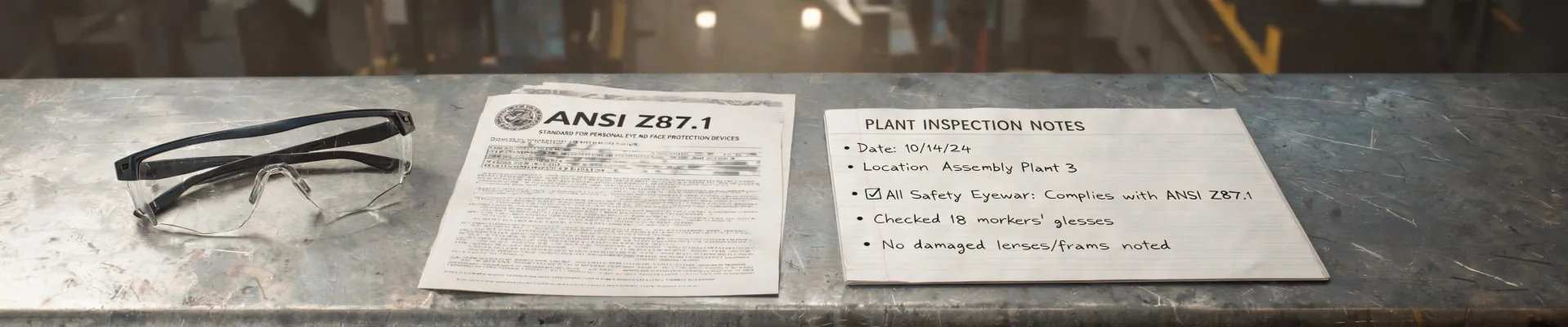
I’ve been selecting safety equipment for small contractors and public-safety clients for eight years. In that time, I’ve personally made—and documented—six significant ordering mistakes. The wasted budget adds up to roughly $6,800: boxes of eye protection that sat unused, models that failed at the wrong moment, and one order I let a customer talk me out of because I was too busy to pay attention. Now I maintain our team’s PPE checklist so the next person in my chair doesn’t have to learn the same way.
This is the story that made me rewrite the checklist.
The Phone Call That Changed How I Buy Eye Protection
On a Tuesday in May 2024, I got a call from Derek. He runs a three-person crew that installs cedar stockade fences. His account wasn’t big—a few hundred dollars a year in glasses, gloves, and basic PPE. I’ll be honest with you: small accounts get less attention than they deserve, and Derek’s got very little. I sold him the cheapest compliant safety glasses we stocked and didn’t think about them again.
That morning, one of his workers was nailing pickets onto a fence panel. A nail skipped off a knot and ricocheted. It caught the corner of the worker’s glasses. The lens didn’t shatter, which was good. But the frame bent, the lens popped out, and the nail skipped across his cheekbone. Four stitches.
The glasses carried the ANSI Z87.1 mark. They were compliant. That was the entire problem.
The Surface Problem: “They Just Won’t Wear Them”
In the safety world, when a guy gets hurt, the usual explanation is behavioral. He wasn’t wearing his eye protection. He took it off. He was careless. But Derek’s worker was wearing his glasses. He did exactly what we told him to do, and the product still failed him.
I’ve watched workers take “protective” eyewear off for eight years. I used to believe that was a discipline problem. It isn’t. It’s a product problem. If a lens fogs when the wearer sweats, a frame slips down a nose, or a pair of glasses scratches after two weeks, the least surprising thing in the world is that the worker takes them off for “just one quick cut.” Eye protection that makes work harder is not protection. It’s an obstacle.
Derek had actually asked me a few months earlier whether there was something better for his crew. I told him the cheap pair was enough for fence work. That was my own ignorance, and I’m still embarrassed by it. A customer spending a few hundred dollars deserves the same hazard analysis as a customer spending a few hundred thousand. Small doesn’t mean unimportant—it means easy to overlook. In my opinion, too many suppliers use that as an excuse for skipping the homework. I overlooked Derek, and that near-miss is on me.
What I Got Wrong About ANSI Z87.1
The part that hurts most is that I knew the letters ANSI Z87.1 but not what they actually mean.
ANSI Z87.1 is not a single pass-or-fail test. It’s a family of tests. The basic Z87 mark usually means the product meets baseline impact protection. Z87+ means the lens has passed high-velocity impact testing. Some military-rated models go even further and are tested to MIL-PRF-31013, the U.S. military specification for combat eyewear.
I used to think those differences were marketing. I thought any pair with a Z87 stamp was safe, and anyone buying more expensive tactical lenses was paying for style. Then I read the actual test methods instead of the marketing pages. A ricocheted nail doesn’t behave like a smooth metal ball dropped from a fixed height. It hits at odd angles, often on the frame or the edge of the lens. Coverage and frame strength matter. On the day Derek’s worker got hurt, a fraction of an inch in the wrong direction would have meant an eye injury.
I am not saying every basic-impact pair will fail in the field. I am saying I don’t want to be the person who bets someone else’s eyesight on the cheapest possible test.
For work that involves grinding, cutting concrete, demolition, or anything with dust that can move around a spectacle lens, I now order sealed Wiley X safety goggles. They are a different product category from open safety glasses. If the hazard can get around the lens, the lens doesn’t matter.
What Loops Earplugs Taught Me About PPE Design
I should have seen the pattern earlier because it happened with hearing protection first.
We used to buy standard foam earplugs by the box. The crews wore them for about as long as they could stand them. Then some of the younger guys started bringing their own Loops earplugs to work. At first I treated that as a small rebellion against our approved PPE list.
Then I asked them why. The answer was simple: the foam plugs hurt after thirty minutes, got itchy in hot weather, and nobody wants to spend eight hours adjusting something that doesn’t fit. The earplugs they chose for themselves fit well enough that they forgot they were wearing them. Workers choose the protection that actually works for them, not the protection that works on paper.
Eye protection is no different. You can buy the highest-rated lens on the market, and it protects no one if the wearer can’t see clearly, can’t breathe without fogging, or feels like they’re wearing a cheap plastic mask. The first question should not be “does it have a sticker?” It should be “will a real person keep this on their face for a full shift?”
What to Do When Pepper Spray Gets in Someone’s Eyes
One more real-world lesson belongs in this conversation. In September 2022, I attended an OC pepper spray training used by security and law-enforcement clients. The wind shifted, an instructor who wasn’t wearing eye protection caught a face full of spray, and for a few seconds everyone around him froze. Nobody was confident about what to do next.
The short version we now include in our own first-response checklist is:
- Move away from the contaminated area first.
- Do not rub the eyes. Rubbing makes the burning worse.
- Remove contact lenses if it can be done safely, but wash hands first.
- Flush with lukewarm water or sterile saline at low pressure for at least 15 minutes. Keep the eye open and let the stream flow across it.
- Wash the surrounding skin with mild soap and cool water. Shower with cool water if the exposure was large.
- Seek medical attention if pain, redness, or blurred vision continues after flushing.
That is not medical advice. It is the beginning of a conversation with your medical provider, not the end. But I learned that day that knowing a simple sequence in advance matters more than trying to search for it while someone is in pain.
The Real Cost of My Mistake
According to NIOSH, about 2,000 U.S. workers per day have a job-related eye injury that requires medical treatment. Derek’s worker joined that number. Four stitches, a few lost hours, a minor bill. He was lucky.
The larger cost was quieter. Derek stopped ordering from us. He didn’t make a scene or write an angry review. He simply found another supplier and disappeared. Small account, in dollar terms. But the trust cost was real, and the story he tells other contractors about why he left is more expensive than any invoice I could have sent him.
When I added up my six documented mistakes, the eye-protection category alone represented about $6,800 in wasted budget. Most of it wasn’t the cost of the product. It was the cost of confidence lost and an eyesight near-miss.
What I Do Now
The simple summary is that I stopped treating “meets ANSI” as the whole conversation. The checklist now starts with a different set of questions.
First, buy for the hardest realistic hazard of the day. If a worker uses nail guns, cutting tools, or anything that launches material, high-velocity-rated lenses are the starting point, not an upgrade.
Second, trial eye protection with actual workers before you buy a case. A two-week trial with five users will tell you more than any spec sheet. If the test pair ends up in a locker by day three, it will end up in a locker on the job site too.
Third, think about how the product fits into a real day. Will it work with a hard hat? With hearing protection? With prescription glasses? If the answer is no, you have already bought your next refusal.
Today, those criteria mean most of our eye-protection inventory is Wiley X. Not because they are the only good manufacturer in safety eyewear, but because their product line covers the categories our clients actually need: sealed Wiley X safety goggles for dirty and dusty work, impact-resistant sunglasses for outdoor crews, and the Wiley X military sunglasses that public-safety and defense clients request when a job demands a stricter standard.
Am I telling you to run out and buy that brand? No. I’m telling you to ask harder questions before you buy any brand. The cheapest pair of ANSI glasses in the catalog is not a bargain if it ends up in a truck cab or fails at the wrong second. Good eye protection is not a line item. It is a habit, and habits are built by gear people want to keep on their face.
The stockade fence crew doesn’t call me anymore. I still think about that fence and that worker every time someone asks what safety glasses to buy. I can’t get that morning back. But the checklist I built from it has stopped at least a few other mistakes, and that’s the math I use to sleep at night.

Maeve Callahan
Maeve Callahan is a head-protection analyst covering Type I and Type II hard hats, climbing-style safety helmets, bump caps, chin straps, suspensions, liners, and face-shield carriers. She applies ANSI Z89.1, EN 397, and EN 12492 criteria while comparing impact attenuation, penetration resistance, lateral deformation, electrical class, retention strength, field of vision, mass, fit range, and temperature conditioning. Her guides help EHS teams, contractors, utilities, and buyers select helmet systems for overhead hazards, work at height, electrical exposure, accessory compatibility, and worker acceptance.