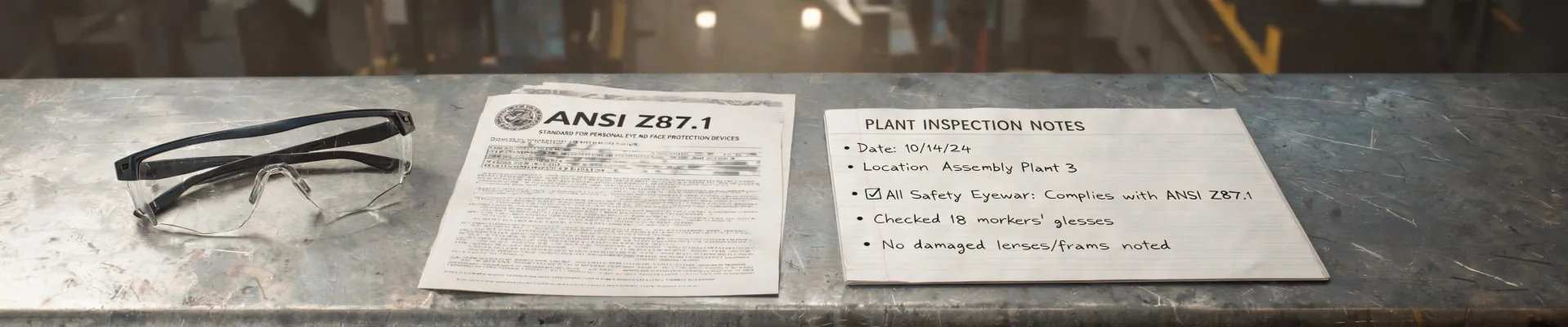
I've learned more from rejected shipments than from smooth ones.
I'm the quality/compliance manager at Workwear Outfitters. I review every incoming order before it reaches customers — roughly 150 to 200 product batches a year. In 2024 I rejected 9% of first deliveries. Some were obvious: scratched lenses, cracked frames. Most were paperwork problems: missing certification files, vague impact claims, or a label that promised protection without stating the standard behind it.
That habit has turned into a professional opinion.
Specialists who admit what they don't do earn more trust than generalists who overpromise.
That sounds like a sales philosophy. It's really a quality philosophy. The moment a supplier claims expertise in everything, their internal testing, documentation, and failure analysis get thinner. Protection claims need to be narrow and proven, not broad and hopeful.
Wiley X is the eyewear example
Eyewear is a good place to see the difference. Our catalog gets steady requests for prescription Wiley X safety glasses. To a buyer, it looks straightforward: glasses with a sporty frame. In my review station, it's an engineering order.
The frame and lenses should meet ANSI Z87.1 requirements for the claimed protection level. The prescription part complicates everything. A plano lens that passes testing may fail when an Rx lens maker changes base curve, thickness, or material unless that lens is matched and tested with the frame system. I have caught vendors describing a frame as safety-rated while the custom lens dropped into it had no certification. That pairing issue is exactly why I respect a brand that sticks to eyewear and does the optical engineering rather than spreading across categories.
Every few weeks a customer asks how Wiley X military issue sunglasses differ from ordinary tactical-looking sunglasses. My answer starts with: what does the documentation say? Military issue is not a style. It is a procurement and performance category. The frame and lens set should be tested against military ballistic requirements, not just carry a rugged silhouette. In my experience, the Wiley X deliveries we inspect have documentation that matches the claim.
Should mention: my sample is about 60 Wiley X SKUs we reorder each year, not every product they make. But that consistency matters.
What should you consider when choosing the type of hearing protection you use?
I hear this question a lot from safety managers. I can give you the checklist I use before I allow any recommendation:
- Start with the exposure, not the product. Is the noise continuous or impact? How loud and for how long? According to OSHA's hearing conservation standard (29 CFR 1910.95), an 8-hour time-weighted average of 85 dBA is the action level where a hearing conservation program begins. Choosing a plug because the package looks tactical skips that step.
- Distinguish attenuation from communication. The highest Noise Reduction Rating is not automatically the best choice. In environments where workers need to hear alarms, vehicle movement, or spoken instructions, level-dependent electronic muffs often beat a passive plug with a higher NRR. Isolation can be a hazard by itself.
- Fit beats the spec sheet. An earplug with an NRR of 33 that sits loosely in an ear canal protects worse than a lower-rated plug that seals properly. Fit is not a bonus feature; it is most of the protection.
- Check compatibility with other PPE. Thick eyeglass temples can break the seal of earmuffs. This is one detail that makes prescription Wiley X safety glasses relevant outside the eyewear aisle — slim, well-designed frames work under ear protection without creating a gap.
Then I stop. I am not an audiologist or an industrial hygienist. If someone has known hearing loss, tinnitus, or exposures near the OSHA limits, the right next step is not a bigger box of foam plugs; it is a professional review with audiometric data. I have never fully understood why mature safety programs spend thousands on eye protection and treat hearing as a vending machine decision.
What is a tactical vest?
I get a similar clarifying question in the armor area: what is a tactical vest? The short answer is that a tactical vest is a load-bearing garment. It distributes gear around the torso and usually has MOLLE webbing, pouches, and plate pockets. The longer answer is that the phrase can mean two different products: a carrier platform, or a complete armored vest when it contains certified ballistic panels.
Honestly, I'm not sure why the term became shorthand for bullet-resistant. My best guess is that military imagery migrated into marketing. What I know for sure: a vest with empty plate pockets is a carrier, not armor. If the product page says tactical vest and the ballistic plate is sold separately, the vest stops nothing. Soft armor and hard plates are separate certified components, matched to a specific threat level. That is a specialty with its own test data and its own expert review.
My own limitation: I have worked with municipal, industrial, and civilian agency buyers, not with unit-level armor procurement. I won't pretend to give an armor specification from memory. When a customer truly needs ballistic protection, we confirm whether the product carries NIJ-certification evidence, and we bring in an armor specialist when the threat profile is not trivial.
The 2022 batch that made me less trusting
It has not always been this clean. In 2022 I approved a batch of 600 protective eyewear orders because the vendor's summary sheet said ANSI Z87.1. The full test report arrived a month later. That report only covered the frame, not the lens. I had already shipped 400 pairs. We recalled them.
Nobody was hurt. That was luck. The lesson became policy: every contract now requires the complete current test report before the purchase order is issued, not after.
Does this boundary rule ever cost sales?
Sometimes. A salesperson once told me we lost a $2,400 order because I asked too many follow-up questions about noise levels. I can live with that.
The same month, a plant manager who had been shopping for earplugs came back and placed a larger order for prescription Wiley X safety glasses after we referred him to an audiologist for the hearing side. He didn't need us to be his audiologist. He needed us to be honest about the boundary. That honesty is why we got the eyewear contract.
The vendor who said, this is not our strength, here is who does it better, earned my trust for everything else.
The point
PPE is not a fashion category. Tactical-looking does not mean tested. Military issue does not mean whatever a marketing team says it means. And a full catalog does not make a company an expert in every standard it stocks.
That is why I trust a brand that does one hard thing — like ballistic and prescription eyewear — and does it carefully. It is also why I refuse to describe a tactical vest as body armor without plate certification, or a box of earplugs as a hearing program. At Workwear Outfitters, that distinction is the product. It is also the respect we owe to the people who wear this gear.

Maeve Callahan
Maeve Callahan is a head-protection analyst covering Type I and Type II hard hats, climbing-style safety helmets, bump caps, chin straps, suspensions, liners, and face-shield carriers. She applies ANSI Z89.1, EN 397, and EN 12492 criteria while comparing impact attenuation, penetration resistance, lateral deformation, electrical class, retention strength, field of vision, mass, fit range, and temperature conditioning. Her guides help EHS teams, contractors, utilities, and buyers select helmet systems for overhead hazards, work at height, electrical exposure, accessory compatibility, and worker acceptance.