-
Why I started pulling PPE specs apart
-
Which PPE can protect you from liquid chemicals? The short list
-
Wiley X-SG-1 tactical goggle reviews: what our side-by-side testing revealed
-
Wiley X safety glasses vs. SG-1 goggles: when to use each
-
What about other PPE? Pyramex hard hat and "body armor drink" aside
-
The benefit of educating the buyer
-
TL;DR for your next PPE order
Short answer: For liquid chemical splash, don't trust a pair of standard safety glasses—even if the box says "chemical splash." You need a sealed goggle that meets ANSI Z87.1+ D3, and ideally one with venting that fits your task. In our plant, the Wiley X SG-1 tactical goggle has been the repeat pick for about 18 months now, not because it's the cheapest up-front, but because its total cost of ownership beats every alternative I've tracked.
I've managed procurement at a 280-person specialty chemical packaging company for 6 years. Our annual PPE budget is around $180,000. In Q2 2024, I finally sat down to compare eight goggle and glasses suppliers using the same TCO spreadsheet I use for every buy. This article is the honest breakdown—including where my conclusion might not apply.
Why I started pulling PPE specs apart
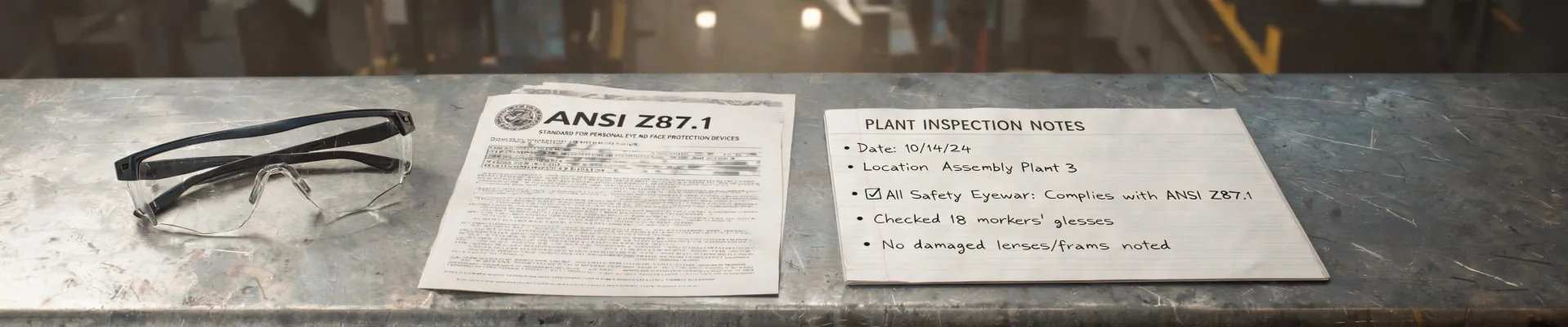
Two orders back, we had an incident: a worker was wearing plain ANSI Z87.1 glasses (yes, with a splash sticker) and a pump line coughed. He got a few drops under the glasses. Not permanent damage, but lost-time, a report, and later $24,000 in workers' comp premiums after the rate adjustment. That "cheap" $6 pair ended up costing $24,006. That's the kind of consequence that changes your priority from unit price to total cost.
So I started comparing actual lab test data, not marketing claims. (Note to self: always ask for the test report before ordering.)
Which PPE can protect you from liquid chemicals? The short list
This question pops up constantly on our safety committee. Here's what I've verified from product data sheets, not hearsay:
- Sealed goggles (not safety glasses) are the primary eye/face protection for splash hazard. Look for indirect venting to prevent chemical ingress and anti-fog coating that actually works.
- Face shields add protection but not as primary if there's splash; they sit over goggles, not replace them.
- Body PPE (nitrile gloves, chemical aprons, sometimes a suit for extreme cases) protects skin and torso. That's separate from eye/face protection.
- A hard hat like Pyramex protects against head impacts and overhead hazards—but it won't stop a liquid chemical splash. You need it in addition, not instead.
So "which PPE can protect you from liquid chemicals" isn't one item. It's a system.
Wiley X-SG-1 tactical goggle reviews: what our side-by-side testing revealed
If you're searching for "Wiley X-SG-1 tactical goggle reviews," you'll mostly see law-enforcement and military comments. I had heard of Wiley X from a friend in that world, but wasn't sure the SG-1 was anything more than a cool-looking tactical product. So in Q3 2024, we ordered samples of five options: three "economy" full-seal goggles, one lab goggle, and a Wiley X SG-1 tactical goggle. We also tested a pair of Wiley X safety glasses for comparison because foremen kept complaining goggles fogged.
Side by side, the SG-1 stood out for three reasons:
- Seal pressure – The SG-1's gasket creates a real seal around awkward faces. Our beard-heavy crew got a decent seal, which is rare.
- Impact plus splash – It's rated ballistic impact (ANSI Z87.1-2020 with high impact) and chemical splash when used with proper vents. That's hard to find in one goggle.
- Lens interchangeability – We buy replacement lenses rather than whole units, reducing annual cost almost 40% compared to cheap units that scratched in a month.
Now, reviews might say SG-1 is for tactics, but nobody says you can't wear it in a lab. If you read the literal ANSI standard and the supplier's data sheet, the SG-1 fits. That's the cost-controller's argument: one platform for multiple hazard types.
Wiley X safety glasses vs. SG-1 goggles: when to use each
Don't buy only goggles. There's a place for Wiley X safety glasses too. For impact hazards—grinding, chipping, overhead work—glasses are lighter and more comfortable. But for liquid chemical tasks, a sealed goggle is the non-negotiable minimum.
When one of our supervisors tried the SG-1 for a full 8-hour shift, he said something like, "I'd rather deal with slight fogging than lost-time." (Actually, we installed anti-fog lens coating and fogging wasn't the issue.)
It comes down to hazard assessment. If you have any chance of splash, goggles. If it's flying particles only, glasses. That's exactly the type of customer education that helps our team choose correctly.
What about other PPE? Pyramex hard hat and "body armor drink" aside
I need to mention Pyramex hard hats, because a lot of people search for PPE keywords after doing a safety inventory. We buy Pyramex hard hats for their price and suspension comfort. But while a Pyramex hard hat stops impact and offers some electrical protection, a worker in a chemical line still needs the goggle under it. The hard hat protects from above, not from front splash.
(And for those who found this because they accidentally typed "body armor drink"—yeah, not that body armor. A hydration drink won't shield you either. But regular hydration helps overall. Just don't mix up search terms and product categories.)
Anyway, I suspect this keyword mix comes from broad-reach queries. But the point stands: evaluate each piece of PPE by hazard type, not by product name.
The benefit of educating the buyer
I've spent years in this seat. It's tempting for some vendors to mystify the specs and let procurement think we just need "the goggles that say chemical resistant" and that's all. But an informed customer asks better questions and makes faster decisions. And in our industry, a wrong decision is a worker's eye.
Per FTC advertising guidance (ftc.gov), every safety claim must be substantiated. So we ask for test reports. If a supplier can't produce a data sheet that specifies a splash rating or ballistic impact, we drop them. No exceptions.
TL;DR for your next PPE order
- Buy sealed goggles for liquid chemicals—look at the actual test method, not the sticker.
- The Wiley X SG-1 tactical goggle is a strong balance of protection and TCO if your team deals with both impact and splash.
- Keep Wiley X safety glasses for impact-only tasks—separate line item in your budget.
- Add Pyramex hard hats as overhead protection, but never rely on them for splash.
- Do your homework before being swayed by a cheap price or a buzzword-covered sales sheet.
This framework is based on 50-plus orders across our own facilities. If you're running a one-person shop and just need occasional splash, your numbers will differ. In that case, an economy sealed goggle might be enough. But if your TCO includes the possibility of an eye injury, the math is pretty clear.
Caveat: I'm a procurement guy, not a chemist. Our safety engineer signs off on every hazard assessment before we implement. You should do the same—bring your own specialists in.
Bottom line: The right answer to "which PPE can protect you from liquid chemicals" is a system, with sealed goggles as the centerpiece for eye protection. The Wiley X SG-1 happens to be the total-cost verified option I keep coming back to—not a magic bullet, but a repeatable solution.

Maeve Callahan
Maeve Callahan is a head-protection analyst covering Type I and Type II hard hats, climbing-style safety helmets, bump caps, chin straps, suspensions, liners, and face-shield carriers. She applies ANSI Z89.1, EN 397, and EN 12492 criteria while comparing impact attenuation, penetration resistance, lateral deformation, electrical class, retention strength, field of vision, mass, fit range, and temperature conditioning. Her guides help EHS teams, contractors, utilities, and buyers select helmet systems for overhead hazards, work at height, electrical exposure, accessory compatibility, and worker acceptance.