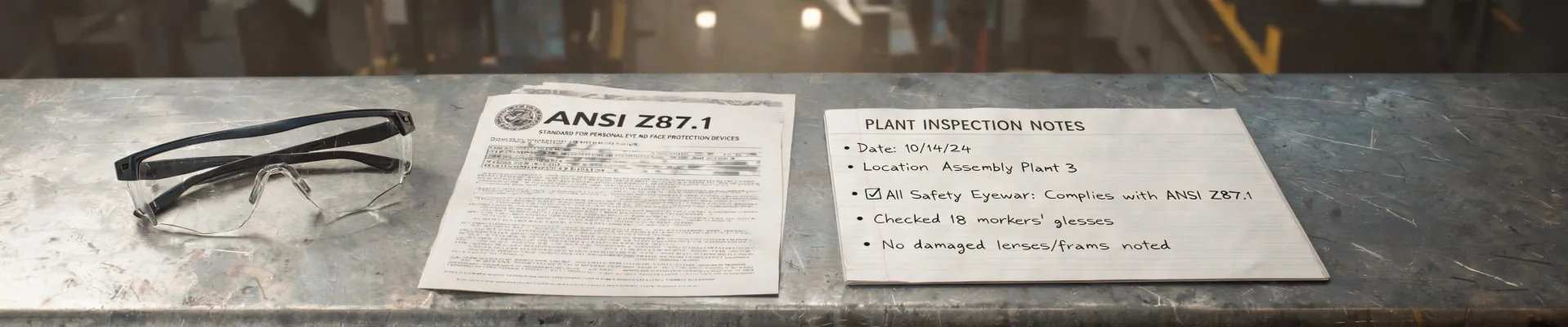
If you're outfitting a tactical unit, an industrial crew, or a first-responder team, and the ballistic helmet is sitting at the top of your equipment list, the list is backwards. I'm not anti-helmet. I'm just aware of where operational risk actually concentrates. In 15 years of buying PPE for law enforcement, oil and gas, and construction teams — more than 200 complete crew outfitting projects — the biggest gaps I've found were rarely in head protection. They were in eye protection. Teams will research a helmet's NIJ rating for weeks, then order generic safety glasses in under a minute. If that sounds familiar, Wiley X safety prescription glasses should probably be the first serious item in your next budget, not a rushed afterthought.
That conclusion runs against what most gear buyers assume. From the outside, all safety glasses look roughly similar. What's different is the engineering behind the lens, the frame geometry, and whether the product can be made to fit someone who already wears prescription glasses. Those differences decide whether your people keep the glasses on their face or leave them in the truck.
Here's the reasoning behind that position — plus what I tell clients about ballistic helmets, tactical boots, masks, and the rest of the kit.
The Helmet Question, Answered and Deprioritized
Every new client asks the same thing: what is a ballistic helmet, and which one should I buy? A ballistic helmet is protective headgear designed to stop or reduce penetrating injury from projectiles, typically certified to standards like NIJ Level IIIA for handgun threats, with heavier models rated for higher-velocity rounds. It is hot, heavy, and answers a threat that may never show up during an entire career. Your eyes, by contrast, face hazards on every shift. According to CDC/NIOSH, about 2,000 U.S. workers sustain job-related eye injuries every day — many simply because the right eye protection was not worn. Some come from dust, some from chemical splash, some from metal shards moving fast enough to cut. A helmet will not help with any of those. A properly rated pair of safety glasses can. That asymmetry is why I tell clients to solve eye protection first and treat the helmet as a specialized purchase once the daily-wear basics are solid.
The Prescription Problem Hiding in Your Current PPE
The question that never makes it onto procurement forms is this: how many people on this crew wear corrective lenses? When a 25-person team includes eight members who need glasses, the standard-issue 'safety specs' become a compliance problem. I had a site manager tell me his crew needed over-glasses to fit above their normal prescription glasses. Over-glasses were exactly what we bought the previous year. They fogged, pinched, and slid around. We discovered the failure during an internal audit when more than a third of his crew admitted to leaving the provided eyewear in their vehicles. We ended up replacing over-glasses with Wiley X safety prescription glasses for everyone who needed a corrective prescription. Within a month, wear compliance was above 90 percent.
The core issue is that workers who need corrective lenses have three rough options:
- Over-glasses: workable for low-hazard tasks but rarely engineered for impact protection; they also fog, scratch, and shift during physical work.
- Regular prescription glasses: comfortable and familiar, yet rarely certified for occupational impact hazards.
- Proper prescription safety eyewear: impact-rated frame and lenses, built to meet a standard like ANSI Z87.1. This is the option that actually gets worn.
Option three used to be painful to source for team-sized orders. That's one reason I've gravitated toward Wiley X.
Why Wiley X Keeps Showing Up on Job Sites
Wiley X is rarely the cheapest eyewear in the distributor catalog, and I'm not going to pretend it is. It earns its place through specifications. The frames I spec need to handle real optical prescriptions, not just plano lenses, and meet impact standards that give a safety manager confidence. Wiley X checks those boxes more consistently than any brand I've used at scale.
- Standards, not slogans. Most Wiley X models meet or exceed the ANSI Z87.1 impact requirements referenced by OSHA (29 CFR 1910.133), and several are tested to military ballistic impact standards.
- Built for actual prescriptions. Wiley X designs frames that optical labs can fit with genuine corrective lenses, which is what 'Wiley X safety prescription glasses' should mean — not a bulky insert slapped over a regular frame.
- Glare control for outdoor work. Polarized lens options make a real difference for crews on roads, docks, helipads, and other high-glare environments.
- A shape for most faces. From compact tactical frames to the Wiley X Fusion safety glasses that crews like for wraparound coverage without a goggle feel, there's usually a fit that passes the all-day wear test.
A maintenance supervisor at a steel plant ordered 12 pairs for his crew in November 2024. Two weeks after delivery, a grinder disc flung a chip that caught one of his techs directly on the lens. The lens cracked. The eye was fine. The supervisor sent me a photo and pointed out that the tech's previous over-glasses were sitting in his truck with a broken arm. I can't prove that moment alone justified the switch. But it reinforces the principle I use with every buyer: the value of certified PPE is not the logo, it's knowing exactly what standard the gear was tested to.
Build the Rest of the Kit Without Repeating the Mistake
Eye protection is not the whole answer. A complete personal protective kit runs head to toe: helmet, eyewear, hearing protection, respiratory protection, gloves, and boots. The lesson is to apply the same scrutiny to each piece.
In footwear, for example, Merrell tactical boots are a common choice among the officers and site supervisors I work with, mainly because the fit and traction hold up across long shifts. But I give the same advice for boots as for glasses: brand matters less than individual fit. Have your people try them on, walk in them, and wear them for a full day before you scale the order.
Respiratory protection gets the same 'just order something' treatment. If your only research is a quick n95 mask near me search on the way to the job, you're treating a respiratory hazard like a convenience-store errand. For workplace use, an N95 mask needs to be NIOSH-approved, and in many cases it has to be fit-tested and part of a broader respiratory protection program. If that step is missing, you have a bin of masks and no actual protection.
The Total-Cost Case for Proper Eye Protection
The procurement objection is always the same: prescription safety eyewear costs three to four times as much as basic glasses. That is the wrong number to look at. The right number is total cost of ownership, and it includes replacement frequency, compliance rates, administrative time, and the cost of an incident.
Basic glasses get scratched, fogged, broken, or lost. I've seen crews reorder them two to four times per year. Prescription safety glasses from a brand like Wiley X cost more upfront, but they stay in service longer and, more importantly, they stay on faces. A single workplace eye injury can easily land in five figures once you count medical treatment, lost time, investigation, and insurance impact. That one incident wipes out years of 'savings' on cheaper eyewear.
The sentence I use with procurement teams is simple: the most cost-effective PPE is the PPE that actually gets worn.
Where I'd Push Back on My Own Advice
I don't want to oversell the premium route. If your hazard assessment shows low eye risk — clean assembly work, office maintenance, no impact, no dust, no chemical splash — basic clear safety glasses are fine. If nobody on the team needs prescription correction, you lose much of the argument for custom Rx eyewear. And no single brand fits every face, including Wiley X; test frames before you spend.
Likewise, don't buy a ballistic helmet because it looks capable. Buy one because your threat assessment says you need NIJ-certified head protection for the particular threats you actually face. Buy boots because they fit your terrain and your feet. Buy masks because they are NIOSH-approved and fit-tested for your workers.
The honest summary after 15 years: helmet research is satisfying, but it won't reduce your most common injury risk. Good eye protection will. Start there — especially if any member of your team is squinting through the wrong pair of glasses right now.

Maeve Callahan
Maeve Callahan is a head-protection analyst covering Type I and Type II hard hats, climbing-style safety helmets, bump caps, chin straps, suspensions, liners, and face-shield carriers. She applies ANSI Z89.1, EN 397, and EN 12492 criteria while comparing impact attenuation, penetration resistance, lateral deformation, electrical class, retention strength, field of vision, mass, fit range, and temperature conditioning. Her guides help EHS teams, contractors, utilities, and buyers select helmet systems for overhead hazards, work at height, electrical exposure, accessory compatibility, and worker acceptance.