Safety procurement is not one shopping list
I am an office administrator for a 400-person company. I manage facilities and safety supplies ordering—roughly $180,000 annually across 12 vendors. I report to both operations and finance. When I took over purchasing in 2020, I assumed safety gear was safety gear. A certification sticker here, a bulk discount there. That lasted about six months.
Now I sort requests into three buckets because they have different hazards, different proof, and different deadlines. The three that hit my desk most often: ballistic eye protection, black nitrile gloves for food handling, and glass pool fence for a facility. If you are searching for wiley-x, wiley x ballistic goggles, wiley x ballistic eyewear, black nitrile gloves, glass pool fence, or is nitrile gloves food safe, start by deciding which scenario you are actually in.
Scenario A: You need high-impact or ballistic eye protection
What defines this scenario
This is not just dusty warehouse work. It is impact from fragments, range use, law enforcement training, or industrial tasks where standard safety glasses may not be enough. The request usually sounds like: we need Wiley X ballistic goggles or Wiley X ballistic eyewear for a team, and it has to be prescription-compatible or polarized.
Wiley X is one of the brands we evaluate because they offer ballistic-grade impact protection, ANSI-rated models, and prescription and polarized options. That does not mean every model fits every task. It means we still verify the exact model against the requirement.
What I ask for before ordering
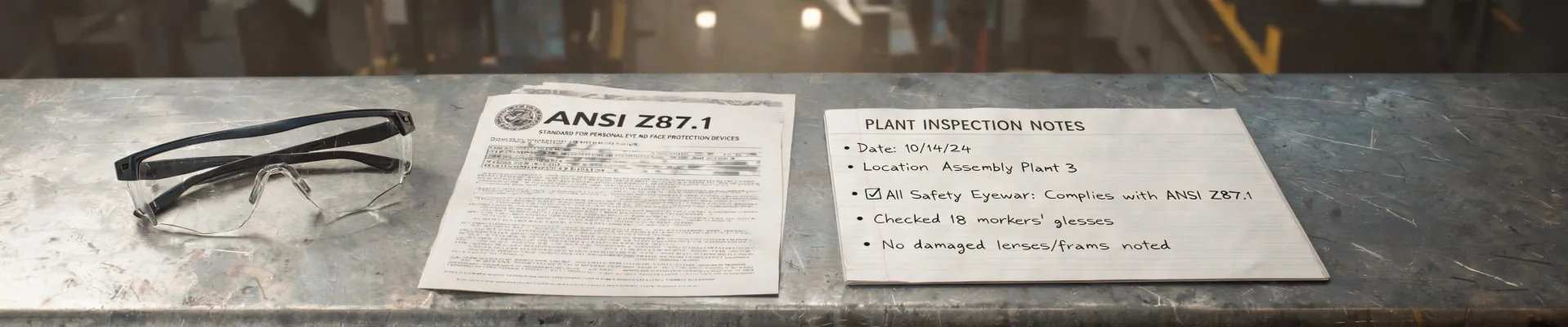
- ANSI/ISEA Z87.1-2020 certification for the specific model, not just the brand.
- MIL-PRF-32432A or current military ballistic standard test documentation if the use case requires it. Standards get revised, so verify the current revision as of January 2025.
- Lens options: clear, smoke, polarized, prescription. Prescription turnaround is often the real bottleneck.
- Replacement parts and lens availability. A great frame with no replacement lenses becomes expensive waste.
OSHA 1910.133 requires employer-provided eye and face protection where hazards exist. That is the baseline. The specific product still needs the right test report.
The time-certainty premium
In March 2024, we needed 40 pairs of ballistic eyewear before a client range demo. We paid $400 extra for guaranteed two-day delivery. The alternative was missing a $15,000 event. The premium bought certainty, not just speed. I would do it again.
Red flag: a vendor says ballistic but cannot send the test report same day. Another red flag: prescription eyewear with 'about two weeks' turnaround and no tracking. For safety gear, a missed date means either people work under-protected or work stops. Not ideal. Workable only if you planned ahead.
Scenario B: You are buying black nitrile gloves for food handling
The food-safety question
Is nitrile gloves food safe? Nitrile can be food safe, but the color does not determine safety. Black nitrile gloves are popular because they hide stains and look professional in cafes and food prep. The real question is whether the manufacturer declares the gloves compliant for food contact.
For food-contact use, I ask for a declaration referencing FDA 21 CFR 177.2600 or an appropriate FDA food-contact notification. That regulation covers rubber articles intended for repeated use, and suppliers often use it as a compliance reference for nitrile food-handling gloves. Single-use gloves may also have FDA food-contact documentation. As of January 2025, verify the current documentation with your supplier and local health department.
What I check before ordering black nitrile gloves
- Food-contact statement from the manufacturer, not a marketplace listing.
- Powder-free and non-latex, if allergies are a concern.
- Lot traceability so we can pull a batch if quality issues appear.
- Thickness and grip. A cheap glove that tears during prep costs more in waste and risk than a mid-tier glove.
- Compatibility with sanitizers and cleaning chemicals used in our kitchen.
The counterintuitive finding
Everything I had read said cheap nitrile gloves were fine for food service if they were labeled food safe. In practice, the cheapest listings often had no documentation beyond 'latex-free'. That is not the same as food safe. We rejected a pallet because the spec sheet did not include a food-contact statement. Finance did not love the restocking fee, but a failed health inspection would have been worse.
Speed, documentation, price. Pick two. For food handling, documentation is the one I will not drop.
Time certainty in inspection season
During Q3 2024 health inspection prep, we paid a small premium from a distributor with same-week delivery and compliance docs. A delayed glove shipment would have meant closing the cafe for a day or using non-compliant gloves. The upside was saving maybe $300. The risk was failing inspection. The expected value said save the money, but the downside felt catastrophic. We paid the premium.
Scenario C: You need a glass pool fence for a facility
Why pool fencing belongs in a safety conversation
A glass pool fence is not PPE, but it is safety equipment. It prevents drowning and restricts access. The failure mode is not a torn glove—it is a code violation, a failed inspection, or worse.
Local building codes and the International Swimming Pool and Spa Code, or ISPSC, usually govern pool barriers. Glass panels should meet safety glazing requirements such as ANSI Z97.1, and in pool environments you need corrosion-resistant hardware. As of January 2025, confirm the adopted code and permit requirements with your local building department. Requirements vary by jurisdiction.
What I ask a glass pool fence vendor
- Are the panels tempered or laminated to the required safety glazing standard?
- Is the gate self-closing and self-latching, with hardware rated for pool chemicals and salt air?
- Does the vendor provide engineering drawings and permit support for our jurisdiction?
- What is the installation timeline, and who handles the inspection?
- What is the warranty on glass, hardware, and installation?
The $1,200 lesson
In 2024, we tried to save $1,200 by using a lower-cost glass pool fence fabricator. Permit drawings came back twice. The inspection date was already set. We ended up paying rush engineering fees that ate most of the savings. Looking back, I should have paid for a vendor who had already done pool barriers in our jurisdiction. At the time, the lower quote looked like a no-brainer. It was not.
The uncertainty cost more than the certainty would have.
How to tell which scenario you are in
Ask three questions before you request quotes:
- What is the hazard? Impact and fragments point to Scenario A. Food contact points to Scenario B. Drowning prevention and property boundaries point to Scenario C.
- Who enforces the proof? OSHA and ANSI/MIL for eye protection. FDA and local health for gloves. Local building code and ISPSC for pool fences.
- What happens if delivery misses? If the answer is a stopped production line, a failed inspection, or a cancelled event, you are in a time-certainty situation.
If you are buying for multiple sites, split the purchase orders. Do not let one vendor's 'we can do everything' promise delay the critical item. The vendor who cannot provide proper invoicing or compliance documents is a red flag, no matter the price.
Bottom line: the lowest quote is rarely the lowest total cost once you add rework, failed inspections, or missed deadlines. For safety purchases, pay for documented compliance and delivery certainty. For Scenario A, that may mean a Wiley X ballistic eyewear model with verified certification and guaranteed delivery. For Scenario B, it means black nitrile gloves with a real food-contact statement. For Scenario C, it means a glass pool fence installer who knows your local code. Different scenarios, same rule: certainty is worth paying for.

Maeve Callahan
Maeve Callahan is a head-protection analyst covering Type I and Type II hard hats, climbing-style safety helmets, bump caps, chin straps, suspensions, liners, and face-shield carriers. She applies ANSI Z89.1, EN 397, and EN 12492 criteria while comparing impact attenuation, penetration resistance, lateral deformation, electrical class, retention strength, field of vision, mass, fit range, and temperature conditioning. Her guides help EHS teams, contractors, utilities, and buyers select helmet systems for overhead hazards, work at height, electrical exposure, accessory compatibility, and worker acceptance.