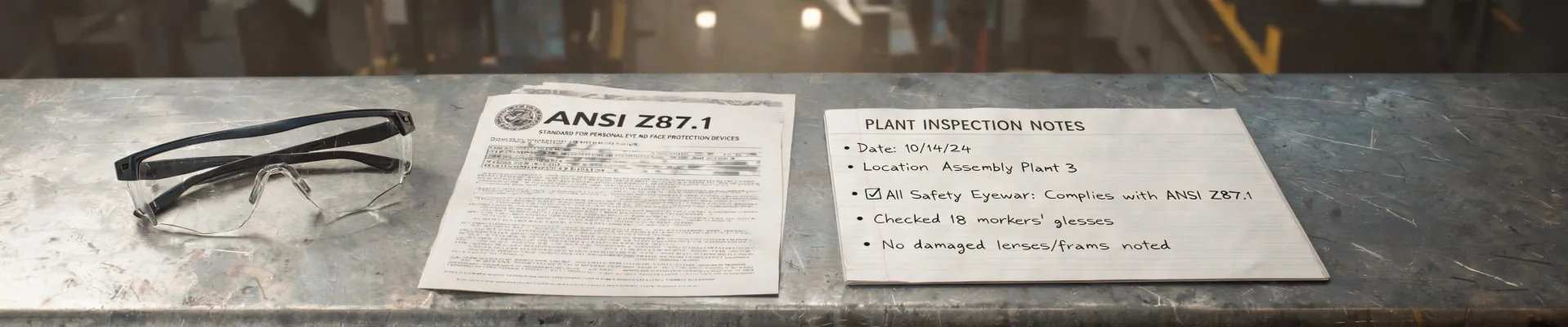
When I took over PPE purchasing for our company in late 2022, I did what office people usually do when they buy for people who work with their hands: I trusted the spreadsheet. I picked the cheapest safety glasses we could order that still met the ANSI Z87.1 standard. They cost about $3 a pair.
Here's the context. We're a fence contractor, 65 employees, most of them out in the field. On any given week, they're installing privacy fence panels behind a commercial building, running metal fence along a highway, or replacing a gate that a delivery truck took out. That means angle grinders, post drivers, nail guns, windblown grit, and glare off bare steel. Eye protection isn't just a checkbox in this line of work.
So I understood the why. What took me two years to understand was how to order eyewear that people would actually keep on their faces. That lesson cost one emergency room visit, one insurance headache, and nearly a half-million-dollar contract.
The Wake-Up Call
In March 2024, one of our crew leads got a sliver of steel under his eyelid. He was cutting a rusted bolt during a metal fence repair when a piece of the cutting wheel deflected. The incident report said, "employee was not wearing safety glasses." If that was the whole story, we could have written him up and moved on.
Then he explained what happened, and I had to sit down.
He had been wearing the $3 glasses that morning. They fogged up on him, which they did constantly. He lifted them to wipe the lens—something he'd done a hundred times that day—and then went back to work without pulling them back down. That's it. One small comfort decision, repeated, and then pure bad luck.
I wanted to blame him. I really did. But the more I thought about it, the more I realized we had issued him protection that was designed for a compliance checklist, not for a man doing actual work. We trained him, indirectly, to take them off. Blaming the worker is easier than blaming the purchase order, but it's not more fair.
The Problem Was the Glasses, Not the Guys
A lot of safety advice starts from the assumption that workers who don't wear PPE are careless. I held that assumption myself for the first year. It's a convenient belief because it puts all the responsibility on the worker and leaves the purchasing department feeling clean.
Here's what we learned when we actually listened to the crews:
- They fogged. In our climate, fogging starts the moment you stop walking. If you can't see your chalk line or your level, you take the glasses off. And once they're off, they end up on a hard hat, then in a pocket.
- They scratched. After two weeks, the lenses were blurry enough that wearing them made the work harder. Nobody wants to choose between bad vision and eye protection.
- They didn't work with prescription glasses. Several of our guys are over 40 and need readers or progressive lenses. The one-size-fits-all safety glasses we bought didn't fit over their regular glasses without sliding, fogging, and generally making them look ridiculous.
- They felt like disposable junk. The frames bent, the foam fell off, and the whole thing screamed "cheap." It's hard to take your own safety seriously when the gear looks like a party favor.
When you look at it from the office, "they didn't wear their eye protection" sounds like a discipline problem. The truth was the opposite. We were giving people equipment that made them choose between comfort, vision, and safety. That's not a worker failure. That's a design failure.
One more misunderstanding made it worse: the belief that all Z87.1 glasses are basically the same. The ANSI Z87.1 mark tells you the lenses survived an impact test. It doesn't tell you whether a human being can wear them for eight hours in the sun. A pair of glasses that passes a test but sits in a truck all day protects nobody. The best eye protection in the world is the pair that's actually on your face when something happens.
The Cost of Protective Equipment Nobody Wears
Marcus's incident cost us roughly $2,400 in immediate expenses. Emergency room co-pay, two days of lost productivity, overtime from the rest of the crew covering his job, paperwork, phone calls. Not devastating, but not nothing.
Then came the part I didn't see coming: our workers' comp experience rating. A single recordable injury followed us into the next policy year and nudged our premium up. That's a cost that shows up quietly on a line item, long after everyone has stopped talking about the accident.
The national numbers are sobering. OSHA says about 2,000 U.S. workers sustain a job-related eye injury every day, and roughly 90 percent of those could have been prevented with proper eye protection. NIOSH has estimated that workplace eye injuries cost around $300 million per year in lost productivity, medical treatment, and compensation. Those statistics used to feel abstract to me. Now they feel like a warning label.
The biggest cost, though, was reputational. In late 2024, we were invited to bid on a school district project worth around $400,000—replacing privacy fence panels across several properties. During prequalification, they asked about our safety record. Our recent eye injury came up, and the tone of the conversation changed. I could hear the hesitation on the other end of the line. A client evaluating a contractor is evaluating risk, and a preventable eye injury is a red flag. We didn't lose the bid, but we came uncomfortably close. The cheapest glasses in the world nearly cost us a contract that would have paid for years of better PPE.
What Changed
I wish I could tell you we had some brilliant safety epiphany. Honestly, it was simpler than that. We asked the crew leads what they would actually wear, and then we stopped treating eye protection like a commodity.
For the guys who wear corrective lenses, we now order the Wiley X Profile prescription safety glasses. It seems obvious in hindsight, but the difference is night and day: the prescription is built into the lens, so there's no bulky over-glasses setup sliding around on their noses. They can see, they don't fog up the same way, and they look like normal, decent eyewear. That last part matters more than I expected.
For the crews working outside all day, we issue Wiley X safety sunglasses with polarized lenses. If you've ever spent a full shift installing metal fence panels in direct sun, you know the glare is brutal. Polarized lenses cut that glare, reduce eye fatigue, and actually make it easier to see the work. When eye protection improves visibility instead of hurting it, people wear it.
We also stopped buying the flimsiest frames we could find. The Wiley X frames we use meet or exceed ANSI Z87.1 high-impact requirements, and many of their models also meet military ballistic impact standards like MIL-PRF-31013. We're not a military unit, but I like knowing the gear we issue exceeds the minimum. When a grinder wheel lets go at speed, I want more than the bare minimum between that and someone's eyeball.
Did our safety budget go up? Yes. But our replacement costs went down because people stopped losing glasses they actually liked, and, more importantly, our recordable eye injuries went to zero after the switch. That's the part spreadsheets don't capture.
The same logic applies to other PPE we issue. Take leather work gloves: we used to buy cheap, stiff ones because they were tough. Turns out nobody wants to wear a pair of cardboard mittens when they need to grab a screw or a fence clip. I looked up how to soften leather gloves more than once, and the quick version is simple: apply a generous amount of leather conditioner or mink oil, let it soak in overnight, then flex and knead the gloves the next morning. It takes ten minutes and saves a lot of gloves from being abandoned in the work truck. But the deeper point is the same. If the gear is uncomfortable, it won't be worn, and it can't protect anyone from the passenger seat.
To be fair, this is what worked for our situation: an outdoor crew doing heavy fence installation and repair. If you're running a low-risk indoor operation, cheaper protection might genuinely be enough. I can only speak to what I saw with my own crew. But if you're asking people to trust their eyes to a product, buy the one they'll actually keep on. The $3 pair saved us money on paper. It almost cost us a lot more in ways that don't show up on an invoice.

Maeve Callahan
Maeve Callahan is a head-protection analyst covering Type I and Type II hard hats, climbing-style safety helmets, bump caps, chin straps, suspensions, liners, and face-shield carriers. She applies ANSI Z89.1, EN 397, and EN 12492 criteria while comparing impact attenuation, penetration resistance, lateral deformation, electrical class, retention strength, field of vision, mass, fit range, and temperature conditioning. Her guides help EHS teams, contractors, utilities, and buyers select helmet systems for overhead hazards, work at height, electrical exposure, accessory compatibility, and worker acceptance.