If you're a fence contractor, you've probably heard the question a hundred times: "What are fall protection measures?" It's a fair one. Falls are the top killer in construction. But after years of inspecting safety gear, I've seen the same mistake over and over: crews put all their safety energy into the harness and forget the stuff that fails quietly.
The job that changed how I think about that happened in May 2022. Or maybe I should say it's when it finally clicked. I was watching a fence crew on a sloped lot. A guy pulled a wire taut, the tensioner slipped, and the wire whipped across his face. He wasn't wearing eye protection. He ended up with a gash on his cheek, and the ER doc said his cornea was millimeters from being scratched. He had safety glasses in his truck. He'd taken them off because they fogged up.
The Surface Problem: "I Can't See With These"
When I ask contractors why they don't wear eye protection, the answers are consistent: the glasses fog up, they don't sit right under a hard hat, the tint is useless in direct sun, and they don't fit over prescription lenses. The assumed problem is comfort.
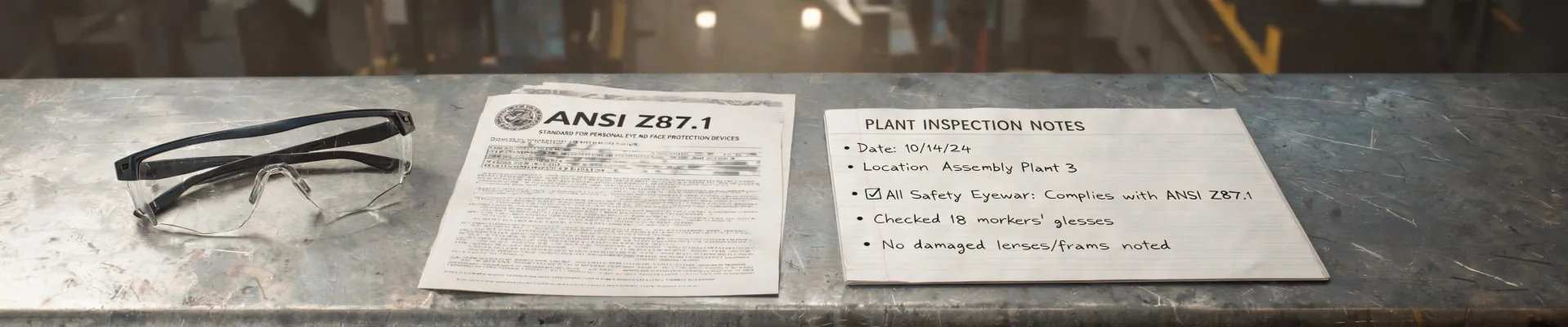
But comfort is a symptom, not the disease. The deeper problem is that a lot of safety glasses are designed for a warehouse, not a fence line. They may meet ANSI Z87.1, but that standard is a floor. It doesn't mean the lens will survive a staple ricochet, wind-driven grit, or hours of UV while you're on a mower.
The Deeper Problem: Fence Work Is Harder on Eye Protection Than It Looks
Fence work combines construction hazards with outdoor hazards. You've got flying debris from post drivers, wire tension, grinding, drilling, and often roads where rocks bounce up. Plus you're in the sun. If your safety glasses have poor optics or no UV protection, you're not going to keep them on. And unused safety glasses are just expensive trash.
This is where Wiley X military glasses and Wiley X prescription safety sunglasses earn their place. I'm the person who inspects the batches before they ship—not a marketing guy. What I care about is the difference between a lens that says "impact resistant" and a lens that's actually built for it. Wiley X lenses are tested to higher impact standards than everyday safety eyewear. Many models offer polarized lenses, which is huge for outdoor crews. And if you need corrective lenses, Wiley X prescription safety sunglasses let you combine vision correction with impact protection in one pair.
When I compared a generic pair and a Wiley X pair side by side—same ANSI test, different lens thickness and base curve—I understood why crews kept ditching the cheap ones. The cheap ones worked in the lab and failed in the field. The Wiley X pair didn't fog as quickly, didn't distort at the edges, and the frame held its shape after being left in a hot truck. That last part (which, honestly, matters more than you'd think) is what convinces me.
What It Actually Costs to Skip the Right Gear
I've reviewed a lot of incident reports. The pattern is always the same: someone thought "we're just doing a quick job" and skipped eye protection, or grabbed the cracked pair because it was better than nothing.
An eye injury doesn't just hurt. It's an OSHA recordable, an insurance claim, and a crew member out for weeks. On a small fence crew, one lost worker in the middle of the season is a disaster. No amount of fall protection training helps if you can't see.
And falls are still the big one. So let's answer the question directly.
What Are Fall Protection Measures?
Fall protection measures are any system that prevents a worker from falling, or catches them if they do. According to OSHA's construction standard (29 CFR 1926.501), workers on a walking or working surface with an unprotected edge six feet or more above a lower level need fall protection. For fence contractors, that often applies when installing gate operators, overhead work, or working on structures.
The basic list includes:
- Guardrails – physical barriers around edges.
- Safety nets – installed below elevated work areas.
- Personal fall arrest systems (PFAS) – harness, lanyard, and anchor point.
- Warning lines and covers – for specific low-slope or hole hazards.
- Training – making sure everyone knows how to inspect and use the gear correctly.
I'm not a fall protection engineer, so I can't speak to every OSHA nuance. What I can tell you from a quality perspective is that the standard is not the ceiling—it's the floor. A harness with a frayed lanyard or an anchor point bolted to a rotten post isn't a fall protection system. It's a false sense of security.
The Other Gear Fence Contractors Forget: Boots
Pair your eye protection and fall protection with good footing. Fence work is hard on the lower body: uneven ground, wet grass, mud, gravel, sprinkler lines hiding just under the surface. This is where lightweight tactical boots come in.
I know "tactical" sounds like overkill. But the useful parts are the sole, the toe, and the weight. A good pair of lightweight tactical boots gives you slip resistance, a stable heel, and enough protection for the inevitable staples and cut ends on the ground. They're not a replacement for steel-toed boots if your contract requires them, but for most fence installation, they beat a heavy boot that leaves your feet dragging by 3 p.m.
The 5-Minute Rule That Costs Nothing
Here's the practical part. In 2023, I rejected just under 2% of incoming bulk orders for missing markings and inconsistent lens thickness. That wasn't because the vendor was careless. It was because we didn't have a formal verification process for PPE specs. It cost us a return, a delay, and a customer who almost bought elsewhere. After that, I built a simple pre-job check:
- Are your glasses ANSI Z87.1 marked and, ideally, high-impact rated?
- If you need prescription lenses, are they in a safety-rated frame, not a drugstore pair?
- Does your fall protection harness and lanyard pass inspection, with no fraying and a solid anchor point?
- Are your boots in good condition with a clean tread?
Five minutes of verification beats five days of correction. That's not a slogan; it's the difference between a near-miss and a paperwork stack that follows you for years.
Bottom Line
If you're a fence contractor, the gear question isn't just about meeting a requirement. It's about whether your crew goes home the same way they came in. So yes, ask what fall protection measures are. But also look at what's in front of your face—literally. Wiley X military glasses and Wiley X prescription safety sunglasses are built to stay on the job. Lightweight tactical boots keep you on your feet. And a few minutes checking your gear is the cheapest safety program you'll ever run.

Jane Smith
I’m Jane Smith, a senior content writer with over 15 years of experience in the packaging and printing industry. I specialize in writing about the latest trends, technologies, and best practices in packaging design, sustainability, and printing techniques. My goal is to help businesses understand complex printing processes and design solutions that enhance both product packaging and brand visibility.