If you’re trying to decide whether Wiley X safety sunglasses are worth the price, I’ve got good news and bad news. The good news: there’s a clear answer. The bad news: it depends on your work environment, your hazard assessment, and honestly, your budget philosophy.
I’ve spent the last six years managing procurement for a mid-sized industrial company. I track every PPE order in our cost system, compare vendor quotes, and have approved thousands of dollars in safety eyewear. So when someone asks “is it worth it?”, I don’t give a simple yes or no. I ask a different question: what’s the worst thing that could hit your eye on a typical shift?
That question splits buyers into three groups. Your answer determines whether Wiley X is a smart purchase, an indulgence, or just the wrong tool for the job.
Scenario A: The “Don’t Cheap Out” Group
If you’re in military, law enforcement, or any environment where flying metal, fragmentation, or projectiles are a real possibility, don’t cheap out. This is where Wiley X’s ballistic-rated products justify their price.
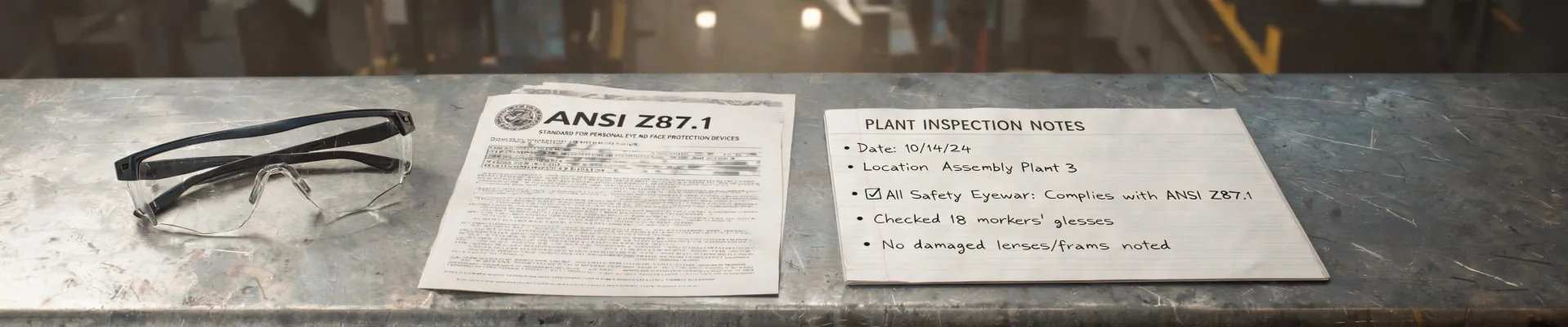
Wiley X safety sunglasses aren’t just expensive sunglasses. Many models meet or exceed ANSI Z87.1-2020 impact standards, and some are tested against high-velocity impact. That’s not a marketing line; it’s a specification that can be the difference between a scratched lens and a trip to the emergency room.
I recommend models with clear impact ratings on the lens, and if your crew wears prescription glasses, look for frames that accept prescription inserts. The “tactical” naming isn’t what matters—the test rating is.
However, there’s a catch. “Ballistic” doesn’t mean “bulletproof.” No eyewear should be sold as 100% bulletproof for all threats. What you want is a certified level of impact resistance that matches your documented risk. If someone promises you absolute protection, that should be a red flag.
Scenario B: Moderate Industrial Work — The Wiley X Boss Safety Glasses Sweet Spot
For most factory floors, construction sites, and repair shops, you’re dealing with dust, debris, and the occasional bump against a steel beam. This isn’t a ballistic environment, but it’s also not a place where a $2 pair of splash goggles feels good after hour four.
This is where I genuinely like the Wiley X Boss safety glasses. They offer ANSI-rated impact protection, decent coverage, and a few practical features that matter when people wear them all day: anti-fog options, polarized lenses for outdoor work, and a fit that doesn’t slide off when someone bends over.
They also come in enough variants that you can standardize one model across a crew. In my experience, standardization beats trying to please everyone. You stock one replacement lens, one temple arm, one ordering line in the system. That reduces admin time and cost—even if the initial unit price is slightly higher than the budget brand.
What about price? The Boss line sits above basic safety glasses but below the top-tier ballistic models. After comparing eight vendors over three months using our total-cost-of-ownership spreadsheet, I found the mid-tier option actually cost us less over time. They lasted longer, and the crew actually wore them.
Even after standardizing on the Boss model, I kept second-guessing. What if the crew rejected them? What if the vendor had a cheaper option we hadn’t considered? The two weeks until delivery were stressful. But when the first shift lead put them on and said they were the clearest glasses he’d had in years, I relaxed.
Still, I’ll be honest: if your hazard assessment says “eye protection required only for dust and splashes,” you don’t need Boss glasses. That’s Scenario C.
Scenario C: Low-Risk Compliance-First Environments — Save the Budget for Other PPE
In a lab, a pharmaceutical cleanroom, or an inspection role, the main reason for safety glasses is compliance, not survival. A basic ANSI-compliant pair does the job. Spending $100+ on Wiley X in this scenario is not a smart use of a safety budget.
Here, being a cost controller means redirecting savings to the PPE that actually matters in that environment.
Take hearing protection. In our own facility, we found that we were overthinking earplugs. If you can get a genuine loop earplugs discount code, the price becomes reasonable. Otherwise, high-quality foam plugs often do the job just as well for a fraction of the cost.
Gloves are another area where people get confused. In almost every kickoff meeting, someone asks about latex gloves vs. nitrile. Latex is cheap, but it triggers allergies for some workers. Nitrile is a better default for many tasks. And if someone asks “are nitrile gloves heat resistant?”—the answer is: they handle minor heat, but they’re not hot-object gloves. Don’t swap them in for a welding task just because they were on sale.
If you spend appropriately in each category, you can often upgrade quality where it counts without raising the total PPE budget. But the key is to avoid gold-plating every line item just because a brand has a good reputation.
How to Know Which Scenario You’re Actually In
Don’t guess. Do a hazard assessment—not the paperwork kind you file and forget, but the practical kind where you walk the floor and ask: “If this tool slips, if this machine throws a chip, if this chemical splashes—what could hit an eye?”
OSHA’s PPE standard (29 CFR 1910.132) requires employers to assess hazards before choosing protective equipment. If you haven’t done that, don’t start with a purchase order—start with a walk-through.
Three quick questions:
- Is there a risk of high-velocity impact or fragmentation? → You’re Scenario A.
- Is there a risk of moderate impact, falling objects, or long-duration discomfort? → You’re Scenario B.
- Is the hazard mostly dust, spray, or compliance? → You’re Scenario C.
One more consideration: worker buy-in. If employees hate the safety glasses, they’ll take them off. I don’t care what the spec sheet says—a pair of glasses that stays in a locker provides zero protection.
That’s the real-world thing that doesn’t show up in a manufacturer’s brochure. Sometimes paying more for comfortable Wiley X Boss glasses reduces the “I forgot my glasses” problem. That saved us real money—not because the glasses were cheaper, but because they actually got worn.
I only learned this the hard way. In Q2 2023, I approved a bulk order of the cheapest ANSI-rated glasses I could find, thinking I’d save $600. Three weeks later, a maintenance tech got a metal splinter under his safety glasses. The medical bill, the paperwork, and the replacement PPE cost us more than the savings. That’s when I built our cost tracker.
The Bottom Line
Wiley X safety sunglasses are a good product. They’re not the right product for every job, and I’d be lying if I said they were. For high-impact and tactical environments, buy them and don’t look back. For moderate industrial work, the Boss series gives you the best balance of protection and comfort. For low-risk compliance environments, save your budget for earplugs, gloves, or whatever hazard is actually in front of you.
Look, I’m not saying the most expensive pair is always the best. I’m saying the cheapest pair can be the most expensive decision. And whichever scenario you’re in, make the decision based on the worst case, not the best price. Because the only thing worse than overspending on safety is explaining why you under-spent after someone gets hurt.

Jane Smith
I’m Jane Smith, a senior content writer with over 15 years of experience in the packaging and printing industry. I specialize in writing about the latest trends, technologies, and best practices in packaging design, sustainability, and printing techniques. My goal is to help businesses understand complex printing processes and design solutions that enhance both product packaging and brand visibility.